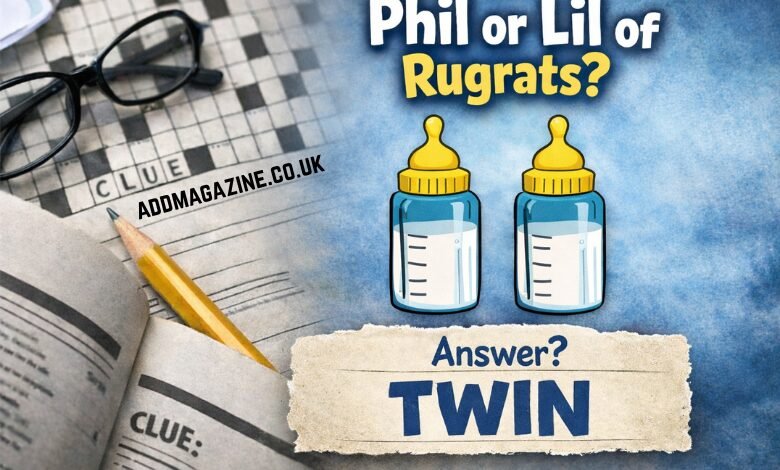
Crossword puzzles are known for testing a person’s memory, vocabulary, and lateral thinking. However, some clues are designed not to test how much you know but how well you can think about what is being asked. One such clue is “Phil or Lil of Rugrats,” which often appears in puzzles and frequently causes confusion among solvers. While it may seem simple at first glance, the real challenge lies in understanding the subtlety of what the clue is asking. It’s a great example of how crossword clues can go beyond trivia to test deeper thinking and problem-solving skills.
The Characters: Phil and Lil
Before diving into the intricacies of the crossword clue, let’s briefly revisit the characters Phil and Lil, who hail from the animated TV show Rugrats. This beloved show, which first aired in 1991, focuses on a group of babies and toddlers navigating their world, often with hilarious and adventurous results. Phil and Lil are twin siblings, known for their mischievous nature, and are the younger siblings of Tommy Pickles, the show’s main character.
Phil and Lil share several distinct traits, including their identical appearance, their shared love of playing pranks, and, of course, their twin status. However, in the context of the Rugrats show, it’s not their personalities that matter for this crossword clue—it’s their relationship to one another as twins.
The Crossword Clue: “Phil or Lil of Rugrats”
At first glance, the clue “Phil or Lil of Rugrats” may seem straightforward. The solver is asked to think of either Phil or Lil from Rugrats, and it might be tempting to assume that the answer is the name of one of the characters. However, as with many crossword clues, the trick lies in the wording. The clue is not asking you for the name of a specific character, but rather, it’s asking you to think about what they are, not who they are.
In most cases, the correct answer to this clue is “TWIN.” Why? Because Phil and Lil are, quite simply, twins. This solution doesn’t require any deep knowledge of the show’s plotlines or character development. Instead, it’s a simple case of recognizing the category that Phil and Lil belong to—they are twins. The crossword is prompting you to think about their relationship to one another rather than their individual traits or actions.
Understanding the Clue Structure: “X or Y, e.g.”
To fully understand why “TWIN” is the answer, it’s important to recognize the structure of the crossword clue. The clue often includes a phrase like “e.g.,” which means “for example.” This phrase is a key indicator that the crossword isn’t asking you to identify a specific name or fact, but rather to categorize or generalize.
In the case of “Phil or Lil of Rugrats,” the “e.g.” suggests that the clue is pointing to an example of a category rather than an individual. This clue doesn’t want you to identify Phil or Lil as individual characters from Rugrats. Instead, it’s asking you to identify what they are in the broader sense, and the answer is “TWIN” because both characters are twins.
This type of clue is not uncommon in crossword puzzles. Many crossword clues rely on category thinking, which challenges the solver to think beyond specific facts or memories and instead focus on relationships, categories, and general concepts. By encouraging this kind of thinking, crossword puzzles engage solvers in a deeper form of problem-solving.
The Art of Solving Crosswords: Focus on Relationships, Not Trivia
Crossword puzzles are often about more than just recalling trivia or facts. While some clues do test your knowledge of specific events or people, many clues are designed to test your ability to think logically and abstractly. The “Phil or Lil of Rugrats” clue is a prime example of this.
It’s easy to get caught up in the idea that crosswords are simply about memorizing names, dates, and facts. However, clues like this one remind solvers to step back and think about the relationships between things and how categories work. You don’t need to know anything about the storyline of Rugrats or remember specific episodes to solve this clue. Instead, you simply need to understand that Phil and Lil are twins. It’s a simple but profound test of how well you can categorize and generalize information.
Crosswords as a Mental Exercise
The “Phil or Lil of Rugrats” crossword clue is just one example of how crosswords train the mind. They encourage critical thinking, attention to detail, and the ability to recognize patterns. Solvers often encounter clues that require them to think beyond the obvious, which is why crosswords can be such a rewarding mental exercise.
Solving crosswords also helps improve problem-solving skills, as they encourage solvers to break down clues into manageable parts. In this case, recognizing the significance of “Phil or Lil” as a pair of twins rather than individual characters is the key to unlocking the answer. It’s a reminder that solving puzzles isn’t just about remembering facts—it’s about how you approach the information at hand and how you use logic to arrive at a solution.
A Broader Look at the “X or Y” Clue Structure
The “X or Y, e.g.” clue structure is not unique to the Rugrats crossword clue. In fact, it appears frequently across crossword puzzles in various forms. These clues are particularly effective because they ask the solver to think about categories and relationships rather than specific details. For example, you might encounter clues like “Pineapple or mango, e.g.,” where the answer would be “FRUIT.” Similarly, you might see a clue like “Shakespeare or Hemingway, e.g.,” with the answer “WRITER.”
By using the “e.g.” phrase, crossword creators can prompt solvers to think more abstractly. Instead of focusing on memorized facts or specific trivia, the solver is encouraged to consider broader categories. This approach makes crosswords not only more challenging but also more intellectually stimulating.
The Value of Category Thinking
At its core, the “Phil or Lil of Rugrats” crossword clue is about understanding how to think in categories. It’s not about remembering the specifics of a show or character but about recognizing the relationship between things. In this case, the relationship is that Phil and Lil are twins.
Category thinking is an important cognitive skill that extends far beyond crosswords. It’s a way of organizing and processing information in a meaningful way. Whether you’re sorting through facts, making decisions, or trying to solve complex problems, the ability to think in categories allows you to break down large amounts of information into more manageable chunks.
In daily life, we often encounter situations that require us to group things into categories. For example, when deciding what to wear, we categorize clothes based on the weather, occasion, and comfort. In business, we categorize tasks based on urgency and importance. In science, categorization is essential for organizing knowledge and making discoveries.
How Crossword Clues Encourage Logical Thinking
- Crosswords often push solvers to think logically about what’s being asked.
- A clue like “Phil or Lil of Rugrats” forces you to focus on their relationship, not individual traits.
- Logical reasoning is key to recognizing that the clue is asking for a category, not a name.
- This type of thinking exercises the brain, helping solvers improve their problem-solving skills.
- Logical puzzles like this one train the mind to stay calm and process information carefully.
The Art of Categorization in Crosswords
- Categorization is a central theme in many crossword clues.
- Clues often encourage solvers to identify what things have in common, like “Phil and Lil” as twins.
- By practicing categorization, solvers can break down complex problems into manageable pieces.
- Crosswords challenge participants to think beyond the obvious, leading to a deeper understanding.
- Recognizing patterns and relationships across categories makes solving more efficient and intuitive.
Crossword Clue Structure: A Deeper Dive
- Phrases like “e.g.” (for example) or “e.g., X or Y” change the entire nature of the clue.
- These subtle cues guide the solver towards a broader category instead of a specific fact.
- For example, “Phil or Lil of Rugrats” becomes a clue asking for a category, with the answer being “TWIN.”
- This subtle change in structure makes crossword puzzles both challenging and rewarding to solve.
The Importance of Attention to Detail in Crosswords
- Solving crosswords requires paying attention to small but important details.
- Words like “e.g.” in a clue might be easy to overlook but are crucial to solving it correctly.
- The solver must differentiate between a clue that asks for specific information and one that asks for a category.
- Small details in the wording can dramatically change the direction of the answer.
- Attention to detail in crossword puzzles mirrors how we approach problem-solving in real life, where even tiny insights can make a big difference.
Why “TWIN” is the Correct Answer
- The answer “TWIN” works because it directly addresses the relationship between Phil and Lil, who are twins.
- This type of clue is often referred to as a “definition by example,” where you are asked to identify the broader category of a specific example.
- Understanding that Phil and Lil are twins—not individual characters—makes “TWIN” the logical answer.
- Crossword puzzles are often about spotting these kinds of relationships between words and concepts.
- “TWIN” is a simple, clear answer that fits perfectly within the constraints of a crossword puzzle.
Crossword Puzzles: Training the Mind for Abstract Thinking
- While many puzzles require factual knowledge, crosswords emphasize abstract thinking.
- They ask solvers to step back, look at the relationships, and think about the categories words belong to.
- Solvers need to think about definitions more abstractly to solve the puzzle, making it an intellectual exercise.
- Abstract thinking in crosswords has real-life applications, helping people think critically and organize information more effectively.
- Whether it’s organizing tasks at work or categorizing information for a project, crosswords build those skills.
The Role of Generalization in Solving Clues
- Generalizing is another important skill in crossword-solving.
- Crosswords often ask solvers to look beyond specific facts and think about general terms.
- “Phil or Lil of Rugrats” is not asking for specific details about the characters but instead for a general category they fit into: twin.
- This generalization requires the solver to think about the category and apply it to other clues, improving their overall problem-solving ability.
- Generalization in crosswords helps develop flexible thinking and the ability to adapt to new situations.
Crosswords as Mental Workouts
- Crosswords are like a workout for your brain.
- Just as physical exercise strengthens muscles, solving crosswords strengthens cognitive abilities.
- They encourage critical thinking, attention to detail, and abstract reasoning.
- Many crossword solvers report feeling mentally sharper after regularly solving puzzles.
- Just like physical workouts, consistent practice makes solvers faster and more efficient at solving clues.
Exploring Other Types of Category-Based Clues
- The “X or Y, e.g.” structure is a common format in many crossword clues.
- Other examples might include “Dog or Cat, e.g.” (answer: “PET”) or “Shakespeare or Dickens, e.g.” (answer: “WRITER”).
- These types of clues test a solver’s ability to recognize shared traits across different examples.
- By solving these clues, solvers build a deeper understanding of how to categorize and generalize information.
- The more puzzles you solve, the better you get at spotting these types of clues.
Crosswords and Cognitive Development
- Crosswords are more than just a fun pastime—they are a tool for cognitive development.
- They improve vocabulary, memory, and general knowledge by encouraging the solver to recall facts and definitions.
- The mental challenges posed by crosswords also improve brain plasticity, the brain’s ability to adapt and learn new things.
- Regular crossword solving has been linked to a reduced risk of cognitive decline in older adults.
- Engaging with puzzles keeps the mind active, helping to maintain sharpness and focus.
How to Improve Your Crossword Solving Skills
- Start by solving easier puzzles to build confidence and practice pattern recognition.
- Focus on learning common crossword abbreviations and clue types, such as “e.g.” or “for example.”
- Take your time with tricky clues like “Phil or Lil of Rugrats”—they encourage deeper thinking.
- Use a pencil (or digital tools) to erase and try different possibilities without pressure.
- Over time, you’ll develop the skills to approach more difficult puzzles with ease and confidence.
Conclusion
The crossword clue “Phil or Lil of Rugrats” may seem simple at first, but it is a great example of how crossword puzzles challenge our thinking. Instead of asking for trivia or facts, it asks solvers to think about categories and relationships. The answer “TWIN” is not a random guess, but a reflection of the broader concept of what Phil and Lil represent in the context of the show. This type of clue encourages solvers to step back, look at the bigger picture, and think more deeply about the information at hand.
As you continue solving crosswords, keep an eye out for similar clues that test your ability to categorize and generalize. You might find that you enjoy this type of thinking just as much as you enjoy recalling facts and trivia. In the end, crosswords are not just a test of knowledge—they are a workout for the brain, encouraging logical thinking, attention to detail, and problem-solving skills.