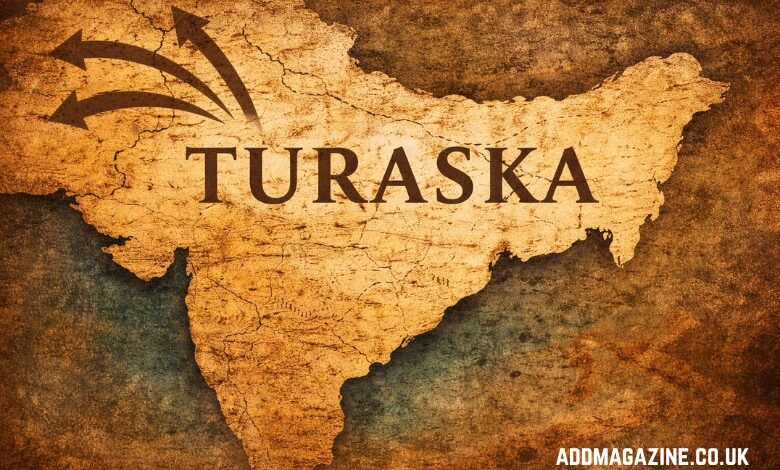
The term “Turaska” is a compelling lens through which we can examine the rich, complex history of cross-cultural interactions in South Asia, particularly during the medieval period. As a descriptor used in ancient Indian texts, it signifies foreign peoples—most notably, the Turkic tribes and Central Asian groups—that influenced the Indian subcontinent through invasions, trade, and other forms of contact. Turaska, as a historical and linguistic term, provides insights into the intricate network of cultural, political, and social exchanges between the Indian subcontinent and Central Asia.
Origins and Etymology
The word “Turaska” has its roots in Sanskrit, where it appears in ancient Indian texts to describe foreign tribes or peoples. The most commonly used transliteration of the term is “Turaṣka,” derived from the Sanskrit word “Tura,” which means “swift” or “quick,” likely referring to the military prowess or the swift horses of these tribes. The suffix “-ṣka” or “-ushka” is typical in Sanskrit and is used to denote ethnic or tribal groups. Thus, the term Turaska may have been initially used to describe the speed and martial skills of the people it referred to.
Historically, the term evolved as different Central Asian tribes began to interact with the Indian subcontinent. While early mentions of Turaska referred to a broader category of foreign peoples, it later became closely associated with Turkic invaders who played a significant role in shaping the subcontinent’s history.
Turaska in Ancient Indian Texts
In texts such as the Puranas, Mahabharata, and other epic literature, the term Turaska is frequently used to describe foreign groups who were often considered “others” or “outsiders.” These groups, described as “mleccha” (barbarians) in Sanskrit, were depicted as having customs that were foreign to the Vedic and Aryan societal norms of the time. In the Mahabharata, Turaska is referred to as part of the northern tribes who participated in the great Kurukshetra war. Their military skill was recognized, and they were portrayed as formidable warriors.
The Puranas, which blend mythological narratives with historical accounts, also mention Turaska. The Vishnu Purana lists them as part of the tribes emerging in the Kali Yuga, a time associated with decline and disorder, further suggesting that their presence was seen as a disruption to the established order. While this negative connotation may be rooted in the political and social tensions of the time, it also reflects the historical reality of foreign invasions and migrations into the subcontinent.
The references in these texts, while sometimes mythologized, were grounded in real historical encounters. They provide valuable insights into the perceptions of foreigners and the growing recognition of Central Asian tribes in Indian literature, stemming from the interactions that occurred through both trade and military campaigns.
The Turkic Invasions and the Rise of Turaska
The significance of Turaska in the historical context becomes even clearer when we consider the Turkic invasions that began in the 10th century CE. The Ghaznavid Empire, under Mahmud of Ghazni, was one of the first major Turkic incursions into northern India. Mahmud’s repeated raids targeted the rich temples and cities of India, introducing Turkic military strategies and administration to the region. The invaders were often referred to as Turaska in Indian sources, emphasizing their foreignness and distinct identity.
Mahmud’s campaigns, though violent, also marked the beginning of cultural exchanges. His patronage of Persian culture and Islamic scholarship set the stage for the later fusion of Indo-Islamic culture under the Delhi Sultanate. This period of interaction, despite the hostility that initially defined it, laid the groundwork for long-lasting changes in Indian politics, culture, and society.
Following Mahmud, the establishment of the Delhi Sultanate in 1206 CE by Qutb-ud-din Aibak brought an era of sustained Turkic rule in India. The Mamluks, Khaljis, and Tughlaqs, all of Turkic origin, ruled much of northern India, and the term Turaska continued to be used to describe the rulers and their military elite. This era was marked by the blending of Turkic, Persian, and Indian traditions, as these groups integrated into the subcontinent’s existing social and political structures.
Cultural Interactions and Influence
The Turaska presence in India was not solely defined by conquest but also by significant cultural and intellectual exchanges. The Turkic rulers introduced new architectural styles, military techniques, and administrative systems that would shape the course of Indian history. The early Islamic architecture in India, including structures like the Qutb Minar and Alai Darwaza, reflects a fusion of Central Asian and Indian elements. The introduction of the arch and dome, two key features of Islamic architecture, transformed Indian building practices and led to the creation of iconic monuments.
In addition to architecture, the arrival of the Turaska rulers brought Persian as a dominant language of administration, literature, and culture. Persian, alongside Arabic, became the language of the elite, and this cultural shift had profound implications. It led to the development of Urdu, a language that blended Persian, Arabic, and local Indian languages, and became the lingua franca of the Indo-Islamic world.
Sufism, another important cultural import from Central Asia, played a crucial role in bridging religious and cultural divides in India. Sufi saints, many of whom were patronized by Turaska rulers, attracted followers from both Muslim and Hindu communities, promoting a syncretic culture that integrated elements of both traditions. This culture of religious tolerance and cultural exchange would have a lasting impact on the development of Indian society.
The Decline of the Turaska Identity
By the time the Mughal Empire rose to power in the 16th century, the term Turaska began to lose its prominence in Indian texts. The Mughal emperors, though of Turco-Mongol origin, increasingly identified with Persian and Indian cultures. The process of indigenization, whereby Turkic rulers became more aligned with Indian traditions, diminished the relevance of the Turaska identity. The Mughals, particularly under Emperor Akbar, embraced Persianate culture and made significant contributions to art, literature, and administration that would come to define the Mughal era.
The shift away from the use of Turaska to describe the Mughal rulers reflects the transformation of the Turco-Mongol elites into a more integrated part of Indian society. However, the legacy of the Turaska rulers endured through their contributions to the cultural and architectural landscape of India.
The Legacy of Turaska
The term “Turaska” and its historical connotations provide a window into the history of Central Asia’s influence on South Asia. While initially a term for foreign invaders, Turaska gradually became a symbol of the diverse and complex interactions that shaped Indian society. The term reflects a broader narrative of cultural exchange, transformation, and identity formation in the Indian subcontinent.
In contemporary scholarship, Turaska is studied not only as a historical term but also as a reflection of the dynamics of “otherness” in South Asian history. Historians have used it as a tool to understand how foreign groups were perceived and integrated into Indian society. The assimilation of Central Asian groups into India’s cultural and political fabric is a testament to the enduring legacy of the Turaska influence, which continues to shape the subcontinent’s historical and cultural identity today.
Conclusion
The history of Turaska, from its initial use in ancient Indian texts to its association with Turkic invasions and later cultural assThe term “Turaska” is a compelling lens through which we can examine the rich, complex history of cross-cultural interactions in South Asia, particularly during the medieval period. As a descriptor used in ancient Indian texts, it signifies foreign peoples—most notably, the Turkic tribes and Central Asian groups—that influenced the Indian subcontinent through invasions, trade, and other forms of contact. Turaska, as a historical and linguistic term, provides insights into the intricate network of cultural, political, and social exchanges between the Indian subcontinent and Central Asia.