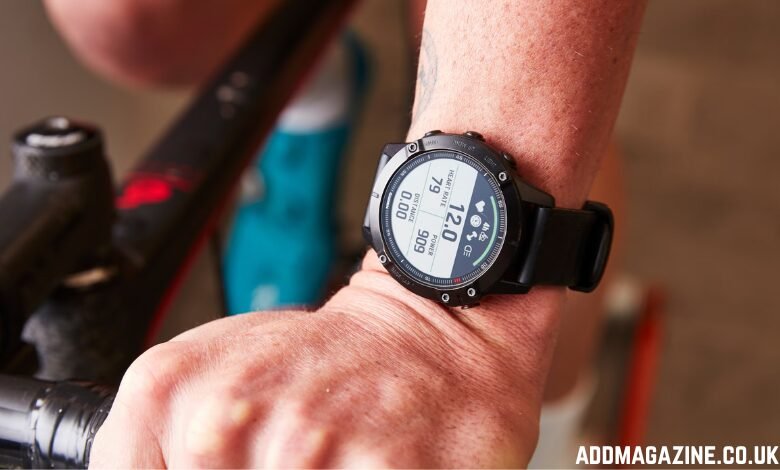
When you are out on the road or a mountain trail, a sports watch is more than just a clock. It is your coach, your navigator, and your safety tool. However, not every feature is worth your money.
To make the best choice, you need to understand which features of a sports watch for cycling actually help you ride better and stay safe.
Why a Dedicated Sports Watch for Cycling is Essential for Modern Riders
A sports watch is a better investment than a basic bike computer because it focuses on your body’s recovery and long-term health. While a computer only tells you how fast the bike is moving, a watch tracks your heart rate and stress levels all day and night.
The logic here is simple: your performance on the bike depends on how well you rested the night before. By monitoring your resting heart rate and sleep patterns, the watch can tell you if your muscles are recovered or if you are pushing too hard. This helps you avoid injuries and ensures that every ride actually makes you stronger.
Prioritizing GPS Accuracy and Multi-Band GNSS for Precise Route Tracking
You should prioritize paying for “Dual-Band” GPS because it is the only way to get true data in difficult environments. Standard GPS signals often bounce off tall trees, cliffs, or buildings before they reach your wrist. This “bouncing” confuses the watch, making it think you traveled further or faster than you actually did.
Dual-band technology uses two different signal frequencies to filter out these errors. By checking both signals, the watch can ignore the “bounces” and find your exact location. This ensures your speed and distance data are accurate, even when the sky is hidden by a thick forest.
External Sensor Compatibility: Connecting Power Meters and Cadence Sensors
Choosing a watch that connects to external sensors is a requirement for serious training because wrist-based sensors often fail during a ride. When you cycle, you grip the handlebars tightly, which restricts blood flow at the wrist and makes it hard for the watch’s light sensor to read your heart rate.
Additionally, vibrations from the road cause the watch to move, creating “noise” in the data. A watch with ANT+ or Bluetooth allows you to link to a chest strap or a power meter on your pedals. These devices send direct, electrical signals that are not affected by road bumps, giving you the professional data you need to improve.
Evaluating Battery Life and Power Management for Long-Distance Rides
High battery capacity should be viewed as a safety feature rather than just a convenience. Cycling adventures often last for many hours, and running a high-brightness screen while tracking GPS uses a lot of energy. If your battery dies while you are miles from home, you lose your navigation and your record of the ride.
The logic for paying more for battery life is to ensure “Continuous GPS” coverage. You need a watch that can stay fully active for at least 20 hours. This guarantees that even if your ride takes longer than planned, your watch will still be working to help you find your way back.
Mapping and Navigation Features for Exploring New Cycling Routes
Investing in a watch with 32GB of internal storage for offline maps is essential for any rider who explores new trails. Many basic watches only show a simple line on a black screen, which is useless if you reach a fork in the road with multiple paths.
Internal storage allows the watch to keep full, colorful maps that show every street, hill, and river. This is important because phone batteries die quickly when using GPS, and cell signals often disappear in the woods. Having the map stored directly on your watch means you can always see exactly where you are, even in total wilderness.
Top-Rated Sports Watch for Cycling Recommendations in 2026
The KOSPET TANK T4 is a top recommendation for cyclists because it provides the expensive navigation and durability features found in pro-level watches at a much better value. It is built to survive the high-impact environment of cycling, where gear is often exposed to crashes, vibration, and mud. Instead of worrying about breaking a fragile device, a rider can focus on the road while the watch handles the difficult work of tracking and navigation in the toughest conditions.
- Stainless Steel Unibody and 9H Glass: This creates a shield that prevents the screen from cracking if a rock flies up from your tires or if you take a spill on a trail.
- Dual-Band GPS and 32GB Storage: It uses the same high-end tracking technology as professional tools, allowing you to save full maps and never lose your way.
- 1000-Nit AMOLED Display: The screen is bright enough to stay clear even under the direct, harsh sun of a summer afternoon ride.
- 10 ATM Waterproof Rating: It is built to survive high-pressure water, meaning you can ride through a rainstorm and then spray your watch clean with a hose.
- Long-Lasting Battery: It provides over 20 hours of continuous GPS tracking, ensuring it stays alive for even the longest weekend adventures.
Conclusion: How to Balance Your Budget Without Sacrificing Performance
The smartest way to spend your budget is to pay for internal hardware and data accuracy rather than “luxury” looks. In the world of cycling, a watch is a tool, not jewelry.
A stainless steel watch with dual-band GPS and a long-lasting battery will help you reach your fitness goals and keep you safe. On the other hand, a fancy-looking watch with weak sensors will eventually let you down during a tough ride. When you buy, always look for “Map Storage” and “Sensor