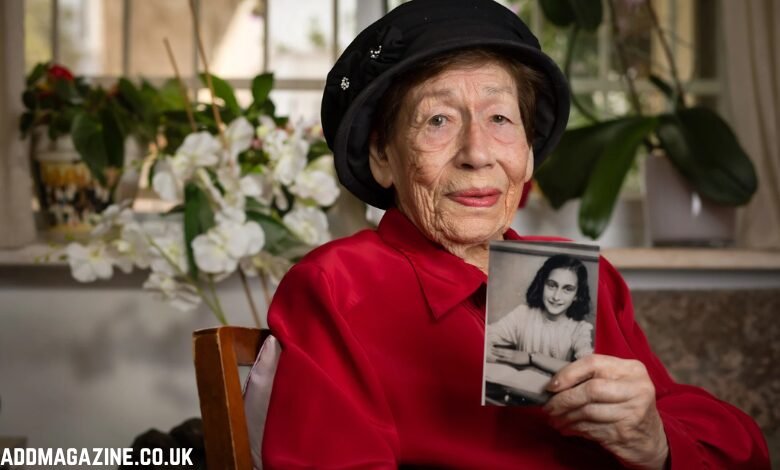
Gabi Goslar, born Rachel Gabriele Ida Goslar on October 25, 1940, in Amsterdam, Netherlands, is a Holocaust survivor who, while not as widely known as some of her contemporaries, holds an important place in Holocaust history. Her close childhood friendship with Anne Frank, the author of “The Diary of a Young Girl,” and her own harrowing experiences as a Jewish child during World War II, have made her an essential witness to the atrocities of the Holocaust.
Gabi Goslar’s life was marked by deep personal loss, survival, and resilience, as she and her family endured the brutal realities of Nazi persecution. Despite the suffering she endured, Gabi’s story stands as a testament to the strength of the human spirit and the importance of preserving the memory of the Holocaust.
Early Life and Relationship with Anne Frank
Gabi was born in Amsterdam, Netherlands, to Hans Goslar and Ruth Judith Klee, a Jewish family who had fled Nazi Germany to escape the rising tide of anti-Semitism. The Goslar family moved to Amsterdam in the early 1930s, seeking safety from the escalating Nazi threat.
In Amsterdam, Gabi became friends with Anne Frank, a relationship that would later become a part of history. The two girls were close childhood friends, attending the same school and sharing many of the same experiences in the Jewish community of Amsterdam. Gabi and Anne spent their early years playing and learning together before the rise of the Nazis disrupted their lives.
Their friendship would later become a key aspect of Anne Frank’s story, as Anne often mentioned her friends in her diary. However, Gabi’s own story, though intertwined with Anne’s, remained less known for many years. As the war progressed, the close bond between Gabi and Anne would be severed as they were both separated by Nazi persecution.
The War and Gabi Goslar’s Family’s Deportation
In 1943, Gabi’s family, like many others in Amsterdam, was rounded up by the Nazis and sent to the Westerbork transit camp. The Westerbork camp was a staging area where Jews were kept before being deported to various concentration camps. It was here that Gabi and her family endured brutal conditions, separated from many of their friends and family members. During their time in Westerbork, Gabi and her family learned of Anne Frank’s decision to go into hiding.
In 1944, the Goslar family was deported from Westerbork to the infamous Bergen-Belsen concentration camp in northern Germany. It was here that Gabi would face the true horrors of Nazi atrocities. Bergen-Belsen was a camp known for overcrowding, disease, starvation, and extreme brutality. It was here that Anne Frank and her sister Margot were ultimately taken after their arrest, and the conditions in the camp would play a key role in Anne’s tragic death from typhus in March 1945.
Gabi’s time in Bergen-Belsen was marked by extreme suffering, but she survived, alongside her sister Hannah Goslar, who was also a close friend of Anne Frank.
The Final Meeting with Anne Frank in Bergen-Belsen
In the winter of 1945, Gabi had a brief but memorable encounter with Anne Frank in Bergen-Belsen. The two girls, separated by a barbed-wire fence, managed to exchange brief words and provide some comfort to each other during their final moments together. Anne, who was gravely ill, had little energy to speak, and their brief meeting was one of the last connections the two childhood friends would have before Anne’s death in March 1945.
After this brief encounter, Anne Frank passed away from typhus in March 1945, just weeks before the liberation of the camp by British forces. Gabi, on the other hand, along with her sister Hannah, survived the horrors of the camp. They were liberated by British troops on April 15, 1945, marking the end of their nightmare but leaving them with deep psychological scars that would shape the rest of their lives.
Life After Liberation: The Rebuilding of Gabi Goslar’s Life
After the war, Gabi Goslar and her sister were among the few members of their extended family to survive the Holocaust. The two sisters returned to Amsterdam, where they were faced with the difficult task of rebuilding their lives. They had lost most of their family members, including their parents, during the Holocaust.
Gabi did not immediately become a public figure like her sister Hannah. Hannah later became a nurse and moved to Israel, where she started a family. Gabi, on the other hand, kept a relatively low profile. While Hannah became more involved in the public discussion of Anne Frank’s life, Gabi focused on rebuilding her own life, trying to make sense of the trauma she had experienced and the profound loss of her family.
Gabi Goslar’s Role in Holocaust Education
Though Gabi Goslar never published her memoirs or sought the public spotlight, she did contribute to the preservation of Holocaust memory through her sister’s work and her participation in interviews. Over time, Gabi’s experiences, particularly her memories of Anne Frank, have played an important role in Holocaust education. Through her connections with her sister Hannah, Gabi has helped ensure that Anne Frank’s story remains an essential part of the historical record.
Gabi’s life, though less publicly documented than her sister’s, continues to serve as an important reminder of the effects of Nazi persecution on Jewish families, especially the children who were caught in the chaos of the Holocaust. Gabi’s participation in interviews has provided a first-hand account of the trauma experienced by Jewish children during the war, and her perspective has been valuable in educating future generations about the Holocaust.
Is Gabi Goslar Still Alive?
As of 2023, Gabi Goslar is still alive. She is in her 80s, and while she has not been as publicly active as some of her contemporaries, she continues to be a part of the important legacy of Holocaust survivors who work to preserve the memories of the war.
Her survival, and her willingness to share her experiences through interviews, has ensured that her voice continues to be part of the larger conversation about the Holocaust. Gabi Goslar’s survival, alongside her sister Hannah’s contributions, is crucial to maintaining the history and memory of Anne Frank and the millions of others who suffered under Nazi rule.
Where Does Gabi Goslar Live Now?
The specific details of Gabi Goslar’s current location are not widely known, as she has kept a private life in her later years. However, it is widely believed that she still lives in the Netherlands, where she returned after the war. Unlike her sister, Gabi has not been as involved in public interviews or the preservation of Anne Frank’s legacy in the same way Hannah was, but she remains an important figure in the broader context of Holocaust education.
Gabi Goslar’s Legacy and Contribution to Holocaust Remembrance
Gabi Goslar’s legacy is intertwined with the history of Anne Frank and the shared experiences of young Jewish children during the Holocaust. While her role has not been as prominent in public discussions as that of Anne Frank, Gabi’s life story is an essential part of understanding the emotional and psychological toll of the Holocaust on survivors.
Through her relationship with Anne Frank and her own survival, Gabi has contributed to the important task of ensuring that the Holocaust is not forgotten. Her life, as one of the few survivors who witnessed the brutality of the camps and the loss of childhood friends like Anne, reminds us of the importance of remembering the victims and the lessons that must be learned from this dark chapter in history.
Conclusion
Gabi Goslar’s story is one of survival, loss, and resilience. Born in October 1940, she endured the worst of the Nazi regime’s atrocities, losing most of her family and her childhood friend, Anne Frank, to the Holocaust. Through her survival and the later sharing of her memories, Gabi Goslar has become a crucial witness to history. Her life, though less publicized than that of Anne, remains an integral part of the larger Holocaust narrative.
Today, Gabi Goslar’s legacy continues through her involvement in Holocaust education and the preservation of Anne Frank’s memory. Her life serves as a testament to the strength and resilience of the human spirit and the importance of ensuring that the horrors of the Holocaust are never forgotten.