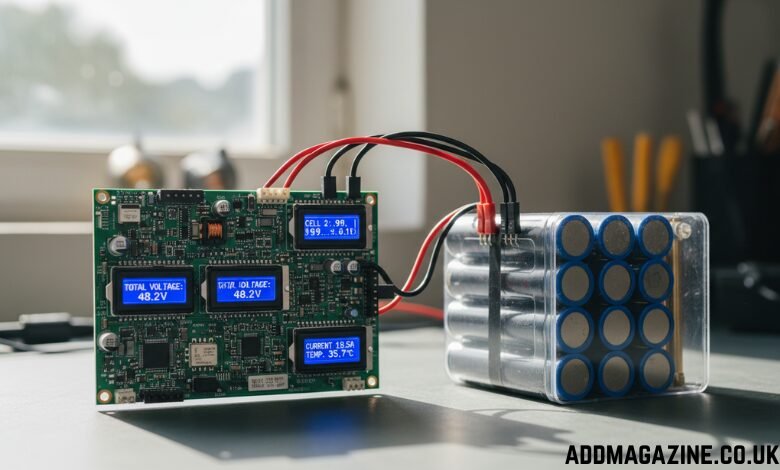
Energy storage is no longer a niche concern for enthusiasts or heavy industry. It sits in the pockets of billions and underpins the shift toward a greener grid. Yet, the focus usually remains on the outward-facing specs: how long does the charge last, or how quickly can it reach 100%? Beneath those numbers lies a complex, high-stakes game of balance. A battery pack is only as strong as its weakest link, and without a sophisticated battery cell monitoring system, that link can fail with little warning.
Managing power isn’t just about moving electrons from point A to point B. It is about understanding the chemical volatility and physical limits of individual components. When thousands of cells are packed together to power an electric vehicle or a massive data center, the risk of a single outlier causing a chain reaction is real. This is where the quiet work of monitoring becomes the difference between a reliable asset and an expensive, or even dangerous, liability.
The Micro-Management of Energy
Why do we care about individual cells instead of the battery as a whole? Imagine a rowing team where eight athletes are pulling a boat. If one person stops or works at half-speed, the rest of the team must compensate.
Eventually, the hardest workers burn out, and the slow rower becomes a dead weight. In a battery pack, if one cell loses capacity or develops high internal resistance, the entire pack suffers.
A battery cell monitoring system acts as the coach for this team. It doesn’t just look at the boat’s speed; it watches every rower’s heart rate and stroke power. By tracking individual performance, the system ensures that no single cell is being pushed beyond its chemical threshold. This level of granularity is what allows modern lithium-ion setups to last for a decade rather than just a few years.
Precision in Tension: Battery Cell Voltage Monitoring System
Voltage is the primary language of a battery. It tells us the state of charge and, more importantly, the state of health. However, reading voltage at the pack level is like trying to diagnose a patient’s health by looking only at their weight. It misses the nuances. A battery cell voltage monitoring system provides the high-resolution data needed to spot trouble before it manifests as a failure.
When a battery charges, the voltage rises. If one cell hits its maximum voltage before the others, the charging process must stop to prevent overcharging, which can lead to thermal runaway. Conversely, if one cell drops too low during discharge, it can suffer permanent chemical damage.
The battery cell voltage monitoring system identifies these discrepancies in real-time. It allows the management software to bleed off excess energy from “high” cells or redistribute the load, a process known as balancing. Without this constant adjustment, the usable capacity of the battery would shrink rapidly with every cycle.
The Thermal Factor in Cell Health
While voltage is the primary metric, temperature is the primary enemy. Batteries are chemical engines, and chemical reactions are sensitive to heat. A cell that runs even five degrees hotter than its neighbors will age faster. This creates a feedback loop: the degraded cell has higher resistance, which generates even more heat, leading to further degradation.
Integrated monitoring does more than just shut things down when they get too hot. It provides the data necessary to manage cooling systems efficiently. If the battery cell monitoring system detects a specific module trending warmer, it can trigger localized cooling or reduce the power draw from that specific section. This preventative approach is far more effective than a simple emergency cutoff.
Scaling Up: The Demand for 40/7 Battery Cell Monitoring
In industrial settings, the stakes are significantly higher. Data centers, telecommunications hubs, and utility-scale solar farms cannot afford “blind spots” in their power supply. This has led to the rise of 40/7 battery cell monitoring protocols.
While the term might seem like a clerical error for “24/7,” in the industry, it often refers to specialized high-frequency or high-density monitoring configurations—such as 40 channels of monitoring across a 7-day rolling high-intensity cycle, or specific hardware configurations designed for massive series strings.
Regardless of the specific nomenclature, the goal of 40/7 battery cell monitoring is total visibility. In these environments, lead-acid batteries are still common alongside lithium-ion. Lead-acid cells are prone to “sulfation” and “dry-out.”
By the time a technician notices a bulging case during a manual inspection, the battery has likely been failing for months. Continuous monitoring replaces guesswork with a digital twin of the battery’s health, allowing for predictive maintenance rather than reactive repairs.
Why Software is the New Chemistry
For a long time, battery improvement was purely a matter of materials science—finding a better cathode or a more stable electrolyte. While that work continues, the most significant gains in longevity are now coming from the software side. The battery cell monitoring system is the brain that manages the raw chemistry.
Think about the way a smartphone manages its battery overnight. It learns your habits and slows down the charging process to ensure the battery reaches 100% right before you wake up. This reduces the time the cells spend in a high-voltage, high-stress state.
On a larger scale, such as in an electric grid, the battery cell monitoring system allows operators to “throttle” energy usage based on the real-time health of the cells. This capability turns a “dumb” hardware component into an intelligent, adaptive asset.
Balancing the Load
There are two main ways a battery cell monitoring system handles cell imbalances:
- Passive Balancing: The system identifies cells with a higher voltage than the rest and dissipates the excess energy through a resistor as heat. It is simple and cost-effective, but it wastes energy.
- Active Balancing: This is the more sophisticated cousin. The system takes energy from the strongest cells and transfers it to the weakest ones. While the hardware is more complex, it maximizes the total energy efficiency of the pack.
- State of Health (SoH) Estimation: By comparing current performance against the battery’s “as-new” profile, the system calculates how much life is left. This is vital for determining the “second life” potential of batteries, such as using old EV batteries for home energy storage.
- Predictive Analytics: Advanced systems use the data gathered to predict when a cell might fail weeks before it actually does, based on subtle shifts in internal resistance.
Safety as a Non-Negotiable Standard
The most cited concern regarding high-energy-density batteries is fire. Lithium-ion batteries contain a flammable electrolyte, and if a cell is punctured or overcharged, it can enter a state of thermal runaway. Once this starts, it is incredibly difficult to extinguish.
A robust battery cell monitoring system is the primary line of defense against such events. It monitors for “internal shorts”—tiny defects that might develop over time. If a cell begins to discharge internally, it will show a voltage drop that doesn’t match the rest of the pack.
The battery cell voltage monitoring system flags this anomaly instantly. In a well-designed system, this allows the faulty module to be electrically isolated before the heat can build up enough to threaten the surrounding cells.
The Economic Argument for Better Monitoring
Budgeting for a high-end battery cell monitoring system can feel like an unnecessary expense at the start of a project. However, the return on investment comes from the extension of the battery’s lifespan. If a monitoring system can extend the life of a $50,000 battery pack from eight years to twelve, it has paid for itself many times over.
Furthermore, there is the issue of downtime. In a commercial setting, a sudden power failure can cost thousands of dollars per minute. Having a battery cell monitoring system that provides a “service required” alert while the system is still operational is a massive operational advantage. It transforms the battery from a “black box” that might fail at any time into a transparent component with a predictable lifespan.
Final Thoughts on Systemic Oversight
The transition to a battery-powered world is a massive undertaking that requires more than just raw capacity. It requires intelligence. The battery cell monitoring system provides that intelligence, serving as the guardian of efficiency and safety. By maintaining a constant watch through a battery cell voltage monitoring system, operators can ensure that their energy assets remain reliable and long-lived.
Whether it is the rigorous demands of 40/7 battery cell monitoring in a critical infrastructure setting or the daily cycles of a commuter car, the goal remains the same: keep the cells in harmony. When the chemistry is balanced and the data is clear, the transition to sustainable energy becomes not just a possibility but a durable reality.