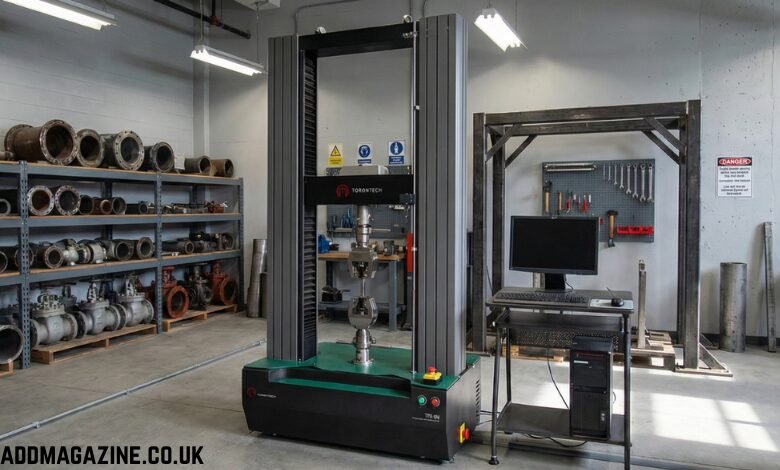
Materials testing laboratories often face confusion due to overlapping terminology. Engineers and technicians frequently use “tensile tester” as a catch-all phrase for any equipment that pulls a sample apart. However, a Universal Testing Machine (UTM) represents a far more versatile class of equipment than a machine focused on a single mode of operation. This distinction is not merely semantic; choosing the wrong category of machinery leads to significant operational bottlenecks, such as an inability to perform compression or bend tests or failing to meet strict repeatability requirements during an audit.
The consequences of an ill-informed purchase usually manifest months after installation. You might find that your lab suddenly needs to support a new product line requiring flexural testing, only to realize your dedicated tensile frame cannot accommodate the necessary fixtures. Or, you may find that your reporting routines lack the traceability required by international standards. This guide clarifies the practical differences between a UTM Machine and a Tensile Tester, providing a decision framework to ensure you select the system that truly fits your lab’s long-term needs. To begin your evaluation, you can browse Universal Testing Machine options from Qualitest to see how different configurations support a variety of industrial workflows.
Quick Definitions: What People Usually Mean by “Tensile Tester” vs “UTM Machine”
Before diving into the technical differences, it is helpful to establish how these terms are used in daily lab practice.
A Tensile Tester typically refers to a system configured primarily, if not exclusively, for tensile testing (tension). These machines are often simpler in design, featuring a single column or a light-duty dual-column frame. They are built to pull a specimen—such as a plastic dog-bone or a metal wire—until it yields or breaks. Because they are specialized for one core method, they are often used in routine quality control environments where the testing parameters rarely change.
On the other hand, a UTM Machine, or Universal Testing Machine, is a test frame and control system designed from the ground up to be “universal.” The name implies that the machine can support multiple test modes, including tension, compression, bending (flexural), and even peeling or puncturing. This versatility is achieved by swapping out the fixtures and grips. In practice, while every UTM is capable of acting as a tensile tester, not every tensile tester is equipped to handle the broader “universal” workflow.
UTM Machine vs Tensile Tester: The Real Differences That Matter
The choice between these two systems often comes down to the diversity of your testing requirements and the level of sophistication required for your data capture.
Test Modes and Versatility
The most obvious difference is the range of test modes supported. A dedicated Tensile Tester is a “one-trick pony” focused on pulling. If your production line only produces wire or thin film and you will never have a need to measure how that material behaves under a crushing load, a tensile-specific frame may suffice. However, a UTM Machine allows you to perform tension, compression, and three-point or four-point bending on a single frame. This is critical for industries like construction or aerospace, where components must be validated under multiple stress conditions.
The Fixture Ecosystem
A universal system is defined by its fixture compatibility. While a basic tensile tester might have integrated grips that are difficult to remove, a Universal Testing Machine features a standardized interface that allows for the rapid exchange of a vast array of grips and fixtures. You can move from wedge grips for metal testing to compression platens for foam testing in a matter of minutes.
Measurement, Repeatability, and Standards
Data quality and repeatability are where the “Universal” class truly stands out. These machines are designed to integrate with high-precision extensometers—tools that measure the exact strain of a sample directly. Whether you are following ASTM D638 for plastics, ASTM E8 for metals, or ISO 527, the UTM provides the stable load frame and sophisticated software needed to ensure every test is compliant with international reporting standards.
The Upgrade Path
When you invest in a UTM Machine, you are investing in an upgrade path. You may only need tension today, but as your company grows, you can add high-temperature furnaces, environmental chambers, or advanced non-contact video extensometers to the same frame.
Note: It is a common mistake to focus only on the maximum force capacity. While “load” is important, the fixtures, specimen geometry, and test method clarity often drive the final quality of the data far more than raw power.
Universal Machine Testing Is a Workflow, Not Just a Frame
To get the most out of your laboratory, you must view Universal Machine Testing as a holistic workflow rather than just a heavy piece of hardware. A successful testing program requires the seamless integration of several components:
- The Load Frame and Controller: The physical structure and the electronics that drive the crosshead with precision.
- Software: The interface where test methods are defined, and data is analyzed. Modern software should offer pre-loaded templates for common standards to reduce operator error.
- Grips and Fixtures: The hardware that holds the specimen. This includes everything from pneumatic grips that prevent specimen slippage to specialized flexural fixtures.
- Strain Measurement: Utilizing an extensometer ensures that you are measuring the material’s actual deformation, not just the movement of the machine’s crosshead.
- Sample Preparation: Consistent results start with consistent samples.
By standardizing each step of this Universal Machine Testing sequence, you ensure that your data is traceable and defensible, which is vital during customer audits or product failure investigations.
Decision Framework: Which One Do You Actually Need?
If you are currently evaluating a purchase, use the following framework to determine which category fits your lab profile.
Choose a Tensile Tester When…
- You strictly perform tensile tests for a single type of material or product.
- Your lab is focused on routine, high-volume QC with methods that never vary.
- You have no anticipated need for compression, bending, or advanced material analysis.
- Your budget is limited, and your reporting requirements are straightforward.
Choose a Universal Testing Machine (UTM Machine) When…
- You need to perform a variety of tests, including tension, compression, and flexural bending.
- You work with mixed materials or support a diverse R&D department.
- You require fixture flexibility and the ability to add advanced sensors (like extensometers) later.
- You must comply with multiple international standards (ASTM, ISO, DIN) that require different setups.
- You need robust data management, traceability, and consistent reporting across different operators.
Common Misconceptions That Lead to the Wrong Purchase
- “They are basically the same machine”: While they look similar, a dedicated tensile tester often lacks the controller logic or the mechanical clearance required for proper compression or bend testing.
- “Capacity is the only spec that matters”: Buying a 100kN machine for 1kN tests can actually lead to poorer data resolution. You must match the load cell and frame to your specimen’s expected break force.
- If the crosshead doesn’t have the right travel or the controller doesn’t support the logic for a flex test, an “upgrade” might require a completely new machine.
- “Compliance features are optional”: In a regulated industry, having a UTM Machine with a full audit trail is the only way to prove your results haven’t been tampered with.
Selection Checklist (Copy-Paste for Buyers)
- Material Diversity: What materials (plastics, metals, rubber, composites) will you test over the next 24 months?
- Test Modes: Do you need tension, compression, 3-point bend, or 4-point bend?
- Regulatory Standards: Which ASTM or ISO standards are relevant to your industry?
- Force Range: What is the minimum and maximum force required for your strongest and weakest specimens?
- Strain Accuracy: Do you need a clip-on or non-contact extensometer for precise modulus measurements?
- Fixture Needs: Do you need pneumatic grips, wedge grips, or specialized platens to prevent slippage?
- Software Requirements: Do you need custom reporting templates or automated pass/fail results?
- Operator Experience: Is the system easy to use for a rotating staff, or does it require a specialist?
Why Qualitest Is a Practical Source for UTM Machine Options
When selecting a partner for your materials testing needs, it is important to work with a supplier that understands the nuance between a simple pull test and a comprehensive research project. Qualitest offers a diverse range of universal testing machines suitable for different laboratory footprints and workloads, from compact benchtop models to high-capacity, floor-standing units.
The value of working with Qualitest lies in their focus on the complete system—not just the frame. By providing the necessary fixtures, extensometry, and software support, they ensure that your UTM Machine is configured for your specific industry requirements. Whether you are testing plastics for the automotive sector or performing high-strength metal validation for aerospace, their systems are engineered for repeatability and long-term durability.
Explore Universal Testing Machine Options From Qualitest
The “right” machine is the one that solves your current testing challenges while providing a clear path for future growth. By identifying your required test modes and the specific standards you must follow, you can move away from the confusion of “tensile testing” and move toward a true universal capability.
We invite you to browse Qualitest universal testing machines and compare Qualitest UTM machines and request a quote based on your materials, test modes, and reporting requirements. Choosing the correct platform today ensures that your lab remains a source of accurate, reliable, and compliant data for years to come.