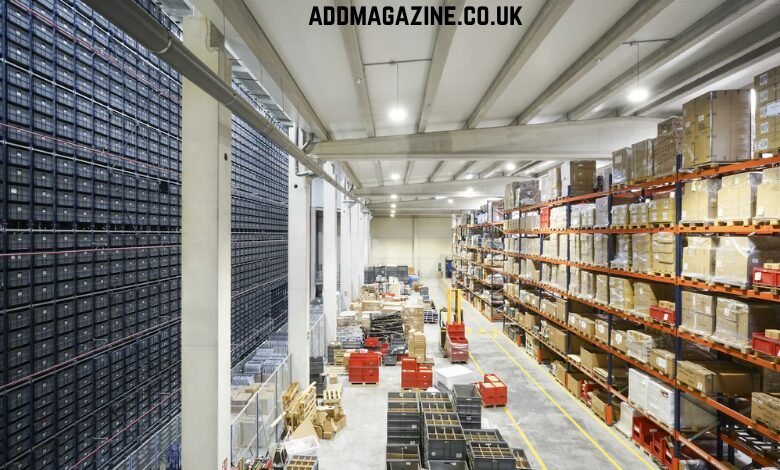
Most conversations about efficiency drift towards software, automation, or labour costs. Fair enough. But on many sites, the daily hold-ups are much smaller and far more ordinary. A worn label. A half-visible warning sign. A storage area that makes sense only to the people who have worked there for years. None of that sounds dramatic, yet it is often where confusion starts.
Workplaces run better when people do not have to stop and second-guess what they are looking at. If a route is clearly marked, a restricted area is obvious, and equipment can be identified without a second look, work tends to keep moving. When those cues are weak, people improvise. They ask around, rely on memory, or make a quick assumption and hope they are right. That may cost only a minute at a time, but over a week or a month, those minutes add up.
Clear identification is not a minor detail
There is a tendency to treat signs, labels, and markers as housekeeping rather than part of operations. In reality, they shape how a site works from one hour to the next. They help staff move through shared spaces, locate stock, recognise hazards, and follow site rules without unnecessary hesitation. In busy environments, that kind of clarity is not cosmetic. It is practical.
It also needs to last. A printed label that works perfectly well in an office may not survive for long in a warehouse, workshop, or production area. Heat, moisture, abrasion, and constant handling all take their toll. That is why some businesses look to specialist suppliers such as Brady UK when standard signs and temporary labels are not robust enough for day-to-day use. The point is simple: workplace identification has to suit the environment, not just the spreadsheet.
Once it stops doing that, people start filling in the gaps themselves. They remember where something “usually” is. They assume a faded marker still means what it meant six months ago. They follow the habits of the last person who worked that area. That is rarely the best basis for safe, consistent work.
Delays often start with small moments of doubt
Not every operational delay comes from a major failure. Plenty begin with a pause. A driver looks for the correct unloading point and chooses the wrong one. A contractor is unsure where access ends and restricted space begins. A member of staff spends extra time checking whether a piece of equipment is the right one because the identifier is damaged or unclear. None of these moments would make it into a weekly report on their own, but together they create drag.
That drag is easy to underestimate because it feels normal. People adapt. Supervisors answer the same questions. Teams build workarounds into the day. Eventually, the organisation stops noticing that time is being lost at all. The problem is not just speed, either. Poor visual clarity also creates inconsistency. Two people can look at the same area and interpret it differently if the cues are weak enough. For operations that rely on repeatable actions, that matters.
Safety still depends on what people can see
There is a more obvious reason to take this seriously. Safety decisions are often made quickly and in passing. People glance at signs, routes, exclusion zones, and warnings while they are already busy with something else. If the information is hard to read, partly hidden, or simply not where people expect it to be, the chance of confusion rises.
This is especially true for anyone unfamiliar with the site. New starters, temporary workers, contractors, and visitors do not carry the same built-in knowledge as long-serving staff. They rely much more heavily on visible cues. That is one reason the HSE says safety signs should be used where a significant risk cannot be avoided by other means alone. Clear visual information will not fix every safety problem, but poor visual information can certainly make one worse.
Reliable sites are built on ordinary things done well
Good workplace identification supports something broader than compliance. It helps create consistency. Materials go back to the right place. Access rules are easier to follow. Checks take less time. People make fewer avoidable mistakes because the environment is giving them the right prompts at the right moment. None of this is glamorous, and that may be exactly why it is often neglected.
There is a wider lesson in that. Small practical decisions tend to shape long-term performance more than businesses expect. ADD Magazine has touched on that same point before in its piece on industrial reliability and material selection. Workplace identification belongs in the same category. It is not flashy, but it does steady work in the background.
When it is done properly, hardly anyone comments on it. They find what they need, move where they should, and make fewer wrong turns along the way. That kind of quiet efficiency is easy to miss, but it is worth having. For businesses trying to cut delays and reduce avoidable risk, clearer workplace identification is a sensible place to start.