
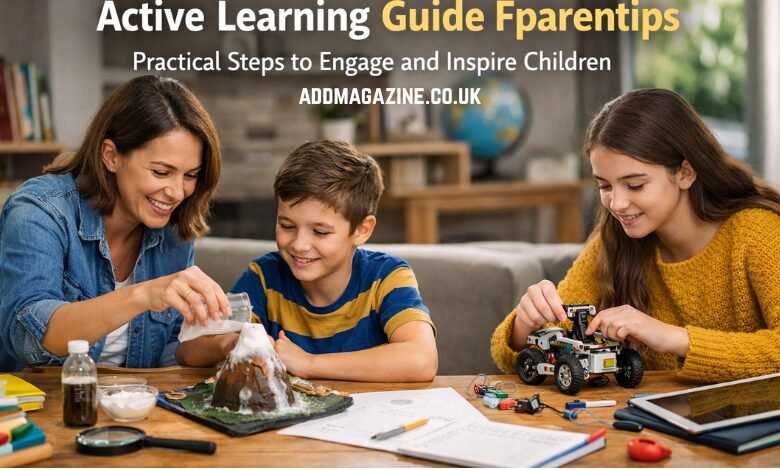
Active learning is a method of teaching and learning that encourages children to engage directly with ideas rather than passively receiving information. For parents, this approach can transform everyday experiences into meaningful educational opportunities. The active learning guide for parents emphasizes hands-on participation, problem-solving, and guided exploration to help children develop critical thinking, creativity, and independence.
Understanding the Active Learning Approach
Active learning focuses on involvement rather than memorization. Children are guided to:
- Explore: Engage with materials and their environment.
- Experiment: Try different methods and test outcomes.
- Question: Ask why and how, encouraging deeper thinking.
- Reflect: Consider what they learned and what could change.
- Discuss: Share ideas, explain reasoning, and listen to others.
The goal is to help children think critically, understand connections, and take ownership of their learning. This approach is applicable at all ages, but it should be adapted to the child’s developmental stage.
Age-Based Active Learning Strategies
Toddlers (2–4 Years)
Children at this age learn mostly by exploring with their senses. Their learning involves touch, movement, and repetition. Parents can create safe environments that allow for exploration without strict rules.
Key Techniques:
- Provide items of different textures, sizes, and weights.
- Encourage pouring, stacking, or sorting activities.
- Ask simple questions: “Which is heavier?” “Which feels smooth?”
Sample Activities:
- Fill cups with water for pouring exercises to demonstrate volume.
- Collect natural objects, such as leaves or stones, and compare characteristics.
- Allow free movement in safe spaces to explore balance and coordination.
Preschoolers (4–6 Years)
Preschool children are developing imagination, language, and early reasoning skills. Active learning at this stage uses role-play, storytelling, and guided questions to expand understanding.
Key Techniques:
- Encourage pretend play with props and costumes.
- Use stories to explore ideas and ask children to reconstruct or extend them.
Sample Activities:
- Set up a mini grocery store at home with play money to teach counting and social interaction.
- Build small forts using cushions and cardboard, encouraging engineering and planning.
- Use story baskets where children retell or modify stories using toys.
Early Elementary (7–9 Years)
Children begin logical reasoning and want to understand cause and effect. They respond well to experiments, simple projects, and challenges that require problem-solving.
Key Techniques:
- Introduce mini science experiments with safe household items.
- Encourage predictions before testing outcomes.
- Discuss results and reasoning, allowing children to correct mistakes independently.
Sample Activities:
- Conduct baking experiments: adjust ingredients and observe changes.
- Build paper bridges or towers and test their strength.
- Map the home or yard to learn measurement, direction, and spatial understanding.
Upper Elementary (10–12 Years)
Children at this stage develop critical thinking, independence, and the ability to work on more structured projects. Active learning can include research tasks, debates, and practical applications.
Key Techniques:
- Encourage ownership of learning through project selection and planning.
- Facilitate problem-solving exercises and structured challenges.
- Promote discussion, reasoning, and comparison of ideas.
Sample Activities:
- Assign a research topic and have the child present findings to family members.
- Introduce a fictional allowance system for financial literacy.
- Debate simple social issues or school topics, focusing on evidence-based reasoning.
Teens (13+ Years)
Teenagers develop abstract thinking and self-identity. Active learning involves collaboration, discussion, and real-world applications. At this stage, the parent’s role shifts from teacher to mentor.
Key Techniques:
- Support independent projects and exploration of personal interests.
- Encourage problem-solving that involves real-life scenarios.
- Listen actively and guide only when asked.
Sample Activities:
- Help design a small business plan or product prototype.
- Explore coding, graphic design, or creative writing projects.
- Discuss current events and social issues, asking for their analysis and proposed solutions.
Practical Steps for Parents
The active learning guide for parents emphasizes a consistent structure:
- Ask a Question: Start with curiosity rather than instruction.
- Present a Challenge: Give a task that requires problem-solving or creativity.
- Build and Experiment: Encourage hands-on work and exploration.
- Observe and Discuss: Talk about results, reasoning, and alternatives.
- Reflect and Extend: Ask what surprised them, what could change, and what they learned.
This framework ensures learning is interactive, not passive. It replaces pressure with curiosity and memorization with experimentation.
Using Everyday Opportunities
Active learning doesn’t require special materials. Household items, daily routines, and natural environments can be turned into learning moments:
- Cooking provides math, chemistry, and sequencing practice.
- Cleaning or organizing introduces sorting, categorization, and planning.
- Nature walks encourage observation, classification, and descriptive skills.
The key is to observe, ask questions, and let children discover connections on their own. Parents guide, rather than dictate.
Benefits of Active Learning
Adopting the active learning approach has several benefits:
- Enhanced Critical Thinking: Children learn to analyze situations and make decisions.
- Increased Independence: Children gain confidence in their ability to solve problems.
- Better Retention: Hands-on experience strengthens understanding.
- Improved Communication: Discussing ideas improves language and social skills.
- Stronger Parent-Child Bond: Shared learning experiences build trust and cooperation.
Integrating Active Learning with Academic Subjects
Active learning can also complement traditional school subjects. For example, a physics lesson can be enhanced using:
- College Physics Active Learning Guide Answers: Use structured problems to guide exploration.
- Active Learning Guide for College Physics PDF: Access to exercises that emphasize experimentation.
- Relativity Active Learning Guide: Explore concepts through thought experiments and practical demonstrations.
By combining structured guides with real-world activities, children connect theory with practice. This deepens comprehension and fosters curiosity beyond rote memorization.
Encouraging Reflection and Discussion
Reflection is critical to active learning. After an activity or experiment, parents should ask questions such as:
- “What did you notice?”
- “What worked as expected?”
- “What would you do differently next time?”
These discussions encourage self-assessment, reasoning, and the ability to articulate understanding. Children learn to see mistakes as opportunities rather than failures.
Adapting to Individual Needs
Every child learns differently. The active learning guide for parents encourages adaptation:
- Adjust tasks for skill level and interest.
- Use the child’s strengths to guide learning approaches.
- Encourage collaboration with peers or siblings to expand perspectives.
Flexibility ensures learning is engaging and meaningful.
Tools and Resources
While expensive tools aren’t necessary, parents can use simple resources to support active learning:
- Household items like measuring cups, blocks, and paper.
- Everyday situations, such as shopping trips, to practice budgeting and planning.
- Free online simulations or guides for science and math concepts.
- Books and educational materials that prompt discussion and creativity.
The emphasis is on interaction and experimentation rather than on passive consumption of information.
Encouraging Curiosity Beyond the Home
Active learning extends to the wider world. Parents can encourage children to explore:
- Museums, science centers, and libraries for hands-on exhibits.
- Community events and volunteering for real-world problem-solving.
- Outdoor exploration to study nature, weather, and geography.
These experiences expand knowledge, develop social skills, and reinforce learning from home activities.
Building Habits for Lifelong Learning
Active learning isn’t just for school years. When children develop curiosity, problem-solving skills, and reflection habits early, they are better prepared for lifelong learning. Parents can help by:
- Modeling curiosity and questioning.
- Showing interest in their child’s discoveries.
- Encouraging persistence and resilience in solving challenges.
- Supporting exploration of personal interests and passions.
Challenges and Considerations
Implementing active learning can require patience. Common challenges include:
- Children resisting participation initially.
- Parents feeling unsure how to guide activities.
- Time constraints with busy schedules.
Solutions include starting with small, manageable activities, observing and asking questions instead of giving answers, and integrating learning into daily routines rather than forcing separate study sessions.
Conclusion
The active learning guide for parents provides a practical framework for turning everyday life into meaningful educational experiences. By focusing on exploration, experimentation, questioning, discussion, and reflection, parents can help children develop skills essential for academic success and personal growth.
From toddlers discovering textures to teenagers solving complex problems, the approach adapts to every stage of development. Parents act as facilitators and mentors, guiding children to take ownership of their learning and encouraging curiosity, critical thinking, and independence.
Active learning transforms study into engagement, challenges into opportunities, and routines into discovery. With consistent practice, children become self-driven learners, confident in their ability to explore, analyze, and understand the world.