
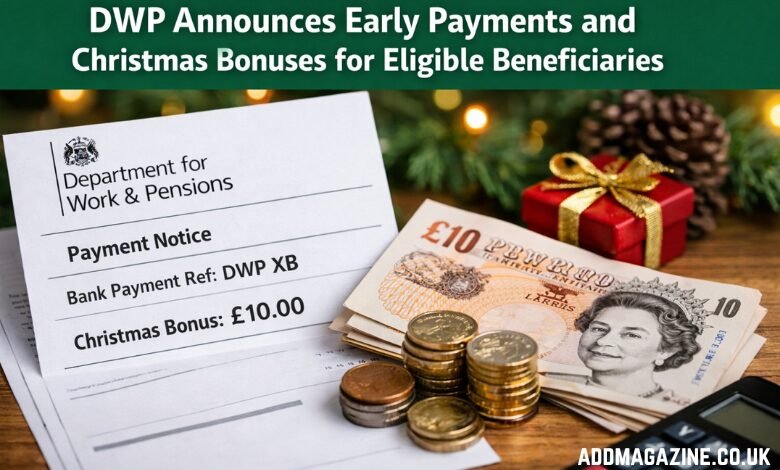
As the holiday season approaches, many individuals rely on additional financial support to cover their living expenses. The Department for Work and Pensions (DWP) has recognized this need and, as part of its annual support for low-income families and individuals, has announced early payments and Christmas bonuses for eligible benefit claimants. This measure, which affects thousands of people across the United Kingdom, provides a welcome boost during the festive period. In this article, we will explore the details of the DWP’s early payments and Christmas bonus, who is eligible, and what this means for claimants.
What is the DWP Christmas Bonus?
The Christmas bonus is an annual, one-off tax-free payment made by the DWP before Christmas. It is meant to help recipients of certain qualifying benefits with their expenses during the festive period. While the amount of the bonus has remained the same since 1972, at £10, it provides essential support to those in need. The bonus is paid automatically to individuals who meet the eligibility criteria, without requiring them to make any claims.
The bonus is generally paid in the first full week of December, with most recipients seeing the money deposited into their bank accounts under the reference ‘XB’ or ‘DWP XB’. In recent years, there has been significant discussion about whether the bonus should be increased to reflect inflation and the growing cost of living, but no changes to the £10 amount have been made.
Eligibility for the Christmas Bonus
To be eligible for the Christmas bonus, claimants must meet specific criteria, including receiving certain qualifying benefits during the first week of December. These benefits include:
- Carer’s Allowance
- Personal Independence Payment (PIP)
- Pension Credit (guarantee element)
- Disability Living Allowance (DLA)
- Employment and Support Allowance (ESA)
- Attendance Allowance
- Armed Forces Independence Payment
- Severe Disablement Allowance
- State Pension
- War Widow’s Pension
The government stipulates that claimants must also be “ordinarily resident” in the UK, the Channel Islands, the Isle of Man, or Gibraltar. This means that individuals living abroad or in certain overseas territories are not eligible for the bonus.
Additionally, if a couple is eligible for the Christmas bonus, both partners must be receiving one of the qualifying benefits. For example, if both members of a couple are claiming benefits such as Pension Credit, they would both be entitled to the £10 Christmas bonus. This makes the bonus an important support measure for families and individuals with multiple eligible claimants.
How the Payment is Made
The £10 Christmas bonus is made automatically to those who qualify, meaning there is no need for claimants to apply for the payment. The bonus is typically paid by the DWP in early December, with the payments arriving directly into recipients’ bank accounts. In most cases, the reference used for the payment will be ‘XB’ or ‘DWP XB’, allowing claimants to easily identify it as the Christmas bonus.
For those who are receiving benefits such as Carer’s Allowance or Personal Independence Payment, the payment will arrive in time for the holidays. The bonus is a simple, straightforward benefit that does not require any action from the recipient, making it an efficient and stress-free way to provide financial relief during the holiday season.
Early Payments for Christmas and New Year
In addition to the Christmas bonus, the DWP has also made provisions for early payments to accommodate the holiday season. For claimants who are due to receive their regular benefit payments around Christmas, such as those falling on Christmas Day (December 25) or Boxing Day (December 26), the DWP has announced that these payments will be made early, on Christmas Eve (December 24), to ensure recipients have their funds in time for the holidays.
This early payment schedule applies to a variety of DWP benefits, including Universal Credit, Jobseeker’s Allowance (JSA), and Employment and Support Allowance (ESA). The goal of these early payments is to avoid delays caused by the Christmas and New Year holidays, when many financial institutions are closed, and to ensure that claimants do not face unnecessary disruptions to their income during an important time of year.
Key Dates to Remember
As part of its holiday adjustments, the DWP also issues key dates for benefit recipients to keep track of. Claimants are urged to be aware of these changes in payment dates to avoid confusion and ensure they receive their benefits on time. For example, this year, most DWP payments due on Christmas Day or Boxing Day will be made on Christmas Eve.
It is important to note that these dates may change slightly each year, so claimants are advised to check official government guidance or the DWP website for confirmation of exact payment dates. These early payments help ensure that individuals and families can plan for the holiday season with greater certainty, reducing financial stress during a time when many people face extra expenses.
Why Is the Christmas Bonus Still £10?
While the Christmas bonus has been a long-standing tradition, there has been increasing pressure on the government to raise the £10 payment, particularly in light of inflation and the rising cost of living. The £10 amount has remained unchanged since it was first introduced in 1972, which means its value has diminished significantly over time. Today, £10 would be worth the equivalent of more than £100 in 1972 terms, making it a much less substantial amount for claimants.
Advocates for increasing the bonus argue that the fixed amount no longer provides adequate financial support, especially for the most vulnerable members of society. As living costs continue to rise, the £10 Christmas bonus does little to alleviate the financial strain many households face during the festive season.
However, despite calls for an increase, the government has not yet made any moves to adjust the bonus. Some have suggested that the bonus should be reviewed in future budgets, while others believe it could be integrated into broader reforms of the welfare system to ensure that support for those in need is more effective and reflective of modern-day costs.
The Need for Broader Welfare Reform
The Christmas bonus is a small but significant part of the UK welfare system, providing essential support for those who need it most. However, it is clear that broader welfare reform is needed to address the financial challenges faced by low-income families and individuals, particularly as the cost of living continues to rise.
In recent years, there has been growing recognition of the need for a more comprehensive approach to social welfare, one that takes into account the realities of modern life. While the Christmas bonus serves as a useful temporary solution, it is unlikely to be sufficient in the long term to address the systemic challenges faced by many people on benefits.
Conclusion
The DWP’s announcement of early payments and Christmas bonuses for eligible beneficiaries provides an important financial boost during the holiday season. While the £10 Christmas bonus remains unchanged, it is still a welcome source of relief for many, especially during a time when financial pressures are heightened. With early payments and key date adjustments, the DWP is helping claimants navigate the challenges of the holiday season with greater certainty and ease.
However, as the cost of living continues to rise, there is an ongoing call for the government to reconsider the amount of the Christmas bonus and explore broader welfare reforms. The goal should be to provide more substantial support to those who are most in need, ensuring that benefits keep pace with the realities of today’s economic landscape.
For now, claimants can rest assured that they will receive their early payments and Christmas bonuses in time for the holiday season, providing a small but meaningful source of support during the festive period.