
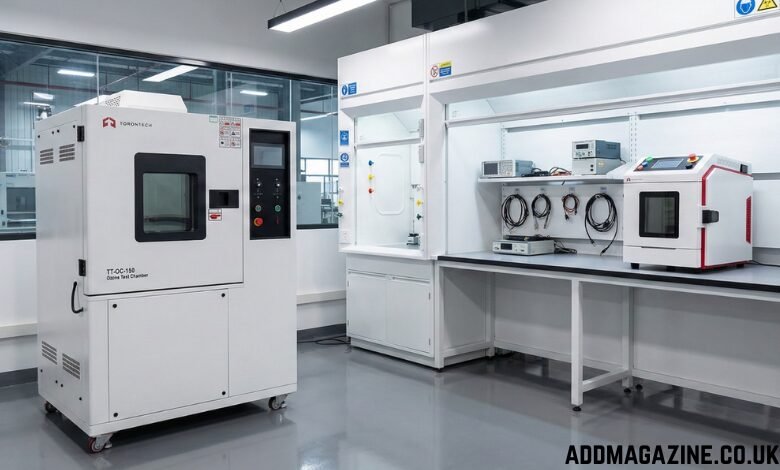
Selecting the right environmental chamber is a critical investment that determines the validity of your reliability testing. An environmental test chamber is a controlled enclosure designed to simulate various climatic conditions—such as extreme temperatures, humidity, and altitude—to evaluate how products behave under environmental stress. Without the correct specifications, you risk inaccurate data, failed compliance audits, and unforeseen product failures in the field.
This environmental chamber selection guide provides a structured checklist to help you navigate technical specifications and ensure your equipment meets your specific testing goals.
Define Your Test Goals and Use Cases Before Choosing an Environmental Chamber
Before looking at hardware, identify the purpose of your testing. Are you performing Environmental Stress Screening (ESS) to catch early manufacturing defects, or is your goal accelerated aging to predict product lifespan?
Your specific application will dictate the type of chamber required:
- Reliability Testing: Long-term exposure to steady-state conditions.
- Accelerated Weathering: Simulating UV, moisture, and heat to see how materials degrade.
- Thermal Shock: Moving a product rapidly between extreme temperatures to test structural integrity.
- Ingress Protection (IPX) Testing: Specifically for checking water and dust resistance.
Temperature, Humidity, and Ramp Rate Requirements That Drive Chamber Selection
The core of any thermal test chamber is its ability to reach and maintain specific thermal conditions. However, the extremes are not the only factors to consider; how fast the chamber reaches those levels is equally vital.
- Temperature Range: Define your absolute minimum and maximum requirements (e.g., -70°C to +180°C).
- Humidity Control: Most climatic test chamber models offer a range of 10% to 95% RH. Consider if you need low-humidity kits for specialized electronics testing.
- Ramp Rate: This is the speed of temperature change (e.g., 5°C/min). A rapid temperature change chamber is necessary if your test standards require high-speed transitions to stress the material.
- Dwell Time: Ensure the controller can handle precise timing for how long a product stays at a specific temperature.
Chamber Volume, Payload, and Airflow Uniformity Considerations
Size matters, but bigger isn’t always better. You must balance the physical dimensions of your product with the need for temperature uniformity.
- Interior Volume: Allow for at least 25% to 30% of free space around your “payload” to ensure proper airflow.
- Payload Composition: High-mass products (like large batteries or engine parts) act as heat sinks, which will slow down the chamber’s ramp rate.
- Airflow Direction: Vertical or horizontal airflow should be chosen based on how your products are oriented on the shelves to prevent “dead spots.”
- Reach-in vs. Walk-in: For oversized components or high-volume batches, a walk-in environmental chamber may be more efficient than multiple smaller units.
Control Accuracy, Sensors, and Data Logging for Repeatable Results
A chamber is only as good as its controller. For stability and repeatable results, the precision of the sensors and the software’s ability to log data are paramount.
- Sensor Type: High-quality units use RTD or thermocouple sensors with high sensor accuracy to prevent thermal overshoot.
- Data Logging and Audit Trail: Modern standards require a digital record of every test. Ensure the system provides a secure audit trail for compliance with internal and external quality audits.
- Calibration: Choose a manufacturer that provides easy access for periodic calibration to keep the unit within its rated tolerance.
Safety, Facilities, and Standards Compliance Requirements
Your environmental test chamber must comply with international testing protocols to be recognized by regulatory bodies. Depending on your industry (aerospace, automotive, or energy), look for systems capable of meeting:
- Standard Protocols: Including IEC 60068, MIL-STD-810, ASTM D5032, and SAE J2527.
- Safety Features: If testing volatile components like lithium-ion batteries, an explosion-proof test chamber with spark-resistant parts and pressure relief vents is mandatory.
- Facility Requirements: Verify the power supply (voltage/amps), water source for humidity, and drainage. For an altitude test chamber, ensure your facility can support the necessary vacuum pump exhaust.
- Certifications: Ensure the equipment meets CSA and UL requirements for electrical safety.
Why Torontech Is the Best Choice for Environmental Chamber Solutions
When precision and reliability are non-negotiable, Torontech is the partner of choice for leading labs and manufacturers. We understand that every degree and every percentage of humidity counts toward the success of your product launch.
Our range of environmental chamber solutions—from compact benchtop units to specialized thermal shock chamber systems—is built to exceed industry standards. With Torontech, you get more than just hardware; you get expert guidance, superior temperature uniformity, and the peace of mind that your data is accurate every time.