
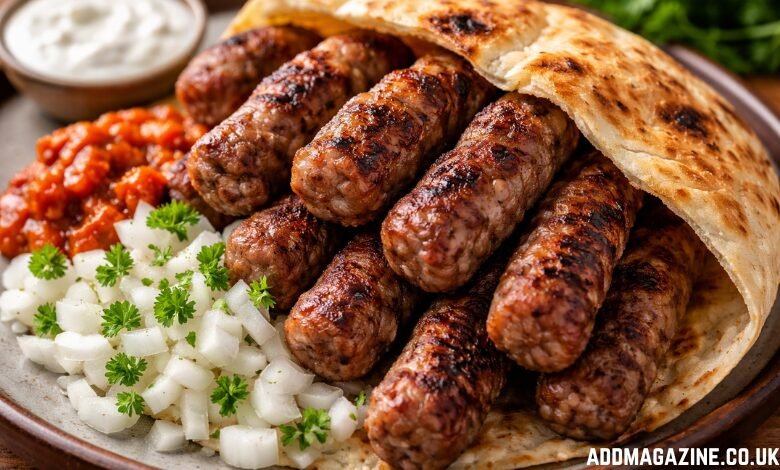
Levapioli is a grilled meat dish linked closely with Balkan food culture. At its core, it is made from minced meat, basic seasoning, careful shaping, and direct heat. That sounds simple, but the dish carries a lot more than its ingredient list suggests. In many parts of the Balkans, food is tied to hospitality, routine, local identity, and the way families gather. Levapioli fits naturally into all of that.
The dish is usually prepared from beef, lamb, or a blend of meats, formed into small sausage-like pieces and cooked over charcoal or another strong heat source. It is often served with flatbread, raw onions, pepper-based spreads, and dairy-based accompaniments. Its appeal comes from balance rather than complexity. The meat is seasoned enough to be distinctive, but not so much that the character of the meat disappears. The bread softens the meal, onions add bite, and sauces bring contrast.
Levapioli also tells a larger story about the Balkans. It reflects a region where grilling has long been part of everyday cooking, where recipes travel across borders, and where small differences in preparation matter to local pride. One town may insist on a certain meat ratio, another on a certain texture, and another on a certain way of serving it. These details are part of what has kept the dish relevant for generations.
As Balkan food has become more visible outside its home region, levapioli has gained wider attention. It appears in family restaurants, street stalls, food festivals, and global menus that focus on grilled meat traditions. Its rise is not based on novelty. It is based on consistency, strong flavor, and the fact that it delivers a complete eating experience without needing unnecessary additions.
This article looks at levapioli from several angles: its historical background, its place in Balkan society, the ingredients and cooking methods that define it, the ways it changes from one place to another, and the reasons it continues to find new audiences beyond its place of origin.
A Dish Shaped by Regional History
The Balkan Background
To understand levapioli, it helps to place it within the larger food history of the Balkans. The region has long been a meeting point of empires, trade routes, migrations, and local traditions. As a result, Balkan cuisine is not built from one influence alone. It has absorbed elements from Slavic, Ottoman, Mediterranean, Central European, and local rural foodways. Levapioli belongs to that mixed history.
Early Grilling Traditions
The method at the heart of the dish—grilling minced or shaped meat over open heat—is old. It emerged from practical cooking conditions. It allowed people to cook meat fast in open spaces and serve it without much difficulty. In communities where fire-based cooking was central to daily life, grilling was efficient and social at the same time. It allowed families to prepare food without elaborate equipment and created a setting where people naturally gathered around the cooking process.
Ottoman Influence on the Dish
Ottoman influence is often part of the discussion when speaking about Balkan grilled meat dishes. Over long periods of Ottoman rule in parts of the Balkans, spice usage, meat preparation methods, and urban food-selling traditions became more widespread. This does not mean levapioli came from one single source or one exact moment in history. Rather, it developed through overlap. Local communities adapted outside influences to local tastes, ingredients, and customs.
From Home Cooking to Street Food
As towns and trading centers grew, grilled meat dishes became well suited to public food culture. They were affordable, filling, and quick to serve. That helped dishes like levapioli move beyond the household and into markets, roadside stops, and urban eateries. Over time, the food became familiar across class lines. It could be part of a regular meal, a festive gathering, or a quick street-food stop.
Why Levapioli Endured
This combination of home tradition and public food culture gave levapioli staying power. It never belonged only to formal dining, and it never depended on luxury ingredients. It survived because it fit real life.
Why levapioli matters in Balkan culture
In many Balkan communities, food is not treated as a side detail of social life. It is one of the main ways social life happens. Levapioli belongs to that setting. It is often served in contexts where people gather for reasons beyond eating: family visits, religious holidays, local celebrations, weekend outings, weddings, and casual meals with friends.
Part of its importance comes from what it represents. Offering grilled meat to guests is often associated with effort, generosity, and welcome. It signals that the host is not serving something accidental or rushed. Even when the dish is simple, preparing it still involves planning, handling the meat correctly, managing the fire, and serving it at the right moment.
The dish also reflects continuity. In many families, the method of making it is learned informally rather than from written recipes. Someone watches a parent or grandparent season the meat, judge the consistency by hand, and shape each portion by feel. Those details are passed along through repetition. That is one reason recipes vary even within the same town. Technique is often personal.
Levapioli also carries regional pride. People in different Balkan countries and cities may argue over what counts as the best version, what bread should accompany it, how finely the meat should be ground, or whether certain additions improve or weaken authenticity. These debates are not trivial. They show that the dish matters enough to be defended.
The ingredients that define the dish
One reason levapioli remains popular is that its ingredient list is direct. It does not require a long inventory. But every element matters, and small choices can change the result significantly.
The main ingredient is minced meat. Beef is common, lamb is also traditional in some versions, and mixed meats are frequently used to shape the final taste and texture. In some places, pork may be included, depending on local custom and the preferences of the cook. The amount of fat is just as important as the type of meat used. If the mixture is too lean, the finished pieces may turn dry and firm. A proper level of fat helps create moisture and improves the way the meat responds to direct heat.
Salt is essential, not only for seasoning but also because it helps develop the structure of the mixture when worked into the meat. Garlic is common, though the amount varies. Paprika may add mild depth and color. Black pepper is often used sparingly to support the meat rather than dominate it. Some cooks add finely grated onion or very small amounts of baking soda, sparkling water, or oil to influence tenderness, though these choices differ widely by region and household.
The important point is that levapioli is not meant to be overloaded with flavorings. Its character comes from restraint. The seasoning should support the meat, the smoke, and the texture. Adding excessive herbs or seasoning can take levapioli away from the simple character that defines it.
Texture, shaping, and preparation
Texture is one of the most important parts of good levapioli. The meat should be fine enough to hold together smoothly, but not so processed that it becomes pasty. Grinding method, mixing time, and resting time all affect the outcome.
After grinding, the meat is combined with salt and seasoning until evenly mixed. Some cooks insist on letting the mixture rest for several hours or overnight. This allows the seasoning to distribute fully and can improve the way the meat binds. In practical terms, resting also gives the mixture a firmer consistency, which makes shaping easier.
Shaping is usually done by hand. The meat is formed into small cylinders, generally uniform in thickness so that everything cooks at the same speed. Consistency matters more than exact size. If some pieces are much thicker than others, the thinner ones will dry out before the larger ones finish cooking.
This part of the process often distinguishes an average result from a strong one. Well-made levapioli shows care in its preparation long before the cooking starts.
The role of fire and smoke
Levapioli is closely tied to grilling. While it can be cooked in other ways, the traditional and most valued method is charcoal or open-flame grilling. That method creates three things difficult to reproduce elsewhere: smoke, surface browning, and a quick cooking environment that seals in juices when handled properly.
The grill must be hot enough to brown the outside without forcing a long cooking time. If the heat is too low, the meat sits too long, sheds moisture, and loses the texture that makes the dish appealing. If the heat is too aggressive, the outside chars before the inside cooks properly. Managing that balance is a skill.
Charcoal remains preferred because it adds a clean smoke character that becomes part of the identity of the dish. That smoky note is not just a background detail. It is one of the first things people notice when levapioli arrives at the table.
Pan-frying is sometimes used in home kitchens, especially where outdoor grilling is not practical. It can produce a decent result, but it changes the dish. The meat may still be flavorful, but it loses the dry heat and smoke interaction that define the traditional version.
How levapioli is usually served
Levapioli is rarely served alone. It is usually part of a broader plate or wrapped meal built around contrast.
Flatbread is one of the most common accompaniments. It gives the meat structure and makes the meal easier to eat.Freshly chopped onions bring a sharp bite that balances the heavy, meaty flavor. Ajvar, made from roasted peppers and often eggplant, contributes sweetness, depth, and another layer of smoke. Some meals include sour cream or a yogurt-based sauce, which cools the palate and softens the intensity of grilled meat and raw onion.
Salads may include tomatoes, cucumbers, cabbage, or greens. Their purpose is not decoration. They help reset the palate and keep the meal from feeling too heavy. In this format, levapioli becomes more than a meat dish. It becomes a balanced plate built around temperature, texture, acidity, and fat.
Regional variation without losing identity
Although levapioli is rooted in Balkan grilling culture, it does not exist in only one fixed form. The broader family of related dishes across Bosnia, Serbia, Croatia, and neighboring areas shows how a shared cooking tradition can still produce strong local identities.
Some versions are more finely textured, while others are slightly coarser. Some lean more heavily on beef, while others use blends. In one place, the bread may be central; in another, the sauce may define the experience. Certain areas take pride in exact serving styles or in the size and shape of the grilled pieces.
This variation is part of the dish’s strength. It allows local expression without dissolving the core idea. The core remains recognizable: shaped minced meat, grilled directly, served simply, and tied to communal eating.
Global spread and changing audiences
As Balkan communities migrated and international travel expanded, levapioli began appearing far beyond its original region. In many cities across Europe and North America, Balkan restaurants introduced grilled meat dishes to diners unfamiliar with the tradition. For some people, the first encounter came through diaspora-owned neighborhood restaurants. For others, it came through food festivals, travel, or social media.
Its international appeal is understandable. It is approachable even for people who know little about Balkan cuisine. It does not depend on unfamiliar presentation or highly specialized ingredients. Anyone who appreciates grilled meat, bread, onions, and pepper-based condiments can understand the dish immediately.
At the same time, levapioli has entered new food contexts. Some restaurants present it as traditional comfort food. Others adapt it into wraps, sliders, or mixed grill platters. Higher-end dining spaces may refine the presentation, use premium meat, or pair it with more elaborate side dishes. These changes bring new audiences, though they also raise the usual question of how far a dish can be adapted before it becomes something else.
Modern changes and home cooking
Modern food culture has changed the way many traditional dishes are produced and discussed, and levapioli is no exception. Some cooks now make lighter versions with leaner meat, while others experiment with plant-based alternatives for vegetarian diners. These adaptations may broaden access, though traditionalists often see them as separate interpretations rather than direct replacements.
There is also more attention now to sourcing. Restaurants and home cooks may choose local meat, better animal welfare standards, or smaller-scale producers. In some ways, this is consistent with the older food values behind the dish, which centered on quality ingredients and practical cooking rather than unnecessary excess.
For home cooks, levapioli remains achievable. The main requirements are good meat, controlled seasoning, enough time for mixing and resting, and access to strong heat. The dish does not ask for advanced culinary technique, but it does reward care. Poor quality meat, uneven shaping, or weak heat can flatten the final result. Done properly, however, it works just as well at home as it does in a restaurant.
Why the dish continues to last
Levapioli has lasted because it satisfies on more than one level. It works as everyday food, guest food, celebratory food, and street food. It can be casual or serious. Levapioli is grounded in strong technique but does not depend on complexity. It invites regional pride without needing rigid uniformity.
Most importantly, it remains tied to real habits of eating. People still want food that is direct, filling, and social. Levapioli provides that. It is built for sharing, for conversation, and for settings where eating is part of a larger gathering rather than an isolated act.
Conclusion
Levapioli is more than a grilled meat dish from the Balkans. It is a practical food shaped by history, a social food built for gathering, and a regional tradition that continues to travel well beyond its point of origin. Its ingredients are basic, but the result depends on balance, texture, fire control, and the experience of those preparing it.
Its continued popularity makes sense. The dish offers strong flavor without overcomplication, tradition without rigidity, and a full meal without unnecessary decoration. Whether served from a street grill, a family kitchen, or a restaurant menu abroad, levapioli continues to represent a style of cooking that values directness, skill, and shared eating.