
Electromagnetic waves surround us constantly—radio signals, WiFi, and radar beams. But what happens when these waves need to vanish? That’s where absorption technology steps in, transforming wave energy into heat through carefully engineered materials. This process powers everything from invisible military aircraft to interference-free smartphones.
How Materials Swallow Electromagnetic Waves
The moment an electromagnetic wave hits matter, a microscopic dance begins. Charged particles respond to oscillating fields, magnetic domains shift and realign, and friction builds up. All that movement? It bleeds energy away as heat.
But here’s the catch: materials can’t just absorb any wave that comes their way. They need the right “tune”—a match between their properties and the incoming radiation. Miss that match, and waves bounce right off like light from a mirror.
Why Impedance Makes or Breaks Absorption
Free space carries a natural impedance of roughly 377 ohms. For waves to actually enter absorbing electromagnetic radiation material rather than reflect away, the material’s surface impedance needs to align with this value. Think of it as opening a door—if the door frame doesn’t fit, nothing gets through.
This explains why surface engineering matters just as much as what happens inside the material. Getting past that initial boundary determines whether absorption even has a chance to occur.
The Science Behind Energy Dissipation
Materials absorb electromagnetic radiation through several clever tricks, each suited to different frequencies and applications.
Electric Field Interactions
Dielectric loss happens when electric fields force molecular dipoles to spin and reorient constantly. These dipoles can’t keep a perfect pace with rapidly changing fields, creating friction that generates heat. Material defects and boundaries add more polarization sites, boosting the effect.
Conduction loss works differently. Free electrons form tiny currents when pushed by electric fields, and these currents fight resistance as they flow. The result? More heat, more absorption. This mechanism shines across radio and microwave frequencies.
Magnetic Responses That Trap Energy
Ferromagnetic materials contain magnetic domains—small regions where atomic magnets point in the same direction. When external magnetic fields sweep through, these domains shift around. Moving them costs energy that doesn’t come back.
Key magnetic loss mechanisms include:
- Hysteresis from domain wall movement
- Resonance occurs when the wave frequency matches the domain oscillations
- Eddy currents in conductive materials
- Domain rotation in high-frequency ranges
Ferrites deserve special mention here. These ceramic compounds mix iron oxide with other metals, creating a high magnetic response without excessive conductivity. Perfect for targeted frequency absorption.
The Quarter-Wave Trick
Place a lossy layer exactly one quarter wavelength from a metal backing, and physics does something beautiful. The reflected wave returns out of phase with the incoming radiation, creating a standing wave. Electric field intensity peaks right inside the absorbing layer, supercharging the dissipation process.
This technique works brilliantly—but only at specific frequencies. Broadband absorption demands more complex solutions.
Building Better Absorbers Through Combination
Modern electromagnetic radiation absorbing material rarely relies on one component. Composites blend different materials to capture multiple loss mechanisms simultaneously.
Popular composite approaches:
- Carbon mixed with magnetic nanoparticles
- Layered structures with varying properties
- Foam architectures that reduce weight
- Gradient materials where absorption increases gradually
Carbon brings lightweight strength and excellent dielectric properties. Add iron or nickel nanoparticles, and magnetic loss joins the party. Finding the right particle concentration takes experimentation—too few wastes potential, too many creates reflection problems or structural weakness.
Metamaterials Push Beyond Natural Limits
These artificially structured materials arrange conductive patterns at scales smaller than target wavelengths. The geometry itself creates absorption, not just the bulk properties. A metamaterial absorber might be paper-thin yet match the performance of much thicker conventional designs.
Split-ring resonators and wire arrays can achieve what natural materials never could—sometimes even negative refractive indices. Manufacturing remains challenging, but advancing fabrication techniques are making complex designs more accessible.
Real-World Applications
Military Stealth Technology
Reducing radar cross-section drove early absorption research. Modern stealth aircraft coat surfaces with materials that swallow radar waves across detection frequencies. These coatings must survive extreme temperatures, weather exposure, and years of service while adding minimal weight.
Naval vessels use similar technology, making ships harder to track. The ocean environment adds corrosion resistance to the requirements list.
Protecting Electronics From Interference
Smartphones pack multiple antennas operating at different frequencies into tiny spaces. Without absorbers preventing crosstalk, these devices would malfunction constantly. Thin absorber sheets line interiors, keeping signals separated.
Data centers and server rooms also deploy absorbing materials to manage electromagnetic environments. As operating frequencies climb higher, interference becomes harder to control through shielding alone.
Communication Systems
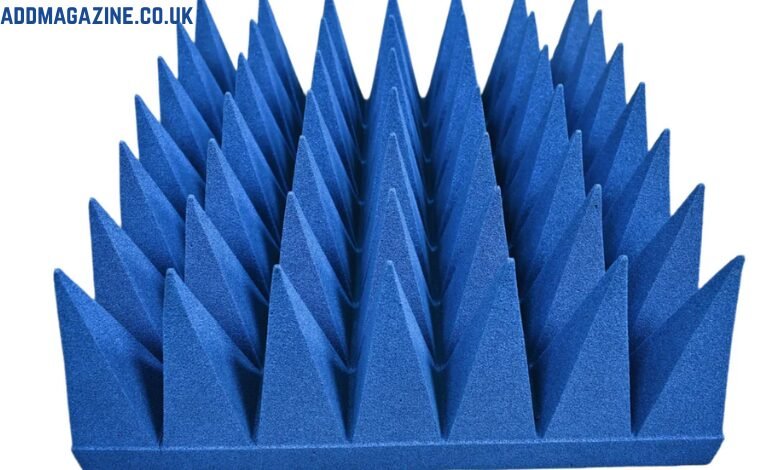
Anechoic chambers eliminate all reflections using specialized pyramid-shaped absorbers, creating perfect testing environments. Satellite systems incorporate absorbers in waveguides and antennas to prevent signal degradation.
Even buildings sometimes get absorption treatments. Lining interiors with materials absorbing electromagnetic radiation helps control wireless signal propagation, reducing interference between floors or rooms.
Medical Equipment Shielding
MRI machines generate intense magnetic fields and radio pulses that need containment. Absorbers help keep these fields inside treatment rooms while protecting nearby equipment from interference. Medical applications demand exceptional reliability—failure could compromise diagnostics or patient safety.
X-ray facilities combine particle shielding with electromagnetic absorbers across various frequencies. Protecting both patients and operators requires materials that meet strict safety standards.
What’s Coming Next
Research pushes toward materials that handle extreme temperatures above 500°C, enabling aerospace applications. Others explore electrically switchable absorbers that turn on or off as needed, or materials that adapt their properties automatically.
Sustainability drives interest in abundant, non-toxic ingredients rather than rare earth elements. Some researchers even look to biological sources for inspiration—nature might have solved electromagnetic problems in ways engineers haven’t considered.
The field of absorbing electromagnetic radiation stays dynamic because demand keeps growing. Higher frequency wireless technology, stricter compatibility requirements, and new applications constantly create fresh challenges. Whether the next breakthrough comes from nanomaterials, computational design, or somewhere unexpected, one thing seems certain: the materials that make electromagnetic waves disappear will remain central to technological progress for years ahead.