You bought a 4x4m shade sail from the hardware store.
Measured your space. Seemed like it would fit.
Now it’s up and there’s a 2-metre gap on one side. The other corner doesn’t quite reach. Your car’s boot sits in full sun half the day.
You wasted $400 on something that doesn’t actually cover what you needed covered.
Custom shade sails fix this by being made for your exact space, not generic dimensions.
Why Standard Sizes Never Fit Properly
Your property isn’t a perfect rectangle.
Existing posts aren’t evenly spaced. Buildings create odd angles. Trees are in inconvenient spots.
Standard sails come in 3x3m, 4x4m, 5x5m sizes. Your space is 3.8 x 4.6m.
You either buy too small and leave gaps, or too big and it doesn’t tension properly.
Neither works.
Custom manufacturing means the sail fits your actual space. Every measurement precise. Coverage where you need it.
No compromises. No gaps. No wasted money on ill-fitting products.
Car Protection Requires Specific Design
Cars aren’t square shapes sitting in square spaces.
A standard triangular sail might cover the cabin but leave the boot exposed. Or shade the front but not the rear.
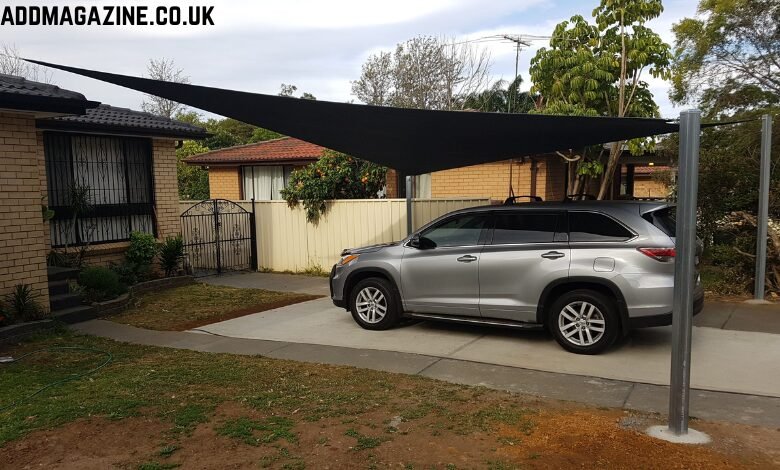
Shade sail carport designs account for vehicle dimensions and parking position.
Full coverage from bumper to bumper. Sides protected from low-angle morning and afternoon sun.
Custom shapes work around driveways, paths, and landscaping without requiring you to dig up pavers or move gardens.
Your property layout determines the design instead of forcing your property to suit a standard product.
Mounting Points Designed Around Existing Structures
You’ve got a house wall, a boundary fence, and maybe one existing post.
Standard sails need four corners in perfect positions. Yours aren’t.
Custom design works with what you’ve got. Attaches to house at the right height. Uses fence where it makes sense. Adds posts only where necessary.
Saves money on unnecessary posts. Reduces concrete work. Minimises disruption to existing landscaping.
Professional design makes your existing structures work instead of requiring expensive new mounting points.
Fabric Selection for Tasmanian Conditions
Hardware store sails use lightweight domestic fabric.
Fine for Melbourne suburbs. Rubbish for Tasmanian coastal wind.
Custom installations specify commercial-grade fabric. 330gsm minimum. UV stabilised for Southern Hemisphere conditions.
Colour choice affects performance. Light tones reflect heat better. Darker colours provide better glare control.
Your exposure determines optimal fabric. Western-facing areas need different specs than southern positions.
Custom lets you optimise for your specific conditions instead of taking whatever’s in stock.
Wind Engineering That Actually Works
Standard sails list wind ratings that assume perfect conditions.
Your exposed coastal block isn’t perfect conditions.
Custom design includes site-specific wind engineering. Accounts for your elevation, exposure, nearby structures creating turbulence.
Hyperbolic curves shed wind properly. Tensioning prevents flapping and wear. Fixings are rated for actual loads, not theoretical ones.
Installation survives Tasmanian storms instead of ripping loose in the first decent blow.
Multiple Vehicles Need Different Approach
Two cars don’t fit under one standard sail unless you waste massive amounts of coverage area.
Custom designs create efficient coverage for multiple vehicles.
Separate sails with strategic positioning. Overlapping coverage zones. Shared mounting posts to reduce cost.
You’re covering cars efficiently instead of shading 40% driveway and leaving vehicles partially exposed.
Better coverage for the same or less money than trying to make standard products work.
Integration with Existing Outdoor Areas
Your driveway connects to outdoor entertaining areas.
Why not extend shade coverage across both zones?
Custom design integrates car protection with patio coverage. Cohesive aesthetic. Unified coverage zones.
Looks planned and professional instead of random sails scattered around the property.
Single design project creates comprehensive outdoor shade instead of piecemeal additions over years.
Long-Term Cost Reality
Standard sail: $400. Lasts two years. You buy three over six years. Total cost: $1,200 plus installation time three times.
Custom sail: $2,500. Lasts 12-15 years. Total cost: $2,500 plus one installation.
Cost per year: standard is $200. Custom is $170-210.
Plus custom actually covers what you need. Standard leaves gaps you live with or spend more trying to fill.
The maths favours custom despite higher upfront price.
When Standard Makes Sense
Small simple spaces with convenient mounting points.
Temporary shade for rentals you won’t live in long-term.
Very tight budgets where upfront cost matters more than longevity.
Situations where coverage doesn’t need to be perfect.
These are rare but they exist. Most residential applications benefit from custom design.
The Simple Truth
Your space isn’t standard. Your car isn’t a standard shape. Your existing structures aren’t in standard positions.
Custom shade sails work with your reality instead of forcing you to work around standard product limitations.
Higher upfront cost. Better coverage. Longer lifespan. Lower cost per year.
For permanent installations protecting expensive assets like vehicles or creating genuinely usable outdoor areas, custom makes financial sense.
Standard products work if you’re lucky with dimensions. Custom works because it’s designed to work.