Three months ago, a coffee shop at 11 PM became the setting for a creative crisis. A laptop screen displayed 63 rejected AI-generated images. The deadline loomed—a client’s skincare launch needed product visuals by morning. Six hours of continuous image generation had depleted a Midjourney subscription, exhausted DALL-E credits, and triggered panic purchases from two additional platforms.
Nothing worked.
The images weren’t terrible—they were simply wrong. Close enough to frustrate, far enough to be unusable. Bottles appeared plastic instead of glass. Lighting felt artificial when organic was needed. Compositions screamed “AI-generated” instead of “professional photography.”
The solution? Emergency stock photos purchased at 2 AM for $89, delivering something safe but uninspired. The client accepted it, but the feeling of being a fraud lingered. The real question remained unanswered: what went wrong?
The problem wasn’t creativity or AI capability. It was something more fundamental: speaking English to a system that thinks in architecture.
Tools like Nano Banana Prompts existed to bridge this translation gap, but remained undiscovered.
The Hidden Costs of Trial and Error
The subscription fees represent just the beginning of AI image generation expenses. Here’s the six-month reality:
Wasted Generation Credits: Approximately 850 failed generations at $0.25-0.40 each cost $247.
Redundant Subscriptions: Maintaining three platforms simultaneously hoping one would work added $180.
Lost Billable Hours: Over 40 hours fighting with prompts instead of client work at $75/hour meant $3,000+ in opportunity cost.
Emergency Stock Purchases: Last-minute panic buying when AI failed totaled $340.
Damaged Reputation: Two delayed projects created incalculable professional impact.
The financial waste hurt. The confidence erosion hurt more. Questions arose about whether mastering AI image generation was even possible.
The Turning Point
A designer in an online community shared a comparison post. Same concept, dramatically different results. The caption: “Left: original prompt. Right: after Nano Banana Prompts. Same AI, same concept, 10x better output.”
Skepticism was natural—previous prompt “enhancers” had simply added flowery adjectives and worsened results. But the before/after comparison was undeniable. Testing it with the exact project that cost $89 in emergency stock photos seemed worth trying.
Original Failed Prompt:
“Luxury skincare serum bottle on marble surface with botanical elements, professional product photography, soft natural light, elegant and minimal”
Forty-five minutes went into crafting that prompt. It seemed detailed. The AI generated 11 variations, none usable.
After Nano Banana Prompts Processing:
The tool restructured the concept into layered specifications: frosted glass bottle with specific dimensions, honed Carrara marble with subtle veining, precise botanical elements (monstera leaf with water droplets, eucalyptus sprigs), style anchors (editorial product photography, Kinfolk aesthetic).
First generation: usable. Second generation: client-ready.
The calculation was simple: knowing about this tool three months earlier would have saved roughly $250 in wasted credits, avoided the emergency stock photo purchase, and delivered superior work faster.
Architecture vs. Description
The initial misunderstanding was thinking effective AI prompts meant adding more adjectives. “Soft light” becomes “very soft, gentle, diffused light.” More words equals better results, right?
Completely wrong.
Successful prompts aren’t longer descriptions—they’re structured specifications organized hierarchically. Consider ordering custom furniture. Nobody tells a craftsman “make a nice table, kind of modern, with good wood.” Instead, provide dimensions, material specifications, construction details, style references, and functional requirements.
AI image generators need identical structural specificity.
The Seven-Layer Framework
Reverse-engineering dozens of Nano Banana-generated prompts revealed a consistent seven-layer structure:
Layer 1 – Subject Core: Physical characteristics, materials, dimensions, key features
Layer 2 – Environmental Context: Setting details, surfaces, background elements, spatial relationships
Layer 3 – Lighting Architecture: Source, direction, quality, color temperature, shadow characteristics
Layer 4 – Compositional Geometry: Framing, aspect ratio, focal points, depth of field, perspective
Layer 5 – Style Anchoring: Genre references, aesthetic movements, specific visual languages
Layer 6 – Technical Parameters: Camera/lens equivalents, rendering quality, texture detail levels
Layer 7 – Exclusions: Explicit “do not include” specifications preventing common AI mistakes
Most amateur prompts cover 2-3 layers. Nano Banana Prompts consistently addresses all seven. That’s not just “more detailed”—it’s structurally complete.
The Banana Prompts Library Education
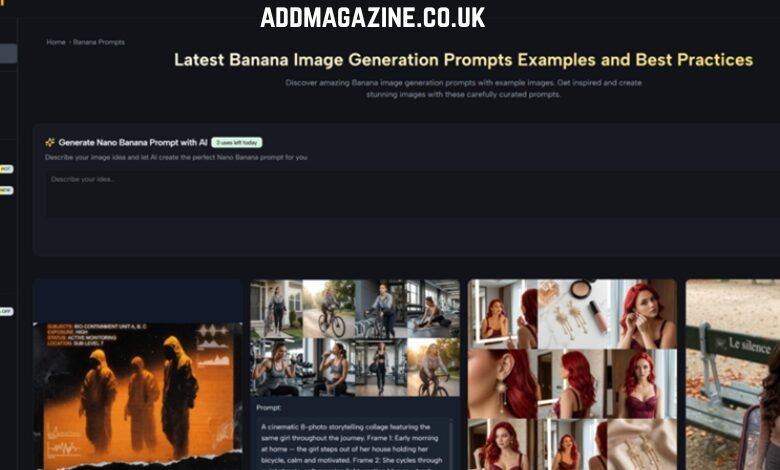
The Nano Banana Prompts generator converts descriptions into structured prompts. But the Banana Prompts library became an unexpected graduate school through curated examples of successful prompts with resulting images.
The learning process involved studying one example daily for 20-30 minutes:
- Examine the final image without reading the prompt
- Write what the prompt should be
- Compare versions to the actual prompt
- Identify missing elements
- Test both prompts and observe differences
This exercise revealed consistent gaps—amateur prompts typically missed 40-50% of specifications that made examples work.
Key Pattern Recognition
After studying 30+ library examples, transformative patterns emerged:
Texture Specifications Are Critical: Every high-quality example explicitly describes textures—fabric weave, skin pores, surface roughness, material reflectivity. Omitting these creates flat, artificial images.
Lighting Requires Three-Dimensional Thinking: Successful prompts specify source location, light quality, color temperature, subject interaction, and shadow characteristics rather than simply “good lighting.”
Negative Prompts Matter Equally: Top examples spend equal effort specifying exclusions. “No plastic smoothing, no artificial studio background, no oversaturation” prevents common AI mistakes.
Style Anchors Need Specificity: “Professional” means nothing. “Editorial product photography in Kinfolk magazine style—natural light, muted colors, organic compositions” provides coherent aesthetic framework.
The Transformation Timeline
Week One: Complete dependency on Nano Banana Prompts as a magic button. Results improved dramatically, but learning was minimal—just outsourcing.
Week Two: Analysis began on why generated prompts worked. Modifications and testing deepened understanding, though workflow slowed.
Week Three: Pattern internalization allowed creating effective prompts independently, using Nano Banana Prompts for refinement rather than complete generation.
The investment paid off. Current AI image generation success rate exceeds 80% on first or second attempts. Credit waste dropped to nearly zero. Client work quality improved measurably.
The $347 lesson was expensive but valuable: AI image generation isn’t about creative vision alone—it’s about learning the architectural language these systems understand. Tools like Nano Banana Prompts don’t replace skill; they accelerate the learning curve from months to weeks.