For food retail businesses, packaging is the difference between hot meals turning into soggy in transit or sauces leaking during delivery. People now prioritise disposable food containers, and businesses need to adopt this change because43% of buyers prioritise environmental effects while making purchases.
There are different types of disposable food containers, but how do you find the right one for your business? The biodegradable food containers can easily break down, but this also means some of them may not be strong enough to handle hot, oily, or liquid food for long.
So, how do you find the right disposable containers for your operations? This blog will help you in making this important decision.
What is Disposable Food Packaging?
Disposable food packaging refers to food packaging used for one-time use. It includes a range of materials, like plastic, paper, and aluminium, and after use, it can be discarded.
These packaging supplies help with food storage, transportation, and sales, in addition to shielding it from contamination or damage from outside sources.
Disposable containers have gained popularity in food packaging due to their portability and ease of use. In the food industry, these containers are frequently used for catering events, meal preparation, and takeout orders. Selecting the appropriate disposable food container is crucial for preserving the food’s freshness and quality, as well as making sure it is portable.
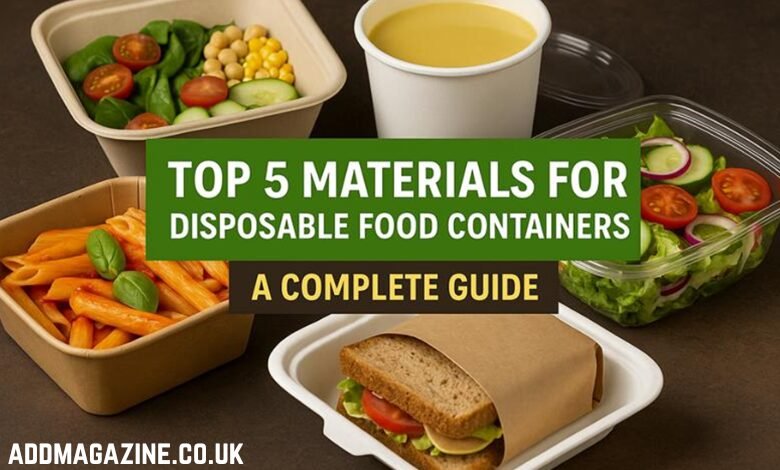
Top Five Choices to Consider for Disposable Food Containers
While reducing waste, eco-friendly food packaging supplies promote a circular economy using recyclable, compostable, and renewable resources. There are many materials that can satisfy food safety regulations and sustainability objectives, ranging from robust and reusable options to biodegradable solutions. We’ll look at a few environmentally friendly packaging options below, each of which has some advantages for food items.
1. Plastic Container
Plastic is one of the cost-effective and efficiency disposable packaging options. It is lightweight, durable, and capable of holding different types of foods without losing shape. However, it is important to understand that not all plastic grades are suitable for hot, oily, or acidic food. Some plastics can warp under high heat, release harmful chemicals when microwaved, or retain strong food odours.
Plastic grades, like PET, PP, HDPE, and PS, are suitable for holding different hot and cold foods. These Plastic containers provide strong sealing options, so they are suitable for deliveries where spills and temperature retention matter.
Pros
- Highly durable, non-leaking, and suitable for a wide range of foods, including liquids.
- Cost-effective for large-scale operations
- Versatile design options, like compartments and temperature-evident lids.
Cons
- Limited recyclability
- Not all variants are safe for microwaving or storing very hot food.
2. Bagasse Food Container
A Bagasse food container is used in diverse settings, such as animal feed and for takeouts at fast food joints. Since it is extracted from sugarcane, Bagasse is a long-lasting substance that is safe to microwave and resistant to both water and oil.
It is mostly used as a non-plastic alternative for disposable dinnerware and food storage. Bagasse is completely disposable, so there’s no reason to worry about any negative effects it might have on the environment.
Although bagasse can be composted at home, it breaks down in industrial composting facilities faster. It only takes 60 days.
Pros:
- Completely renewable and environmentally friendly, made from sugarcane waste.
- It doesn’t leak and is safe for hot, cold, and greasy foods.
- Freezer and microwavable food containers for excellent convenience.
Cons:
- More expensive than alternatives made of plastic.
- It can become weak after eating a lot of moist food.
- Restricted options for color and design.
3. Cardboard and Paper Containers
Many businesses see paper and cardboard as easy ways to meet their plastic reduction targets. Packaging made of cardboard and paper, such as the BePulp containers and Kraft delis, is recyclable, biodegradable, and made from renewable resources. Because these cardboard takeaway boxes are inexpensive and lightweight, they are often used in food packing.
Pros:
- Recyclable and environmentally friendly, lowering the use of plastic.
- Lightweight and portable.
- It is easily customizable with designs or branding.
- Most dry and semi-wet meals are safe.
- Gives a natural, high-end appearance.
Cons:
- Unsuitable for uncoated liquid or oily foods.
- It can become damp if exposed to moisture for an extended period of time.
- Reuse is limited in comparison to plastic.
- Requires the cutting down of trees if recycled paper isn’t used.
4. Aluminum and Tin
Choices like aluminium food containers are practical and safe for serving hot foods and grilled meats. They are completely recyclable and suitable for ovens. Businesses can switch to foil-lined versions to keep the food warmer for longer. You can even use them for high-end catering events. Although they are more expensive, they lessen customer complaints about cold food.
Pros:
- Excellent heat retention and ideal for baking.
- Durable and completely recyclable.
- Keeps food fresh and shielded from the air and light.
- Robust and long-lasting.
- Both hot and cold foods can use it.
Cons:
- More costly than plastic or paper.
- It can become hot to the touch after heating.
- Not safe to use in a microwave.
- The energy cost of production is substantial.
5. Biodegradable and Compostable Materials
Many biodegradable bowls and plates, such as Ingeo Soup containers, are perfect for use on outings or when traveling. These products include things like recycled paper, bamboo, or palm leaves, which provide a sustainable packaging alternative to products made of plastic or foam. It is sturdy, appealing, and biodegradable, qualities required in a world where consumers care about sustainability.
Pros:
- Safer for health because food doesn’t contain any dangerous chemicals.
- Disposal without guilt, knowing that it won’t damage the environment.
- Attracts like-minded clients by demonstrating eco-conscious ideals.
Cons:
- Costlier than substitutes made of plastic.
- There are particular circumstances in order to break down effectively.
- Heavy-use packaging has limited availability and durability.
Choose Sturdy, Innovative, and Greener Packaging Options Today
Disposable food packaging provides added convenience to people’s lives in an increasingly fast-paced lifestyle. In the catering industry, using disposable food packaging results in fewer customers and lower costs. Cleaning up the table is easy and doesn’t require hiring someone to wash the dishes; everything is just placed in the trash after usage. How quick and easy!
However, it takes consideration to select the appropriate disposable food containers. It’s crucial to understand their composition, effects, and application. Therefore, selecting the best disposable packaging is a smart commercial decision as well as an environmental obligation. Discover our selection of packaging alternatives at Food Packaging Direct, including sustainable solutions catered to your food product demands, custom packaging, and labeling services.