Chess competitions vary not only in name (championship, cup, open, etc.), but also in the way that the organizers decide which pairs will play against each other, how many games each participant plays, what time control is used, and how the final ranking is calculated. These parameters are defined in the regulations, and for over-the-board play, the basic framework is defined in the FIDE rules, which define play at the board, rather than online play.
The practical meaning of understanding what type of game you will play for the players and organizers is quite simple: the format determines what is required of the equipment. A classic game in a hall and a blitz tournament with a tight schedule have different requirements for the stability of the pieces, readability of the design, convenience of the board, and even how many spare sets are needed at the site. Therefore, it is logical to complement the discussion of “Chess Competition Types” with the question: which tournament chess set or professional chess set should you choose so as not to suffer from “slippery” pieces and a cramped board?
Tournaments with Mass Participation: Swiss System
The most common format for large open chess tournaments and festivals is the Swiss system. Its key idea is that the number of rounds is announced in advance; players do not meet twice; if there is an odd number of participants, one receives a bye (does not play in the round and receives points according to the rules); and pairs generally tend to form “point groups” (i.e., players with the same current score most often play with each other).
It is also essential for the quality of the competition that pairs cannot be manipulated manually: the rules for Swiss tournaments stress the need for objectivity/reproducibility of pairing (different arbiters or different certified programs must come up with the same pairs with the same input data), and it is expressly prohibited to change correct pairs in favor of a particular player.
There is a different reason why the Swiss system has close ties with the choice of equipment: in large open tournaments, there are typically a large number of tables, a high density of rounds, and a greater need to be fast. This makes high-value practical solutions for Chess Sets – stable pieces, clear Staunton silhouettes, and tournament boards with a comfortable cell size (often labeled in stores as a tournament chess board or an international chess board).
Knockouts and Match Formats
Knockout
Knockout chess is a type of tournament format in which a single loss eliminates a player from the tournament.
An example is the FIDE World Cup tournament, which is entirely played as a knockout competition. In each match, two games are played at classical time controls. In case the score is still tied, faster tiebreaks are played with a shorter time control. In case the score is still tied, the match can be decided with an Armageddon game in which a win is required by one of the players, while a draw is sufficient for the other.
Match
A match format is a type of competition between two players over a set number of games.
World Chess Championship tournament uses a match format. In this tournament, the participants compete against each other in 14 games. The first participant to reach 7 points becomes the winner. If the points are tied at 7-7 after the completion of the 14 games, tiebreakers are used to declare the winner.
In the match format, consistency is very important because the format is played in a very controlled setting. In all cases, the same chessboard is used every day with the same world chess championship chess set. This allows the participants to completely focus on their game.
In preparation for a match format, a chess enthusiast can train with a championship-grade chess set. This allows the pieces to be at the same height as the king and can help to better prepare the enthusiast for a tournament situation.
Time Control Options Include Classical, Rapid, and Blitz
When people speak about various kinds of chess competitions, they are typically referring to the time control. The type of time control selected influences the playing style and the type of equipment needed.
FIDE has restrictions on rapid and blitz games. Rapid requires each player to have more than 10 minutes, but less than an hour, including any increments. Blitz consists of having 3 to 10 minutes each per player.
Classical (standard) chess time controls are varied depending on the tournament, but generally longer. For example, a knockout competition could award 90 minutes for the first 40 moves, with an additional 30 minutes for the rest, with a 30-second increment from move one.
Why is this important to the selection of the board and pieces? In fast games, there is a chance to mess up due to any form of distraction, from poor lighting, slippery boards, glare or light pieces. Therefore, the professional-grade board delivers stability and good readability.
Tournament-level Inventory: Standards and Purchases
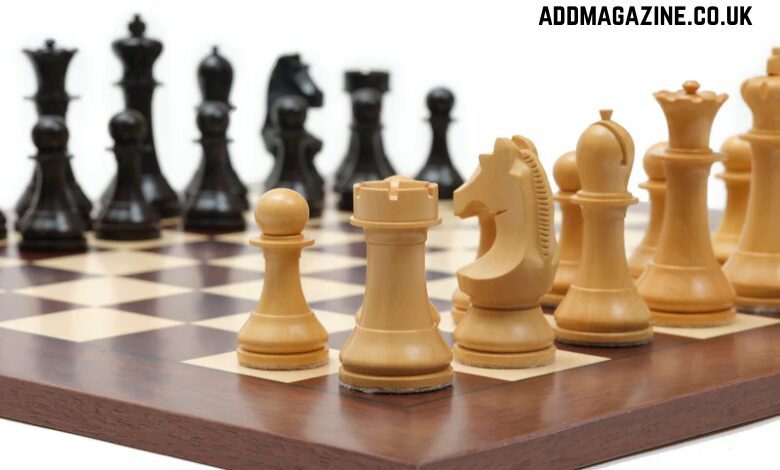
Different types of competitions can be played on anything, but if the goal is comfortable practice and participation in tournaments, it is useful to focus on standards. FIDE‘s technical standards for equipment dictate that pieces should be of the Staunton style, typical heights are given for the various pieces: king 9.5 cm, queen 8.5 cm, etc., and the diameter of the base of the piece is recommended to be within 40-50% of its height.
The same document defines one important guideline for the board, namely that the side of the square should be 5-6 cm, and the phrase “four pawns should fit on one square” defines an intuitive test for “is it too crowded”. It is also underlined separately that the surfaces should not be shiny (important for the illumination of tournament halls and video recording), and the board should be rigid.
Translated into buyer’s language, the correct tournament chess set usually coincides with common ‘tournament’ standard: a king of about 3,75 – 4″ and a square of about 50 – 57 mm. This is exactly how the “regulation” size is described in the selection of tournament chess sets in the store’s website: The king size is approximately 3.75 – 4″ and the squares measure 2.0 – 2.25″ (50-57 mm) plus Staunton design, weighted pieces and often more queens for realistic promotions. These are the parameters you should take into account if you want to buy chess pieces.
To avoid getting lost in names like international chess board, professional chess board, or world championship chess board, it is useful to take a look at verifiable characteristics (these can be used as a mini-checklist when choosing, including when you are looking for chess sets for sale or chess boards for sale):
- Cell size around 5-6 cm and consistency with the king’s base (it should not be cramped).
- Non-glare board surface and legible cell contrast.
- Staunton silhouettes so that the pieces can be distinguished instantly.
- Weighted pieces (this is especially critical for rapid and blitz games).
- The presence of additional queens (a common practical detail that really saves time in a tournament).
If your task is to assemble a set piece by piece, then it makes sense to purchase a chess board and pieces separately: pick a board with the grid that you want, then you can also pick pieces according to your taste. Spare or replacement pieces are also available from many catalogs, which is handy for clubs and organizers.
Physical space is another detail usually underestimated. If you are playing long control games at a club or at home and want to have a stationary aesthetic, a chess table with a built-in board might be more convenient than a portable board. However, for official competitions, the size of the squares and ease of setup are still more important than the format of the furniture.