
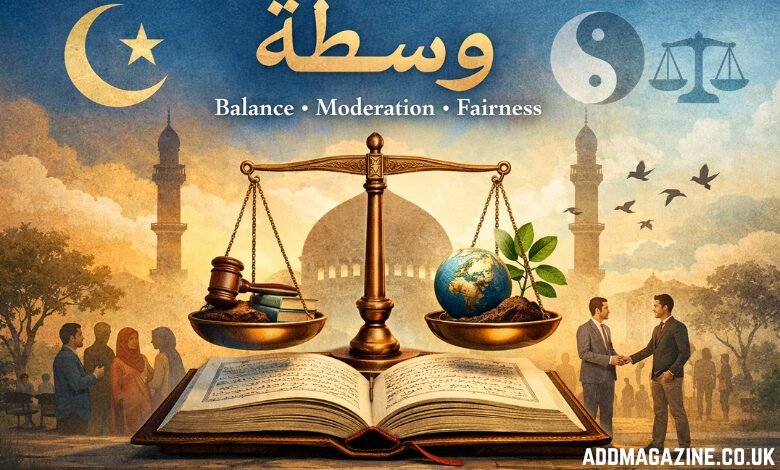
The concept of wasatha (وسط), which derives from the Arabic root “wasat,” meaning “middle,” “center,” or “between,” holds significant ethical and philosophical importance. In its simplest form, wasatha refers to the concept of balance and moderation, something situated equidistant between two extremes. However, over time, the word has come to encompass much more, representing a core principle of justice, fairness, and rational judgment, particularly in Islamic teachings.
In this article, we will delve deeper into the meaning of wasatha, explore its importance in Islamic thought, and provide examples of how this principle manifests in various aspects of life.
What is Wasatha?
The word wasatha can be traced back to the Arabic language, where it signifies a state of equilibrium or balance. Literally, it implies a “middle” point — neither too much nor too little, but rather a state of moderation and appropriateness. It is not simply about avoiding extremes, but about navigating between them to achieve balance, wisdom, and fairness.
In many ways, wasatha can be compared to the Greek concept of the golden mean, as well as principles in Eastern philosophies that emphasize harmony, such as yin and yang in Taoism. However, the Islamic application of wasatha carries a more holistic and divinely guided purpose, extending beyond personal virtue to societal and communal well-being.
Wasatha in Islam: The Middle Path
In Islam, wasatha is not just a philosophical principle but also a divine command. The Quran explicitly mentions the importance of being wasat (balanced) in a variety of contexts. One of the most well-known verses that highlight this concept is from Surah Al-Baqarah (2:143), where Allah says:
“And thus We have made you a just (wasat) nation that you will be witnesses over the people and the Messenger will be a witness over you…”
(Quran 2:143)
This verse underscores the idea that the Muslim Ummah (community) is meant to be a balanced nation, taking the middle ground between extremes, embodying justice, moderation, and fairness. It stresses that wasatha is not just about personal moderation but also about fulfilling communal and social responsibilities. The purpose is to guide the Muslim community to be exemplary in terms of their conduct, standing as a model of fairness and equilibrium to the rest of humanity.
Islamic scholars emphasize that wasatha does not mean indecision or a passive, neutral stance in the face of injustice. Rather, it is a philosophy of measured judgment — knowing when to stand firm on principles and when to show flexibility. For example, in the context of justice, Islam encourages individuals to act with fairness and righteousness, but also with mercy and understanding. Wasatha guides believers to avoid the extreme of being overly harsh or overly lenient in their judgments.
The Balance Between Extremes
The concept of wasatha encourages Muslims to avoid extremes in every aspect of life:
- In Faith and Worship: Islam teaches moderation in spiritual devotion. Muslims are encouraged to worship Allah regularly, but not to overburden themselves to the point of neglecting other duties such as work, family, and rest.
- In Personal Behavior: Whether it concerns eating, socializing, or personal habits, Islam advocates for moderation. For example, the Prophet Muhammad (PBUH) said, “The best of deeds are those that are done consistently, even if they are small.” This suggests that Islam encourages consistency in moderate actions rather than overindulgence or neglect.
- In Governance: Islam advocates for just and moderate governance. Leaders are urged to be firm when necessary but also to show mercy and compassion. The middle ground ensures that governance is neither oppressive nor excessively lenient, promoting a fair and just society.
Wasatha in Political and Social Life
On a societal level, wasatha encourages peace, tolerance, and mutual respect. Societies that embody wasatha as a core principle tend to emphasize dialogue over conflict and reconciliation over division. This approach fosters a more harmonious environment, where diverse viewpoints and beliefs are respected, and social cohesion is preserved.
In the political sphere, wasatha can be understood as a rejection of both extreme authoritarianism and unrestrained liberalism. In this sense, wasatha advocates for a balanced, ethical approach to governance — one that promotes justice, equality, and the welfare of the community. This concept is evident in Islamic governance systems where the needs of both the individual and the collective are taken into account, ensuring that the rights of all are protected without oppressing any group.
Examples of Wasatha in Islamic History
Throughout Islamic history, there have been numerous examples where the principle of wasatha has been put into practice. Here are a few key instances:
1. The Life of the Prophet Muhammad (PBUH)
The Prophet Muhammad (PBUH) is the best example of the wasatha in action. His life was a constant demonstration of balance — between work and rest, prayer and family, individual rights and social duties. His leadership style was one of moderation and justice. For instance, when it came to governance, the Prophet was firm in upholding the principles of justice, but he also showed incredible mercy and compassion, forgiving his enemies and showing kindness to those in need.
2. The Caliphate of Umar ibn al-Khattab (RA)
During the caliphate of Umar ibn al-Khattab (RA), the principle of wasatha was demonstrated in his governance. He was known for his fair and just rulings, ensuring that the needs of the poor were met and that the rights of women and minorities were respected. At the same time, he was firm in his approach to enforcing the laws of Islam, ensuring that justice prevailed.
3. Islamic Legal System
Islamic law, or Sharia, is another area where wasatha plays a crucial role. And Islamic jurists have emphasized the importance of moderation when interpreting religious texts and applying legal rulings. The principle of Ijtihad (independent reasoning) is used to ensure that Islamic law remains balanced and appropriate to the needs of the time, avoiding both extreme rigidity and overly liberal interpretations.
The Importance of Wasatha in Islam
The importance of wasatha in Islam cannot be overstated. It is a core concept that governs not only personal conduct but also societal interactions, governance, and even international relations. Here are some key reasons why wasatha is vital in Islam:
- Promotes Justice: Wasatha ensures that justice is always pursued in a fair and balanced manner. It avoids both oppression and negligence, ensuring that rights are protected and wrongs are corrected.
- Encourages Mercy and Tolerance: While Islam upholds the importance of justice, it also emphasizes mercy. Wasatha allows for the practice of compassion without compromising justice.
- Fosters Social Harmony: Societies that adhere to the principle of wasatha are more likely to promote peace and coexistence. By avoiding extreme views, individuals and communities can work together to build a more unified and stable society.
- Sustains Mental and Emotional Well-Being: On a personal level, wasatha encourages balance in life, preventing individuals from falling into the extremes of overwork, indulgence, or neglect. It supports a healthier, more balanced lifestyle.
- Guides Ethical Governance: Wasatha provides a model for ethical and responsible governance. Leaders who embrace this principle can foster equitable and just systems that benefit everyone in society.
Wasatha in the Modern World
In today’s world, where polarization and extremism are increasingly prevalent, the concept of wasatha offers a valuable antidote. Whether in the political, social, or personal spheres, the idea of balance can guide individuals and societies toward solutions that are fair, just, and sustainable. By avoiding extremes and embracing moderation, we can create a world where peace, justice, and mercy coexist.
Wasatha in the Modern World: A Need for Balance
In the contemporary world, wasatha provides a profound answer to many of the issues we face today. We live in a time marked by polarization, extremism, and conflict, where opposing ideologies often clash, creating divisions in societies and between nations. Whether it is the political divide, social unrest, or environmental degradation, the principles of wasatha offer a framework to restore balance, harmony, and fairness.
1. Addressing Political Polarization
In the realm of politics, wasatha offers a counterbalance to the growing extremism in many parts of the world. Political ideologies are often divided between two extreme positions, leading to a lack of productive dialogue and a failure to address pressing issues in a balanced way. Wasatha teaches that instead of choosing sides in an ideological battle, we must seek the middle ground — one that promotes compromise, understanding, and collaboration.
A wasathic approach to politics would involve policies that take into account the needs of all citizens, balancing individual freedoms with collective responsibility. Leaders and citizens alike are encouraged to avoid becoming entrenched in extreme views, but instead, focus on solutions that are practical, fair, and inclusive. For example, economic policies might strive for a balance between fostering innovation and protecting workers’ rights, while social policies might balance the needs of marginalized communities with those of the majority.
2. Promoting Interfaith and Intercultural Dialogue
In an increasingly interconnected world, wasatha plays a crucial role in promoting interfaith and intercultural dialogue. In societies where religious, cultural, and ethnic groups coexist, tensions often arise from perceived differences. The wasathic approach encourages mutual respect and the recognition of shared values. It calls for the avoidance of intolerance, extremism, and the imposition of one belief system over others.
By embracing the concept of wasatha, societies can foster a spirit of unity and collaboration. People are encouraged to engage in constructive dialogue, learn from each other, and work toward common goals. Wasatha reminds us that while differences exist, there is always a middle ground where peace and mutual respect can be found.
3. Finding Balance in the Age of Technology and Social Media
In today’s digital age, technology and social media often fuel extremism and misinformation. The fast-paced nature of social media platforms can sometimes create an environment of instant gratification, sensationalism, and polarizing content, which may amplify emotions rather than encourage rational discourse.
The concept of wasatha teaches us to approach the information we consume online with critical thinking and moderation. Instead of falling prey to sensational headlines or extreme opinions, we are encouraged to seek balanced perspectives. It also advocates for the responsible use of technology, ensuring that social media serves as a tool for constructive conversation, awareness, and positive change, rather than a platform for division.
Moreover, wasatha in the digital age calls for balance between online activity and offline experiences. Modern life often leads individuals into a cycle of overwork or constant digital engagement, resulting in burnout or a lack of real-world connection. Wasatha encourages individuals to find a middle ground — using technology in a way that enhances their lives, without allowing it to dominate or overwhelm them.
4. Striving for Balance in Environmental Sustainability
As we face the pressing challenges of climate change and environmental degradation, the philosophy of wasatha can guide us toward more sustainable and balanced environmental practices. Extreme approaches — whether overexploitation of resources in the name of economic growth or complete rejection of progress due to environmental concerns — can be detrimental in the long term.
Wasatha calls for a balanced approach to sustainability. It advocates for finding solutions that balance economic development with environmental preservation. This might include adopting technologies that promote energy efficiency, conserving resources, and ensuring that economic development does not come at the expense of the environment. The middle path involves utilizing innovation to meet modern needs while safeguarding the planet for future generations.
5. Achieving Balance in Personal Life
On a personal level, the concept of wasatha holds immense significance. In today’s world, it is easy to be swept up by the pressures of modern living — the need to constantly perform, achieve, and compete. People often find themselves working long hours, neglecting their health, or becoming consumed by material pursuits, all in the name of success. Alternatively, some withdraw entirely from the demands of modern society, seeking isolation or complete disengagement.
Wasatha teaches us the importance of moderation in all things. It encourages individuals to live a balanced life, where personal ambition is tempered with self-care, work with rest, and worldly pursuits with spiritual reflection. Embracing this principle allows individuals to lead lives that are not only productive but also fulfilling and harmonious. By focusing on balance, people can avoid the extremes of overwork or indulgence, which often lead to stress and dissatisfaction.
Moreover, wasatha emphasizes the importance of emotional intelligence — knowing when to be firm in one’s convictions and when to be flexible and empathetic toward others. It is about cultivating resilience and mental well-being while maintaining a compassionate and balanced approach toward the challenges of life.
Practical Examples of Wasatha in Daily Life
To further illustrate how wasatha can be applied in daily life, let us consider a few practical examples:
1. Healthy Diet and Lifestyle
Wasatha encourages moderation when it comes to personal health and diet. While Islam allows for the enjoyment of food and drink, it also advises against overindulgence. The Quran mentions:
“Eat and drink, but do not be excessive. Indeed, He likes not those who commit excess.”
(Quran 7:31)
A balanced approach to nutrition — eating enough to nourish the body without overindulging — reflects the principle of wasatha. It is about finding the middle ground between extreme dieting and overconsumption, promoting a lifestyle that nurtures both the body and the soul.
2. Social Media Engagement
In terms of social engagement, wasatha advises moderation. Social media can be a powerful tool for connection and education, but excessive use can lead to unhealthy comparison, envy, and anxiety. A balanced approach involves using social media constructively, avoiding both complete detachment from it or excessive immersion.
3. Work-Life Balance
Professionally, wasatha advocates for a balanced work ethic. Islam encourages striving for success in one’s career but not at the cost of neglecting family, health, or spiritual practices. The Prophet Muhammad (PBUH) once said, “Your body has a right over you, your family has a right over you, and your Lord has a right over you.”
A balanced approach in work involves pursuing professional growth and success while also ensuring time for personal well-being, family, and faith.
Conclusion
The principle of wasatha offers a timeless guide for creating a balanced, fair, and harmonious life. Whether applied to personal choices, societal governance, or global challenges, wasatha encourages individuals and communities to avoid extremes and embrace a middle path that fosters justice, mercy, and mutual respect.
In a world increasingly divided by ideological, political, and social extremes, the concept of wasatha provides a much-needed framework for finding common ground, promoting cooperation, and creating a just and peaceful society. By embracing wasatha, we can not only navigate the complexities of modern life but also foster a more balanced, compassionate, and sustainable future for generations to come.