
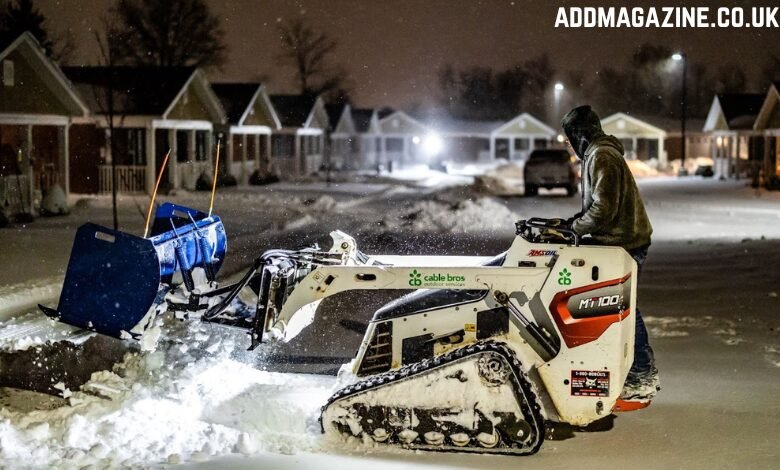
If you have lived in the Dayton area for more than a single winter, you know the drill. One minute, the weather forecast predicts a “light dusting,” and the next, you are waking up to six inches of heavy, wet accumulation. While snow days might be a cause for celebration for school-aged children hoping for a sledding adventure, for property owners and business managers, they often signal the start of a logistical headache.
Navigating the freeze-thaw cycles of Southwest Ohio requires more than just a sturdy shovel and a bag of rock salt from the hardware store. It requires strategy. To help you better understand the mechanics of keeping your property safe and accessible during the colder months, we have compiled answers to the most frequently asked questions about snow and ice management.
Why Is Ice Management Often More Critical Than Plowing?
When we think of winter storms, we visualize towering piles of white snow. However, the invisible danger—ice—is statistically the bigger threat. Slip-and-fall accidents are a primary concern for any property owner. Often, snow acts as an insulator; when it is compacted by foot traffic or tires, it turns into a slick sheet of hardpack that is difficult to remove.
Pre-treating surfaces before a storm hits is a common professional tactic. By applying brine or granular de-icers beforehand, professionals prevent the snow from bonding to the pavement. This makes the eventual clearing process significantly more effective. If you wait until the ice has already formed, you are fighting an uphill battle that requires more abrasive chemicals to break the bond.
What Are “Trigger Depths” and How Do They Function?
In the world of professional snow contracts, you will often hear the term “trigger depth.” This refers to the amount of snow accumulation required before a crew is dispatched to your site. Common triggers are one inch or two inches.
For high-traffic areas like medical facilities or 24-hour retail centers, a “zero tolerance” policy is often preferred. This means that at the first sign of accumulation or icing, crews are on-site to maintain bare pavement. Understanding your specific needs is crucial. A warehouse that only operates 9-to-5 might not need the same level of urgency as an emergency room entrance, but neglecting the lot entirely can lead to operational paralysis.
Is Professional Removal Necessary for Businesses?
For residential driveways, a snowblower and some elbow grease are often sufficient. However, the stakes are significantly higher for commercial properties. It is not just about convenience; it is about liability and accessibility. If employees cannot park safely or customers cannot reach your front door, revenue stops.
This is why securing a reliable partner for commercial snow removal is a standard operational expense for prudent business owners. Having a contracted team ensures that your lot is cleared automatically according to your agreement, rather than scrambling to find a contractor during the peak of a blizzard when everyone is booked solid.
Does Road Salt Damage Concrete and Landscapes?
This is a valid concern. The traditional rock salt (sodium chloride) used on highways is effective, but it can be harsh. It lowers the freezing point of water, causing a cycle of freezing and thawing that can cause concrete to spall or crack over time. Furthermore, if salt laden slush is shoveled onto your grass or garden beds, it can dehydrate plants and alter soil chemistry, leading to “salt burn” come spring.
Professional services often utilize different de-icing agents depending on the temperature and surface. Calcium chloride and magnesium chloride, for example, are effective at much lower temperatures than standard rock salt and are generally considered less corrosive to concrete when used correctly. A knowledgeable crew knows how to balance safety with property preservation, applying enough product to melt the ice without saturating the surrounding landscape.
When Should I Set Up My Snow Removal Plan?
Procrastination is the enemy of winter safety. The worst time to look for a snow removal contractor is whilst the snow is falling. By that time, reputable companies have already allocated their equipment and manpower to existing clients. Route density is key in this industry; crews need efficient paths to service all their properties. Adding a new stop in the middle of a storm is often logistically impossible.
The ideal time to organize your winter plan is in the late summer or early autumn. This allows time for the contractor to walk your site, identify obstacles like curbs and fire hydrants, and stake the property boundaries before the ground freezes.
Managing the Unpredictable Ohio Weather
Ohio weather is famously fickle. This unpredictability makes professional monitoring essential. It is not enough to look out the window; crews monitor ground temperatures and weather radar to anticipate refreezing overnight.
If you’re seeking a team that specializes in local weather trends and emphasizes safety, Cable Bros Outdoor Living & Landscaping is here to guide you through the upcoming season.
With the right preparation and an understanding of how snow management works, you can keep your property safe, accessible, and running smoothly, no matter what the forecast brings.