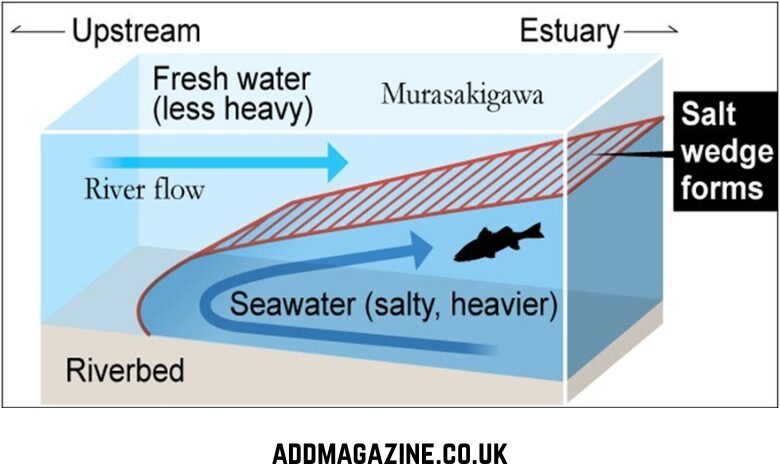
There is a moment — if you have ever stood at the edge where a great river finally surrenders itself to the sea — when you notice something almost impossible. Two worlds of water touch, and yet they do not become one. The river holds its freshness. The ocean holds its salt. Between them, invisible yet firm, stands a barrier no human hand has ever drawn.
This is not poetry. It is physics. And remarkably, it is Qur’an.
Allah The All-Mighty says in Surah Al-Furqan, verse no. 53
Fourteen centuries before hydrology gave us the vocabulary of haloclines, pycnoclines, and salinity stratification, the Qur’an named a phenomenon that human eyes could witness but human science could not yet explain. That is worth pausing over — not as a debate point, but as an invitation to awe.
The Qur’anic Verses: A Portrait of Precision
The Qur’an speaks of this boundary in three separate verses, each offering a slightly different window into the same profound reality. In Surah Al-Furqan, the word barzakh — a barrier or partition — is used. In Surah Ar-Rahman, the two seas meet and yet neither transgresses upon the other. In Surah An-Naml, the very existence of this separator is presented as one of the signs of divine wisdom and power.
The Arabic word barzakh carries a richness that the word ‘barrier’ barely captures. It evokes separation. That the Qur’an chose this word for the boundary between freshwater and seawater — rather than a simple wall or wall-like structure — speaks to a kind of knowledge that sees beyond the surface.
Classical scholars of Qur’anic commentary understood this boundary as an expression of divine wisdom: freshwater was created for human use — for drinking, irrigation, the sustaining of life on land. Saltwater was created to surround the continents and serve its own purposes. Divine wisdom, the commentators wrote, dictates that each remains as it was meant to be.
What Science Has Since Confirmed
Modern hydrology has given precise names to what the Qur’an described in evocative language. When a river meets the sea, what prevents the two from merging into one indistinct body of water is primarily a matter of densityand Salinity.
The Density and SalinityBarrier
Seawater, heavy with dissolved salts, sinks beneath the lighter freshwater that flows from rivers. This creates a stable stratification — a layered arrangement — where fresher water floats atop saltier water. The boundary between them is marked by what scientists call the halocline (where salinity changes rapidly) and the pycnocline (where density changes sharply). These invisible lines act as the ‘barzakh’ the Qur’an described: real, functional, and firm.
The Hydraulic Force
There is also a directional force at work. Freshwater, moving from the higher elevations of inland areas down toward the sea, carries hydraulic pressure with it. This pressure pushes seawater back, preventing it from intruding into river systems. Remove the freshwater flow — through drought or excessive human extraction — and seawater begins to creep inland, as has been observed along the Shatt Al-Arab River in Iraq and in the Nile Delta of Egypt.
Witnesses in the Real World
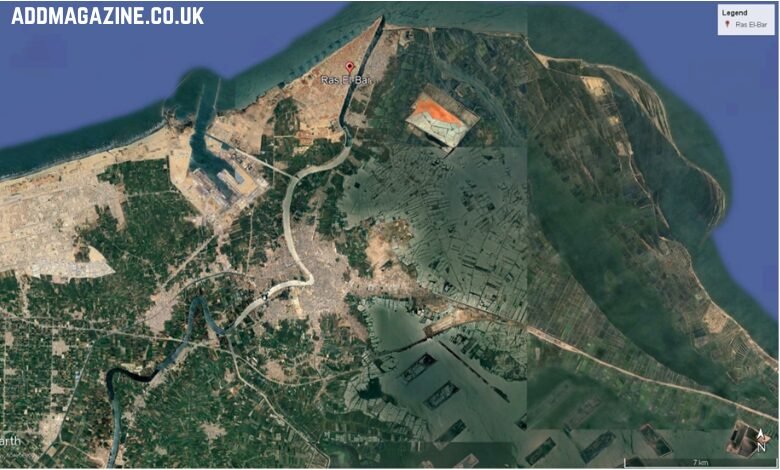
At Ras El Bar in northern Egypt, visitors can see this phenomenon with their own eyes: the waters of the Nile meeting the Mediterranean Sea, distinct in color and character, held apart by the laws Allah wove into creation.
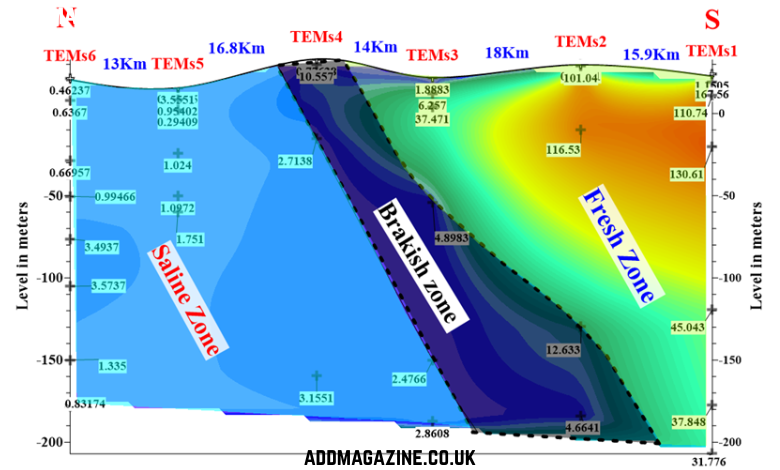
Geophysical surveys across the world — in Pakistan, Egypt, and the Gulf region — have mapped these stratified boundaries both at the surface and deep underground, in coastal aquifers where freshwater and saltwater coexist withoutcrossing each other. Look of section below describing 80Km from near Alexandria city to south Tanta showing fresh, brackish and saline water interface each other , the brackish exist in the salinity stratification zone (halocline)
Note: The Amazon River’s drainage path has existed for over 65 million years — its freshwater flowing into the Atlantic, its boundary with the ocean maintained across geological time, a silent and ancient testimony to the stability of divine law in creation.
A Reflection for the Heart
It is one thing to learn that the Qur’an described a physical phenomenon. The Prophet Muhammad ﷺ, may peace be upon him, lived in 7th-century Arabia — far from the great river deltas and ocean coastlines where this phenomenon is most visibly observed. The Bedouin world he inhabited was one of desert and trade routes, not oceanographic research. And yet the Book revealed to him described, with calm precision, the behavior of waters at the boundary of river and sea.
This is the nature of Qur’anic knowledge: it does not argue for itself noisily. It simply states. And then science, centuries later, arrives at the same place — often without realizing the journey had already been made.
For the believer, Every stratified boundary where freshwater meets salt is a reminder that the universe is not random, that its laws were written by One who knew them before the first river found its way to the first sea.
→ to read the full scientific and Qur’anic exploration of this phenomenon, visit the article Two Seas don’t mix
Deepen Your Connection with the Qur’an
If this reflection stirred something in you, it is an invitation. The Qur’an holds countless such signs — waiting not just to be admired as intellectual marvels, but to be recited, memorized, understood, and lived, Luqman Institute offers a complete path for every stage of that journey