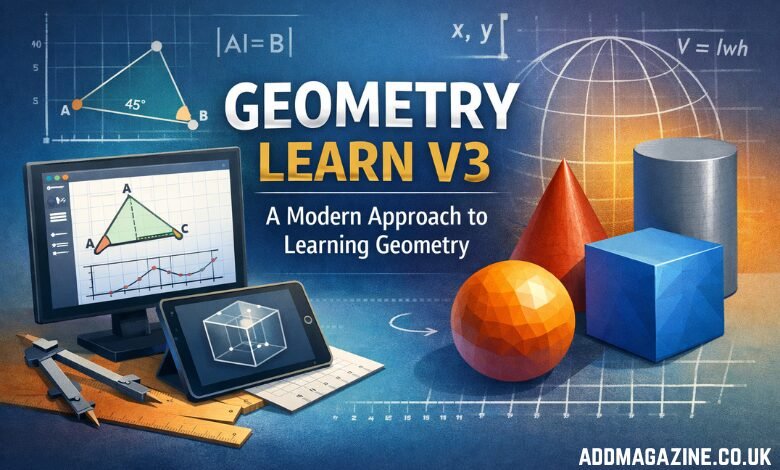
Geometry, as one of the foundational branches of mathematics, plays a vital role in shaping how we perceive the world around us. From the simplest shapes to the complex structures that dominate our cities, geometry is present everywhere. However, for many learners, understanding geometry can be challenging, especially when taught through traditional, textbook-driven methods. The introduction of Geometry Learn V3 provides a modern, interactive solution to this long-standing issue by incorporating hands-on, visual, and self-paced learning environments. This version is designed to make geometry both accessible and engaging, using technology to bridge the gap between theory and practical understanding.
In this article, we will explore how Geometry Learn V3 works, the benefits it offers, and how it is changing the way students, teachers, and self-learners approach geometry education.
The Evolution of Geometry Learning
To fully appreciate Geometry Learn V3, it is helpful to understand how the methods of teaching geometry have evolved over time. Here’s a breakdown of the three major stages:
Version 1: Traditional Learning Methods
In the past, geometry education relied heavily on textbooks, chalkboards, and rote memorization. Students were expected to memorize theorems, formulas, and properties of shapes, often without understanding their practical applications. Teachers typically used static diagrams to explain geometric concepts, which left students with limited opportunities to interact with the material.
Version 2: The Digital Shift
With the rise of the internet and digital tools, geometry education began to transition from traditional methods to more tech-based solutions. Online resources, PDF documents, and videos began to supplement classroom learning. Although this was a step forward, these tools remained largely passive, providing limited interaction between the student and the material.
Version 3: Geometry Learn V3
Geometry Learn V3 marks the third generation of geometry education, where interactivity and learner engagement take center stage. Unlike the previous versions, Geometry Learn V3 encourages students to actively manipulate shapes, experiment with geometric properties, and see the immediate effects of their actions. It’s a learner-centered platform that prioritizes visual learning, hands-on practice, and real-time feedback, making geometry feel more tangible and connected to the real world.
Key Features of Geometry Learn V3
The primary difference between Geometry Learn V3 and traditional geometry learning methods lies in its approach. Here are some of the key features that make this platform stand out:
Interactive Visuals
Geometry is inherently a visual subject, and Geometry Learn V3 makes the most of this by offering dynamic, interactive diagrams. Instead of just reading about geometric concepts, students can manipulate shapes, change angles, and observe how properties evolve in real time. For example, by adjusting the angles of a triangle, learners can see how the sum of the angles always equals 180°, reinforcing their understanding of fundamental geometry concepts.
Self-Paced Learning
Every student learns at their own pace, and Geometry Learn V3 recognizes this. Whether a student is struggling with basic concepts or ready to explore more advanced topics, the platform allows them to control the pace of their learning. Students can take extra time with difficult topics and skip over areas they already understand, which promotes a more personalized learning experience.
Conceptual Understanding Over Memorization
One of the major struggles with traditional geometry learning is that students often memorize formulas without fully understanding them. Geometry Learn V3 emphasizes conceptual understanding. Rather than simply learning that the area of a triangle is half the base times the height, students can explore why this formula works by adjusting the base and height of the triangle and seeing how the area changes. This deeper understanding is crucial for building long-term retention.
Hands-On Exploration
The platform encourages hands-on interaction with geometry concepts. By dragging points, adjusting shapes, and experimenting with transformations, students can explore geometric relationships in a more intuitive and engaging way. This kinesthetic learning approach helps improve retention and provides a more meaningful learning experience.
Topics Covered in Geometry Learn V3
Geometry Learn V3 covers a comprehensive range of geometry topics, all presented in a logical and structured format. The curriculum is designed to build from foundational concepts to more advanced topics, ensuring that students develop a deep and thorough understanding of geometry.
Basic Geometric Concepts
The journey begins with basic concepts, such as points, lines, angles, and planes. Students learn how to identify and classify different types of angles (acute, right, obtuse) and understand the basic properties of lines, rays, and line segments. Visual diagrams provide clarity and reinforce the concepts.
Two-Dimensional Geometry
Once students grasp the basics, Geometry Learn V3 introduces more complex shapes and their properties. Topics covered include:
- Triangles: Types of triangles (equilateral, isosceles, and scalene), triangle inequality theorem, and the properties of right triangles.
- Quadrilaterals: Analysis of squares, rectangles, parallelograms, and trapezoids, focusing on their properties and how to calculate their areas and perimeters.
- Polygons: Understanding regular and irregular polygons, calculating their interior and exterior angles, and exploring the concept of symmetry.
- Circles: Students learn about the parts of a circle, the relationship between radius, diameter, and circumference, and the formula for the area of a circle.
Interactive diagrams allow students to manipulate shapes, helping them observe properties like angles and side lengths firsthand.
Three-Dimensional Geometry
Understanding three-dimensional objects can be more challenging for students, but Geometry Learn V3 makes it easier with rotatable models of shapes like cubes, spheres, cones, and cylinders. Key topics include:
- Surface Area and Volume: Students learn how to calculate the surface area and volume of different 3D shapes.
- Cross-Sections and Nets: The platform allows students to visualize 3D objects by creating cross-sections and nets, which are helpful in understanding the structure of 3D shapes.
Coordinate Geometry
To bridge the gap between algebra and geometry, Geometry Learn V3 introduces the concept of coordinate geometry. Students learn about the Cartesian plane, distance and midpoint formulas, and graphing geometric shapes. This section helps students see the connection between algebraic equations and geometric concepts.
The Benefits of Geometry Learn V3
There are several advantages to using Geometry Learn V3 for both students and teachers:
1. Visual Learning
For many students, geometry is a visual subject, and Geometry Learn V3 capitalizes on this by providing a visual, interactive learning environment. This helps students understand abstract concepts by making them more tangible.
2. Personalized Learning
With its self-paced approach, Geometry Learn V3 allows students to tailor their learning experience. This personalization ensures that students can spend more time on areas they find challenging and move through concepts they already understand with ease.
3. Real-Time Feedback
Interactive tools in Geometry Learn V3 provide immediate feedback, allowing students to identify and correct misunderstandings quickly. This real-time feedback is invaluable in preventing students from reinforcing incorrect ideas.
4. Increased Student Engagement
Traditional textbooks can be dry and uninspiring, but Geometry Learn V3 makes learning fun and engaging. By allowing students to experiment with geometric shapes and transformations, the platform promotes active learning and encourages exploration.
5. Accessibility and Flexibility
Geometry Learn V3 is available on multiple devices, including smartphones, tablets, and computers, making it accessible to students anytime, anywhere. This flexibility is particularly beneficial for self-learners or students who need to review concepts outside of class time.
How Teachers Can Use Geometry Learn V3
Geometry Learn V3 is not only useful for students but also provides valuable tools for teachers. Educators can use the platform to:
- Demonstrate concepts visually: Teachers can use the interactive diagrams and visualizations in Geometry Learn V3 to explain complex geometric concepts in a way that is easier for students to understand.
- Assign practice problems: Teachers can assign interactive problems for students to solve, which helps reinforce classroom learning.
- Differentiate instruction: Since the platform allows for self-paced learning, teachers can assign different tasks to students based on their individual needs, ensuring that all students are appropriately challenged.
The Role of Geometry Learn V3 in Real-World Applications
One of the significant advantages of using Geometry Learn V3 is that it connects abstract geometric concepts to real-world applications. For many students, understanding how geometry is used in practical scenarios can make the subject feel less theoretical and more useful. Geometry Learn V3 ensures that students don’t just memorize formulas but also see how geometry plays a vital role in various fields and industries.
Architecture and Design
Architecture relies heavily on geometry. Buildings, bridges, and other structures require precise calculations of angles, dimensions, and surface areas. Geometry Learn V3 introduces students to the foundational geometric principles that architects use in their everyday work. For example, when studying shapes like triangles and quadrilaterals, students can see how these shapes are incorporated into architectural blueprints and construction plans.
By learning how to calculate areas and volumes, students can better appreciate the complexity involved in designing and constructing buildings. Furthermore, the interactive features in Geometry Learn V3 can simulate how different shapes and designs might look in a real-world setting, helping students visualize what they’ve learned and apply it creatively.
Art and Graphics
Another area where geometry plays a crucial role is in the field of art and design. Geometric principles underpin many aspects of visual art, from the symmetry in paintings to the design of digital graphics. Students who use Geometry Learn V3 can explore how angles, symmetry, and shape manipulation are essential in creating visually appealing works of art. Artists use geometric techniques to determine proportion, perspective, and balance, and Geometry Learn V3 helps students recognize how these concepts can be applied in their own artistic endeavors.
For example, the platform’s ability to manipulate shapes and observe changes in symmetry can be directly related to designing patterns for textile production, graphic design, or creating 3D models for animation. By understanding the geometry behind these applications, students can gain insights into how mathematics can influence creative fields.
Engineering and Technology
Engineering is another field where geometry is essential. Whether it’s mechanical engineering, civil engineering, or software development, engineers use geometric principles every day. From calculating forces in structures to designing mechanical components, geometry is at the core of problem-solving in these fields. With Geometry Learn V3, students can gain an understanding of how these principles apply to real engineering challenges.
For instance, the platform’s lessons on surface area and volume can be tied to real-world applications in designing containers, packaging, or even the components of machines and vehicles. Students can see firsthand how manipulating the dimensions of an object affects its capacity or how scaling up a design impacts its structure.
Geometry Learn V3 and Its Impact on Test Preparation
Preparing for standardized tests or school exams can often be a stressful process, especially when dealing with a subject as complex as geometry. Fortunately, Geometry Learn V3 provides the tools that students need to master geometry and perform well in their exams. The interactive nature of the platform makes it a valuable resource for students preparing for high school geometry exams or standardized tests like the SAT or ACT, where geometry is often a significant component of the math section.
Tailored Practice Problems
One of the most valuable aspects of Geometry Learn V3 for test preparation is its ability to offer tailored practice problems. As students progress through the platform, they are presented with problems that match their current level of understanding. This ensures that students are always working on problems that challenge them without overwhelming them.
Additionally, the real-time feedback provided by the platform allows students to learn from their mistakes immediately. For instance, if a student incorrectly calculates the area of a triangle, Geometry Learn V3 provides instant explanations and allows the student to try again. This form of adaptive learning ensures that students are continuously improving and reinforcing their knowledge.
Exam-Style Questions
In addition to providing interactive problems, Geometry Learn V3 also offers exam-style questions, which can help students familiarize themselves with the types of questions they will encounter on standardized tests. These questions simulate the conditions of real exams and help students practice managing their time effectively during the test. Furthermore, the platform’s structured progression from basic concepts to more advanced topics mirrors the structure of most geometry exams, ensuring students are fully prepared for every aspect of their test.
Enhancing Teacher-Student Interaction with Geometry Learn V3
While Geometry Learn V3 is a powerful tool for students, it also plays a vital role in enhancing teacher-student interaction. In traditional classrooms, teachers often find it challenging to keep every student engaged and ensure that each student fully understands the material. Geometry Learn V3 addresses this challenge by providing a range of tools that teachers can use to supplement their lessons.
Demonstrating Concepts with Visuals
Teachers can use Geometry Learn V3 to demonstrate geometric concepts visually, which can be especially helpful for visual learners. By using the interactive tools, teachers can show how shapes transform, how angles change, or how 3D objects come together. These demonstrations help students understand concepts that might be difficult to grasp through traditional methods alone.
Assigning Interactive Practice
Teachers can assign interactive practice problems for students to work on, either during class or as homework. Since the platform provides immediate feedback, students can work through problems independently while receiving guidance on how to solve them correctly. This not only helps reinforce classroom learning but also provides teachers with insight into which concepts students are struggling with, allowing for more targeted instruction.
Differentiated Instruction
Every classroom is made up of students with varying levels of ability, and Geometry Learn V3 helps teachers implement differentiated instruction. With its self-paced learning model, students can work at their own speed, focusing on the topics that they find most challenging. Teachers can assign specific tasks to different students based on their individual needs, ensuring that all students are appropriately challenged and supported.
Geometry Learn V3 for Self-Learners
For self-learners, Geometry Learn V3 provides an invaluable resource for mastering geometry outside of the traditional classroom environment. Whether you’re a middle school student looking to improve your skills, a high school student preparing for exams, or an adult learner hoping to revisit geometry, Geometry Learn V3 allows you to learn at your own pace and on your own terms.
Structured Learning Path
Geometry Learn V3 is organized in a way that makes it easy for self-learners to follow a structured learning path. The platform’s logical progression from basic to advanced topics means that you won’t get lost in a sea of information. The organized curriculum ensures that each concept is built on the foundation of the previous one, making learning more coherent and easier to digest.
Access to Resources Anytime, Anywhere
One of the most significant advantages of Geometry Learn V3 for self-learners is that it’s available on multiple devices. Whether you’re at home, in a coffee shop, or on the go, you can access the platform anytime, anywhere. This flexibility allows learners to fit geometry study into their busy schedules, making it easier to stay on track and continue progressing at their own pace.
Conclusion
In conclusion, Geometry Learn V3 represents a significant advancement in the way geometry is taught and learned. By emphasizing interactivity, visual learning, and self-paced exploration, the platform makes geometry more engaging and accessible for students of all levels. Whether you’re a student looking to improve your understanding of geometry, a teacher looking for a new way to engage your class, or a self-learner trying to master the subject on your own, Geometry Learn V3 offers a valuable tool for mastering geometry in a way that is both effective and enjoyable. With its combination of real-time feedback, interactive visuals, and comprehensive curriculum, Geometry Learn V3 is setting a new standard for geometry education.