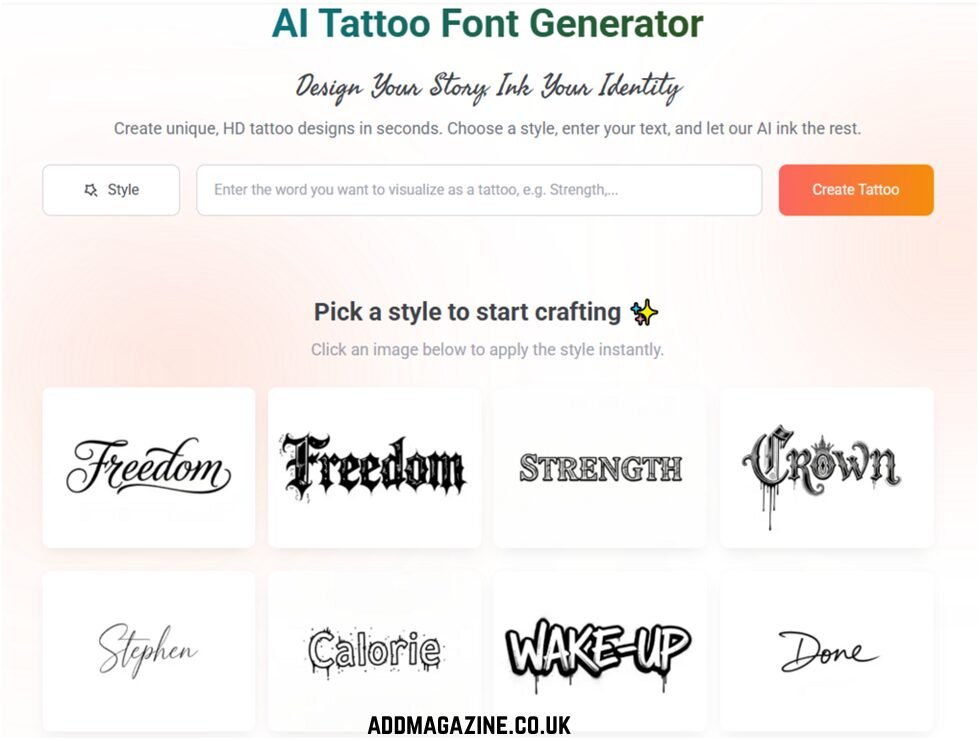
Geometry in tattooing is more than just shapes; it is a pursuit of mathematical perfection. From the intricate layers of a Mandala to the sharp, interlocking lines of Metatron’s Cube, geometric tattoos represent balance, symmetry, and the fundamental laws of the universe. However, a significant challenge arises when a client wants to embed text—such as a name, a date, or a philosophical mantra—into these complex patterns. The fluid, organic nature of standard handwriting often clashes with the rigid precision of geometric art. To solve this aesthetic conflict, designers are turning to a specialized tattoo font generator to create linear, mathematically aligned typography that complements rather than disrupts the sacred geometry.
The Aesthetic Conflict: Why Traditional Fonts Fail Geometry
The primary pain point for fans of geometric tattoos is “visual dissonance.” When you place a standard cursive or a traditional serif font inside a highly symmetrical geometric frame, the eye is immediately drawn to the inconsistency. Geometric tattoos rely on perfect angles and consistent line weights. If the text within the design has varying thicknesses or irregular curves, the entire composition loses its “Sacred” quality.
In the past, artists had to hand-draw every letter to ensure it fit the geometric grid. This was not only time-consuming but also prone to human error—a single millimeter of misalignment can ruin a symmetrical piece. By utilizing a high-performance tattoo font generator, users can now access “Linear” and “Monolinear” font styles. These AI-generated fonts maintain a perfectly consistent stroke width, mirroring the precision of the geometric patterns they are meant to inhabit.
Finding the Mathematical “Flow” in Typography
Integrating text into a Mandala or a Sacred Geometry piece requires a deep understanding of “Proportional Harmony.” The text should not sit on top of the pattern; it should feel like a structural extension of it.
1. Linear Symmetry and Mono-weight Lines
For geometric tattoos, “Mono-weight” fonts are essential. These are fonts where every part of the letter—the stems, the bars, and the bowls—has the exact same thickness. When you use a tattoo font generator to select a monolinear style, you can match the font’s line weight to the needle size the artist plans to use for the geometric outlines. This creates a seamless visual transition between the art and the information.
2. Angular Alignment
Geometric art is defined by its angles (60°, 90°, 120°). A traditional font often has “slants” or “italics” that don’t match these specific degrees. Modern digital tools allow you to customize the “slant” and “aspect ratio” of the text. By aligning the vertical strokes of your font with the radial lines of a Mandala, you ensure that the text supports the overall symmetry of the tattoo.
The Role of AI in “Pattern-Ready” Typeface Design
Standard font libraries are designed for flat paper or digital screens. They don’t account for the way ink settles into skin or how a design must wrap around a cylindrical limb. This is where a dedicated tattoo font generator proves its worth. AI technology can analyze the “density” of a geometric pattern and suggest font styles that won’t get lost in the complexity.
For instance, if the background pattern is a dense “Flower of Life,” the AI might suggest a “Stencil” or “Minimalist Sans” font. These styles provide enough “negative space” within the letters to ensure the text remains legible even when surrounded by hundreds of interlocking circles. The goal is to find a font that acts as a focal point without overpowering the intricate background.
Practical Strategies for Embedding Text into Shapes
When planning a geometric text tattoo, consider these three structural strategies:
- The Radial Inscription: Placing text in a circular path around the center of a Mandala. This requires a generator that can handle “Text on a Path” with precise kerning (letter spacing) to avoid crowding at the top or bottom of the circle.
- The Interlocking Lettering: Designing the letters so they actually form part of the geometric grid. This works best with “Angular” fonts where the ‘V’, ‘A’, and ‘W’ shapes can double as triangles within the pattern.
- The Minimalist Core: Placing a single word in the center of a geometric frame. This requires a font with “perfect proportions”—where the height and width of the letters are mathematically balanced to fill the central “void” of the design.
Longevity and the “Math” of Aging Ink
A major concern for any geometric tattoo is how it will look in ten years. Because geometric pieces often use fine lines and precise spacing, they are susceptible to “blurring” if the design is too cramped. This risk is doubled when you add text.
Expert designers use a tattoo font generator to test “Legibility Thresholds.” By increasing the “Internal Spacing” of the letters, they ensure that as the ink spreads over time, the “holes” in the letters (like the middle of an ‘A’ or ‘O’) don’t close up. This technical foresight is what separates a professional geometric tattoo from a “DIY” disaster. Symmetry must be maintained not just on the day of the appointment, but for the life of the wearer.
Why “Clean” Fonts are the Future of Sacred Ink
The trend toward “Minimalist Realism” and “Fine-line Geometry” has made the demand for clean, linear fonts higher than ever. We are moving away from the “messy” aesthetics of the past toward a future where tattoos look like architectural blueprints or sacred manuscripts.
Digital tools have democratized this level of precision. A person no longer needs a degree in graphic design to create a balanced layout. By inputting their mantra into a generator, adjusting the weight to match their geometric pattern, and experimenting with spacing, they can walk into a tattoo studio with a “stencil-ready” masterpiece. This empowers the client and provides the artist with a mathematically sound foundation to work from.
Conclusion: Achieving Harmony through Technology
Sacred Geometry is the study of the patterns that connect all things. When we add human language to these patterns, we are attempting to bridge the gap between the universal and the personal. This bridge must be built with care, precision, and a deep respect for symmetry. By using a tattoo font generator, you ensure that your personal message is presented with the same mathematical integrity as the sacred shapes surrounding it. You don’t have to choose between a beautiful pattern and a meaningful word; with the right linear, AI-optimized font, the two become one. Whether you are designing a small geometric sigil or a full-sleeve Mandala, let technology help you find the perfect balance. Your skin is a temple of your own design—ensure the “script” within that temple is as perfect as the geometry that defines it. Use a professional tool to design with confidence, and create a tattoo that is a true reflection of universal harmony.