For most of automotive history, driving pleasure was tied directly to mechanical involvement.
A good car communicated constantly with its driver. You felt the road through the steering wheel, judged braking pressure instinctively, and learned the personality of the gearbox over time. Even ordinary cars demanded a level of physical attention that made driving feel participatory rather than passive.
Modern vehicles increasingly operate differently.
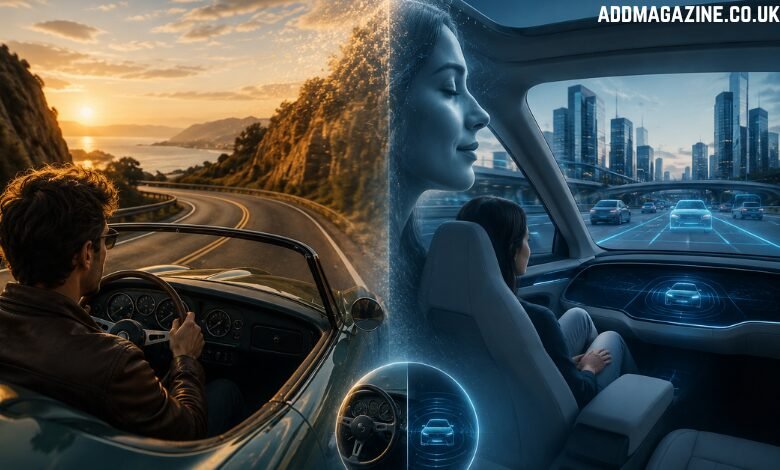
Advanced driver assistance systems now steer, brake, park, monitor blind spots, maintain lane position, and regulate speed with minimal human input. Artificial intelligence is quietly reshaping everything from route planning to predictive safety systems. Fully autonomous driving remains unevenly distributed across markets, but the direction of travel is obvious: cars are becoming less dependent on human skill.
That raises an uncomfortable question for car culture.
If driving becomes easier, safer, and increasingly automated, what happens to the emotional connection people have traditionally had with cars?
The Shift From Mechanical Skill to Digital Experience
The automotive industry has undergone a profound identity change over the past decade.
Manufacturers once competed primarily through engineering characteristics: engine refinement, suspension tuning, steering feel, and performance figures. Increasingly, competition now revolves around software ecosystems, interface design, connectivity, and automation capabilities.
In many modern vehicles, the dashboard resembles a consumer technology product more than a traditional driving environment.
This shift has created a cultural divide between drivers who see automation as progress and those who view it as the gradual removal of driving itself.
But the reality is more complicated than nostalgia versus technology.
Most drivers already accept automation when it reduces stress. Few people genuinely miss parallel parking without cameras or navigating motorways without adaptive cruise control. Driver assistance systems have improved safety significantly while making long-distance driving less physically exhausting.
The contradiction is that convenience and emotional engagement do not always coexist comfortably.
Driving Joy Was Never Just About Speed
There’s a tendency to romanticise older driving experiences as though enjoyment came purely from performance or mechanical purity. In reality, driving pleasure has always been deeply contextual.
A lightweight hatchback on a quiet B-road can feel more emotionally rewarding than a supercar trapped in traffic. A late-night drive home with music playing softly can become memorable for reasons entirely unrelated to horsepower.
Driving joy often comes from immersion and attentiveness — the feeling of being mentally present in a moment rather than simply transported through it.
Automation changes that dynamic.
When the car assumes more responsibility, the driver’s role shifts from active participant to supervisor. That reduction in engagement can make driving feel emotionally flatter, even if the overall experience becomes objectively smoother.
The irony is that many technological improvements succeed precisely because they remove friction. Yet some degree of friction is often what makes experiences memorable.
Why People Still Personalise Cars
Interestingly, even as automation increases, vehicle personalisation culture continues to grow.
This suggests people still crave emotional ownership, even if the mechanics of driving itself are changing.
Drivers personalise interiors, lighting, wheels, trims, and visual details not because these changes improve efficiency, but because they reinforce identity. In an era where many vehicles are becoming technologically similar, aesthetic individuality becomes more valuable.
That trend extends across both combustion and electric vehicles. Even highly digital EVs are increasingly customised by owners seeking emotional distinction within a standardised technological landscape.
Businesses such as Number 1 Plates reflect part of this broader personalisation ecosystem, where drivers look for subtle ways to make modern vehicles feel more individual and emotionally connected to their lives.
What’s notable is that personalisation often becomes more important as driving itself becomes less mechanical.
If cars increasingly operate like intelligent systems, drivers may seek emotional attachment through aesthetics, identity, and experience instead.
The Rise of “Calm Technology” in Cars
Modern automotive design increasingly follows the philosophy of “calm technology” — systems designed to operate quietly in the background without demanding constant attention.
Lane assist gently corrects steering inputs. Collision systems intervene before danger escalates. AI-driven interfaces anticipate routes, climate preferences, and charging behaviour.
These systems are intentionally designed to reduce cognitive load.
For many drivers, particularly in urban environments, this genuinely improves quality of life. Driving in congested cities is often tiring rather than enjoyable. Automation can reduce stress, fatigue, and distraction in ways that make modern motoring more accessible.
The problem emerges when efficiency becomes the only design priority.
Some contemporary vehicles feel so insulated, filtered, and digitally mediated that the act of driving risks becoming emotionally interchangeable regardless of the vehicle itself.
A car may be technically exceptional while feeling strangely anonymous.
Younger Drivers Define Joy Differently
Part of the tension surrounding automation comes from generational assumptions about what driving enjoyment should look like.
Traditional enthusiasts often define joy through control and mechanical feedback. Younger drivers, however, have grown up in a fully digital environment where convenience and seamless integration are normal expectations rather than compromises.
For many newer drivers, enjoyment may come less from mastering a manual gearbox and more from how effortlessly a car fits into daily life.
Technology itself can also create new forms of emotional connection. Smart lighting, adaptive interiors, integrated entertainment systems, and personalised software profiles make cars feel responsive in increasingly human ways.
In some cases, AI may strengthen attachment rather than weaken it.
A vehicle that remembers preferences, adapts behaviour, and integrates naturally into routines begins to feel less like machinery and more like a personalised environment.
That represents a very different form of automotive pleasure, but not necessarily an inferior one.
The Future of Driving May Become More Intentional
As automation becomes more common, fully manual driving may gradually shift from necessity to choice.
That could fundamentally change how people experience driving pleasure.
Historically, most driving has been functional rather than enjoyable: commuting, traffic, errands, repetitive motorway journeys. Automation may eventually absorb much of that burden, leaving human driving reserved for moments where people actively want engagement.
In that sense, automation could preserve driving joy rather than eliminate it.
The future may separate transportation from driving in the same way streaming separated music access from vinyl collecting. One becomes frictionless utility; the other becomes intentional experience.
Enthusiast culture may become smaller but more emotionally focused.
Joy Has Always Adapted Alongside Technology
Automatic gearboxes were criticised for removing involvement. Power steering was once considered artificial. Early electronic systems were accused of sanitising the driving experience.
Yet car culture adapted each time.
What people ultimately seek from cars is not always mechanical purity. More often, it’s emotion: freedom, identity, calm, excitement, solitude, exploration, or simple escape from routine.
Technology changes how those emotions are delivered, but rarely removes them entirely.
Cars may become quieter, smarter, and increasingly autonomous over the next decade. But as long as people continue attaching meaning to mobility itself, the emotional side of driving is unlikely to disappear.
It will simply evolve into something less mechanical — and perhaps more human than enthusiasts expect.