When you are a college student dealing with acne, the problem is rarely just about skincare products. It is usually a mix of stress, late-night studying, irregular sleep, fast food, and sometimes even just environmental changes like pollution or humidity. In this situation, choosing between skincare brands becomes confusing, especially when two popular names keep coming up everywhere: La Roche-Posay and Neutrogena.
Both brands are widely used for acne-prone skin, but they are not built the same way. One focuses more on dermatologist-style gentle care, while the other focuses on stronger and faster acne treatment. For a college student, the right choice depends on skin sensitivity, budget, and how consistent you can be with your routine rather than which brand is more famous.
How acne behaves during college years
Acne in college-age skin is usually not random. It is closely linked to hormonal activity, lifestyle habits, and stress levels. During this stage of life, the skin tends to produce more oil, which can easily clog pores when combined with sweat, pollution, or improper cleansing. This is why breakouts often appear on the forehead, cheeks, and jawline.
Another important factor is inconsistency. Many students switch products too quickly or use multiple strong treatments at once, which can damage the skin barrier. Instead of improving acne, this often leads to dryness, irritation, and even more breakouts. Understanding this behavior is important before deciding between La Roche-Posay and Neutrogena.
What La Roche-Posay actually focuses on
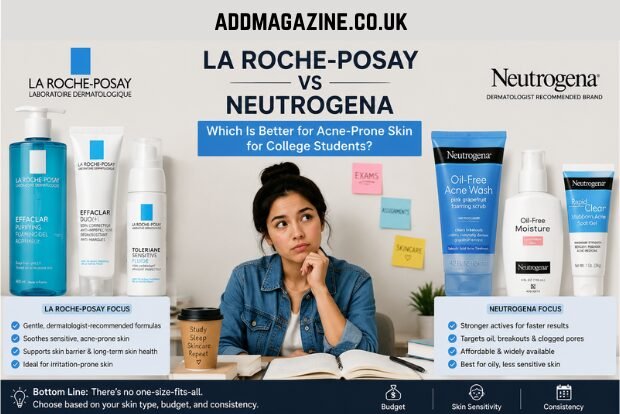
La Roche-Posay is generally considered a dermatologist-recommended brand, especially for sensitive and acne-prone skin. Its formulations are usually designed to reduce irritation while slowly improving acne over time. The brand often includes calming ingredients and avoids overly harsh combinations that can disturb the skin barrier.
In acne-specific lines, like the Effaclar range, the goal is not just to remove acne quickly but to maintain long-term skin stability. This means fewer aggressive reactions but also a slower visible change. For students whose skin easily becomes red, flaky, or irritated, this approach often feels more manageable.
What Neutrogena focuses on
Neutrogena is more focused on direct acne control and oil reduction. It is widely available, affordable, and designed for people who want visible results in a shorter time. Many of its products contain active ingredients like salicylic acid or benzoyl peroxide that target acne-causing bacteria and clogged pores.
Because of this stronger approach, Neutrogena can be effective for oily skin and active breakouts. However, the same strength can sometimes lead to dryness or tightness, especially if the skin is sensitive or if the products are overused. For many college students, it works well in the beginning but requires careful balancing with moisturizers.
Ingredient approach and how they differ
The biggest difference between the two brands comes from how they handle active ingredients. La Roche-Posay tends to use actives in a controlled and balanced way, often combined with soothing agents that protect the skin barrier. This makes it more suitable for long-term daily use without causing too much irritation.
Neutrogena, on the other hand, focuses on stronger concentrations of acne-fighting ingredients. This can reduce pimples faster but may also increase the risk of dryness or peeling if the skin is not properly supported. In simple terms, La Roche-Posay is more about stability, while Neutrogena is more about speed.
Which is better for oily acne-prone skin
If your skin is oily but not very sensitive, Neutrogena can be a practical choice because it directly targets excess oil and clogged pores. Many students notice faster improvement in active breakouts when using it consistently. However, it is important to pair it with a good moisturizer to avoid over-drying.
La Roche-Posay can also work for oily skin, but the results are usually more gradual. It focuses on balancing oil production instead of stripping it completely. This makes it a better long-term option if you want to avoid sudden dryness or irritation cycles.
Which is better for sensitive acne-prone skin
For sensitive skin, La Roche-Posay is usually the safer option. Its formulations are designed to reduce the risk of irritation while still treating acne. This is especially important for students whose skin reacts easily to strong cleansers or acne treatments.
Neutrogena can still work for sensitive skin, but it requires careful product selection and controlled usage. Using strong acne treatments too frequently can damage the skin barrier, making acne worse instead of better. Sensitive skin often responds better to slower but gentler routines.
Cost and student lifestyle factor
For college students, budget is a real concern. Neutrogena is generally more affordable and easier to find in most local stores, which makes it a practical everyday option. This affordability also helps with consistency, which is more important than brand strength.
La Roche-Posay is more expensive, but it is often positioned as a more “dermatology-level” skincare option. Some students prefer investing in fewer but more stable products, while others prefer cheaper products that can be replaced easily. Both approaches can work if the routine is consistent.
Can both brands be used together
In many cases, yes, both brands can be combined in a routine. For example, a student might use a Neutrogena cleanser for oil control and a La Roche-Posay moisturizer to maintain skin barrier health. This kind of combination often balances strength and gentleness.
However, mixing too many active ingredients from both brands can cause irritation. The key is not to overload the skin with multiple acne treatments at the same time. A simple routine usually performs better than a complicated one.
Final comparison for college students
There is no single winner between La Roche-Posay and Neutrogena. Both brands are effective but designed for different types of acne management. Neutrogena works faster and more aggressively, which can be useful for oily skin and active breakouts. La Roche-Posay works more gently and is better suited for sensitive skin or long-term barrier health.
For a college student, the real decision comes down to skin tolerance, budget, and consistency. If your skin can handle stronger actives, Neutrogena may give quicker results. If your skin reacts easily or you want a more stable routine, La Roche-Posay is usually the safer long-term choice.