
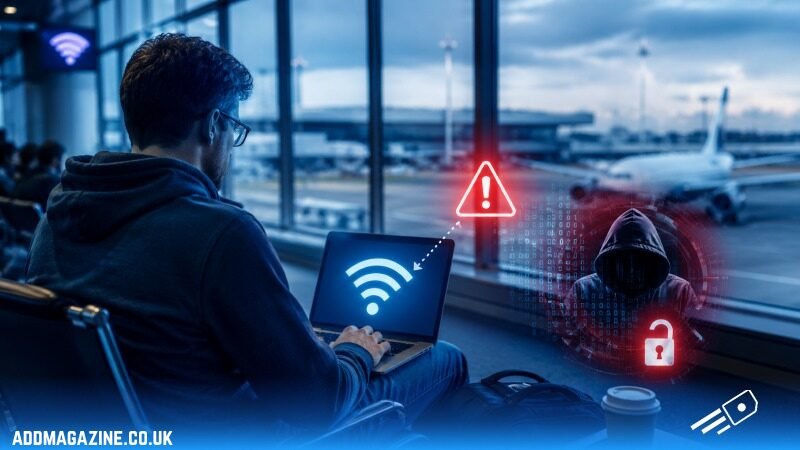
Picture this: You’ve just landed, you’re waiting at the gate, and your phone pops up with a familiar notification – “free airport Wi Fi available.” You connect without thinking twice, as most of us do. It’s free, it’s there, and you just want to check your messages before the next leg of the journey…so, what’s the issue?
Using Wi-Fi at a crowded international airport can expose travelers to security threats, including the theft of passwords and account details. In this guide, we will explore the risk that comes with using open Wi Fi and how you can protect yourself from it.
The Privacy Risks Hidden Behind Free Public Wi-Fi Networks
The issue with public WiFi security comes down to one word: encryption. Or rather, the lack of it.
When you connect to your home Wi-Fi, your router encrypts the data travelling between your device and the internet. Anyone trying to intercept that traffic sees scrambled nonsense. So, when you connect to the type of WiFi you find at airports and tourist destinations worldwide, that encryption is often absent or significantly weaker
Open WiFi networks are called so for a reason. This is what security professionals call a “man-in-the-middle” vulnerability, and it’s the foundation of attacks and dangers of public WiFi.
Five Public WiFi Risks Every Traveller Should Know
The danger of public WiFi is something every traveller should take seriously. Here are the specific risks that make security experts consistently wary of open Wi Fi settings and unprotected networks:
Evil Twin Networks
Here, a bad actor sets up a fake Wi-Fi hotspot with a name almost identical to the legitimate airport network, for example, “Heathrow_Free_WiFi” instead of “Heathrow_Free_Wi-Fi,”. Your phone connects automatically, thinking it’s the real thing, but everything you do on that connection is now visible to whoever set it up.
Packet Sniffing
On an unencrypted open WiFi network, it’s technically possible for someone with the right software to capture and read the data packets your device is sending and receiving, such as usernames, passwords, and session tokens. Basically, anything transmitted without HTTPS encryption can potentially be read in plain text.
Session Hijacking
When you log into a website, that site gives your browser a session cookie (a small piece of data that keeps you logged in). On an insecure network, that cookie can be stolen and used to access your account, such as your email or banking app, without ever needing your password.
Malware Distribution
Some WiFi networks, particularly in less regulated environments across certain tourist destinations have been used to push malware onto connected devices. A pop-up will appear asking you to update software before connecting and if you click or install it, your device will get malware.
Unencrypted Data Exposure
Even on legitimate airport Wi-Fi, your browsing activity, the apps you’re using, and the services you’re connecting to can potentially be logged by the network operator. Airport WiFi security policies vary enormously and in some countries, that data is subject to local laws that don’t offer the same protections you’re used to at home.
How Public Wi-Fi Puts Travellers at Greater Risk
Traveling internationally can increase the risks of using public WiFi due to several important factors.
No Mobile Data Means Public Wi-Fi Becomes the Default
Arriving in another country can leave you temporarily disconnected, especially when your regular mobile plan does not support international roaming. With no easy alternative available, travelers often end up relying on complimentary airport WiFi. And that moment of vulnerability is exactly when most people connect to it without a second’s thought.
Better Alternative: A Global eSIM from eSIM Cards keeps you connected on trusted local networks from arrival, so you don’t have to depend on unsecured public Wi-Fi.
Convenience Taking Priority Over Security
Travel security is harder to maintain on the road. You’re using unfamiliar networks, you’re in unfamiliar environments, and you’re probably not thinking about digital privacy at the same level you would at home.
The Threat Extends Beyond the Airport
The risks associated with unsecured WiFi extend far beyond the airport terminal. The service is available across hotel reception areas, crowded coffee shops, popular sightseeing locations, and central railway terminals.
International travel guidance is incomplete when it fails to address the potential cybersecurity risks of using public Wi-Fi at airports.
eSIMs Are a Better Way to Stay Connected While Travelling
Determining whether airport WiFi is secure requires understanding the potential risks involved in using public networks. is simpler than you think. Many regular travellers rely on travel eSIMs to reduce the security risks that often come with using unsecured public WiFi networks. An eSIM is a digital SIM card built into your phone that lets you download a local data plan before you travel. This approach keeps your connection secure without requiring you to manage unsecured WiFi settings.
eSIM Cards is one of the top provider which offers instant-activation travel eSIM plans for over 190+ destinations worldwide. You can arrive with your own private mobile data connection on major local networks without a single unencrypted public hotspot involved in the process.
A travel eSIM can also provide hotspot access, allowing your other devices to connect through your mobile data instead of relying on public airport Wi-Fi. If you want to understand how that works in more detail, the does hotspot use more data guide breaks it down clearly.
Can’t Avoid Using Public Wi-Fi? Follow These Safety Tips
Sometimes there’s no better alternative. So, if you genuinely need to use public/airport Wi Fi and have no other option, a few practices can meaningfully reduce your exposure:
- Use a VPN: A Virtual Private Network encrypts your traffic before it leaves your device, making it significantly harder to intercept even on an open network.
- Stick to HTTPS: Check that any site you’re using shows “https://” in the address bar before entering any credentials. HTTPS encrypts the specific connection between your browser and that website, even on an unencrypted network.
- Avoid anything sensitive: Avoid any banking, work emails, or accounts involving passwords or personal data entirely.
- Forget the network after use: Go to your Wi-Fi settings and tell your phone to forget the public network once you’re done. This stops your device from automatically reconnecting in the future.
- Turn off auto-connect: Open Wi Fi settings on your device and disable the option that automatically connects your phone to known networks.
Stay Connected Without Compromising Your Privacy with eSIM Cards
Airport WiFi is convenient, but it’s also one of the least secure ways to get online, in an environment specifically targeted by people who exploit that convenience. The smarter alternative is to arrive with your own connection. eSIM Cards makes that straightforward. You can buy a travel eSIM before you fly, activate it with a QR code, and land with mobile data already running on a local network without compromising digital privacy.