Most people shop for a drone the way they shop for a phone. Sensor size, bitrate, folding arms, how many minutes it stays up. All fair questions — and all secondary to the one number that decides how much of your flying will actually be legal. Take-off mass. In the EU, the gap between 249 grams and 251 grams is not two grams. It is a different rulebook, a different registration obligation, and a different answer when someone asks whether you can fly here.
I have watched a guy spend serious money on an aircraft and then find out he could only legally fly it 150 metres away from anything resembling a town. The drone was fine. He just never read the label.
H2 – The 250-gram line runs through everything
Maximum take-off mass includes the payload. That detail catches people out constantly — prop guards, a heavier pack, a small mount, and a 244-gram drone quietly becomes a 268-gram drone in a different bracket. Nothing on the box changes. Your obligations do.
In Poland, two things flip at that line. Operator registration is required for drones with an MTOM of 250 g or more, and separately for any drone carrying a sensor capable of collecting personal data — a camera, in other words — unless the aircraft meets the toy requirements of Directive 2009/48/EC. Which means the camera clause catches almost everything worth buying, including the featherweight models. The second change is competency: from 250 g upward you need the A1/A3 training and test; below that, reading the manufacturer’s manual is formally enough.
Worth saying out loud, because the marketing never does: a sub-250 g drone buys you legal freedom and pays for it in the air. Those machines get shoved around badly in 8 m/s wind, and gusts near buildings will drag them off position no matter how good the stabilisation is. Lighter is easier on paper. It is not always easier to fly.
Class marks decide what the drone is allowed to do
Since 1 January 2024, drones put on the EU market for the open category carry a class label. The letter tells you which subcategory you can operate in, and there is no arguing with it after purchase.
C0 and C1 — the two most buyers should care about
C0 covers everything under 250 g with a top speed of 19 m/s. It flies in A1, needs no remote ID, and demands nothing beyond reading the manual. C1 covers drones under 900 g or under 80 joules of impact energy, requires the A1/A3 certificate, and must have direct remote ID and geo-awareness built in. A C1 machine may fly over uninvolved people. Over an assembly of people — never, no class, no exception.
C2, C3, C4 — heavier kit, tighter leash
C2 tops out under 4 kg and unlocks A2: 30 metres horizontally from uninvolved people, dropping to 5 metres with low-speed mode engaged. That one needs the A2 certificate, a separate theory exam. C3 and C4 sit under 25 kg and are A3 only — at least 150 metres from residential, commercial, industrial and recreational areas. In a country built as densely as Poland, that requirement quietly deletes most of the spots you had in mind for Saturday morning.
No class label? Then the scales decide for you
Drones placed on the market before 2024 without a C mark, and privately built aircraft, may still be operated — in A1 if MTOM is under 250 g, and in A3 if it is under 25 kg. There is no middle option. So a 700-gram legacy machine that would happily fly A1 with a C1 label is stuck out in the fields alongside the heavy equipment. Home-built quads land in the same place, and always will: the class mark comes from a conformity assessment performed by the manufacturer, and a person soldering a frame in their kitchen is not a manufacturer in that sense.
Two limits apply across all of it, regardless of label: 120 metres above ground, and unaided visual line of sight at all times.
The paperwork costs nothing and takes one evening
This is the part people dread and then finish before dinner. Registration happens on drony.gov.pl, it is free, it runs entirely online, and the A1/A3 training and test are included at no cost. There is no medical requirement for the open category, and the whole thing is usually a single day’s work. The minimum age for a pilot is 14. Write the operator number on the airframe the same day you get it. “I’ll do it at home” is how people end up flying unmarked for a month.
Then there is the flight itself. Under the guidance in force, every flight in Polish airspace should be preceded by a formal check-in, and PAŻP’s own DroneTower app is the system for doing it. It went live on 15 April 2024, replacing the interim checkin.pansa.pl tool, and it also handles non-verbal two-way contact with air traffic control when you are operating inside a controlled zone.
If that feels like bureaucracy for a hobby, look at the traffic. By the end of 2024 Poland had almost 303,000 registered UAS operators, up 36% year on year, with more than 814,000 drone operations recorded in PAŻP systems. That is not a quiet sky anymore.
Now pick the machine — and know which hobby you are buying
Camera drones and FPV quads get sold from the same shelves and have almost nothing in common.
A camera drone holds position. Let go of the sticks and it sits there, GPS locked, gimbal keeping the horizon flat. It is a flying tripod, and it is genuinely forgiving. You will get usable footage on day one.
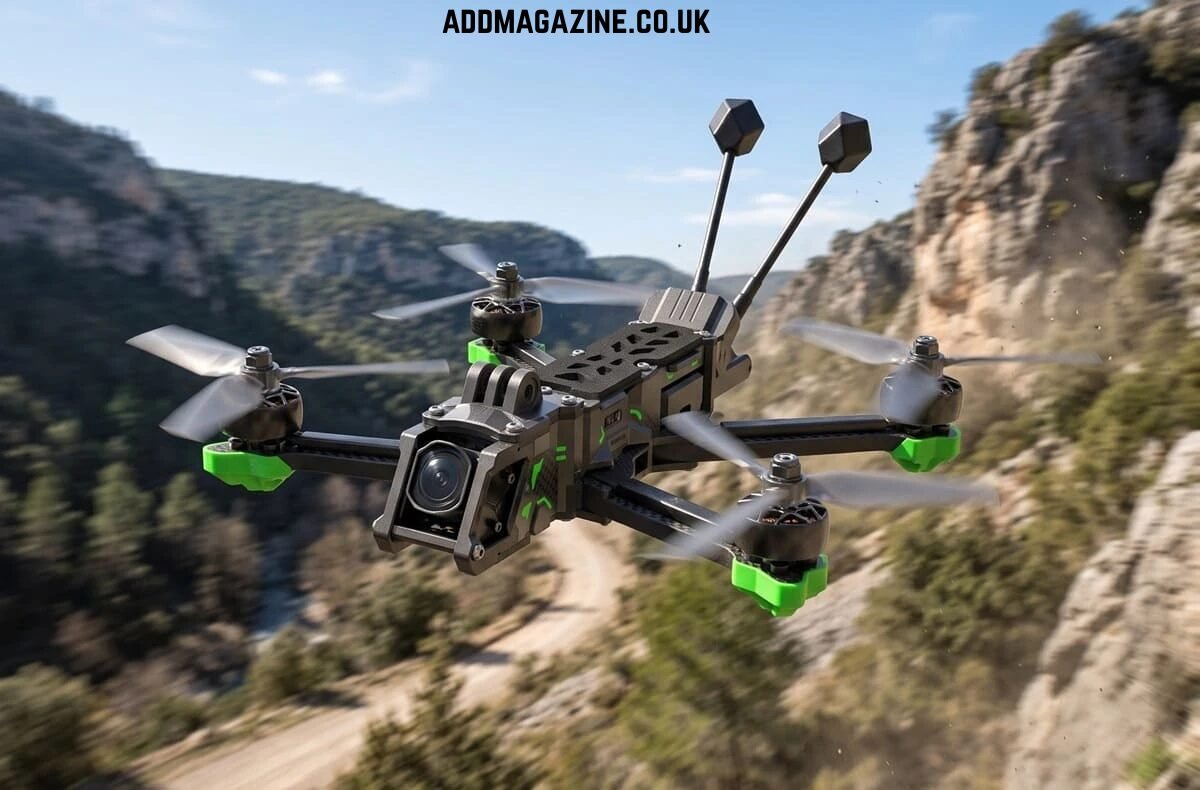
An FPV quad does not hold anything. Drop the throttle and it drops with it. You fly it through goggles in acro mode, and the aircraft does exactly what you told it to, including the stupid things. Budget 15–20 hours in a simulator before the first real pack — not to be cautious, but because crashing in a sim costs nothing and crashing a 5-inch quad costs a motor, an arm, and your afternoon.
When you get to the shopping stage, sort by take-off mass and class label before you look at anything else. A serious drone store publishes both on the product page, along with the spare parts for that model — and if a listing hides the MTOM, that tells you something about the listing.
The second invoice nobody budgets for
The aircraft is roughly two-thirds of what you will actually spend in the first month.
One battery gives you one flight. A camera drone pack runs 20-odd minutes on the box and noticeably less in cold or wind; a 5-inch FPV pack gives you four to six minutes of real flying. Four packs minimum, or you are driving somewhere to fly for twelve minutes. Add a charger that can handle them in parallel, a fireproof bag, and the discipline to store lithium cells at around 3.8 V per cell rather than fully charged — full storage kills capacity faster than flying does.
Then the small stuff that stops the day when it is missing: spare props, an SD card fast enough to sustain the bitrate you paid for, ND filters if you want cinematic shutter speeds, and a case that survives a car boot.
Where I see people get this wrong
They buy for advertised flight time and then fly eight minutes because they only own one battery. They buy a 900-gram aircraft with no class mark and discover A3 is the only door open to them. They skip the simulator and write off a quad in week one. And a lot of them take that very first flight in wind, over water, in a park full of people — three bad decisions stacked into one afternoon.
A sensible order
Register and pass A1/A3 first. Decide camera or FPV second — they are separate hobbies and separate budgets. Then choose the class mark that matches where you actually intend to fly, and only then compare specific models. Buy batteries and spares in the same order as the aircraft. Check in on DroneTower before you take off, every time.
Do it in that order and the drone arrives into a setup that is ready for it. Do it backwards and you will own a very capable machine you are not allowed to fly anywhere near your own house.