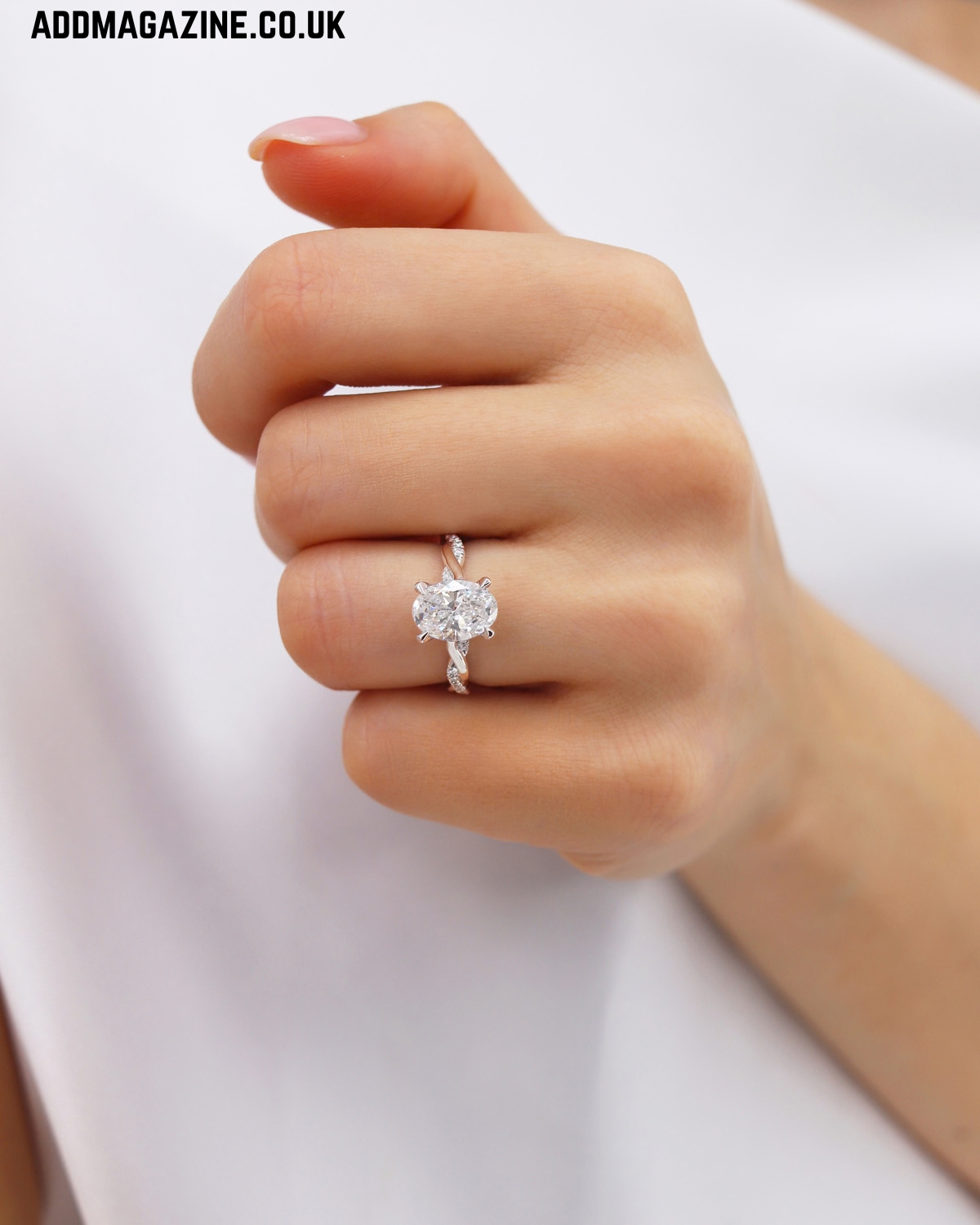
Sometimes the detail that makes you save a ring photograph is the space around the stone. Two fine lines of metal separate as they approach the centre, leaving a glimpse of skin between them. The ring has a broader outline, but it still looks open.
That is the appeal of a split-shank engagement ring. Its band divides into two or more branches near the centre setting, rather than continuing as one strip. The shape of that opening can change the whole design, from a subtle fork beneath a solitaire to a wide sweep around a halo.
What does split shank mean?
The shank forms the circular part of the ring that wraps around your finger. The divided branches usually rejoin further around it, so the design remains a single ring.
It helps to separate the band design from the stone arrangement. A split shank can support a solitaire or a halo; the term does not tell you the centre stone’s shape or how many claws hold it.
Lily Arkwright’s engagement rings offer a useful starting point for comparing a single band with a divided one. The Dahlia round lab-grown diamond solitaire, for example, combines a split shank with a four-claw setting. Look at the opening on either side of the stone, then compare it with the uninterrupted line of a conventional solitaire band.
Look at where the band divides
A split that begins close to the stone creates a small opening, so the effect can be easy to miss at first glance. When the branches separate further down the shoulders, the opening becomes a more prominent part of the ring.
Look at the gap as well as the metal. Is it a narrow slit, a soft curve or a more angular shape? Do the branches grow in roughly the same direction, or do they spread inward toward the middle? These differences explain why two rings described as split shank can feel quite different.
Use a photograph taken straight down over the ring to compare those outlines. Then look at a side view: branches that seem separate from above may meet underneath the setting. A split band can sit beneath a low or raised setting, so check its height separately.
Plain metal or diamond-set shoulders?
Plain, polished branches make the lines of the band easy to follow. They can be a good starting point if you like the divided shape but prefer a quieter ring. Pavé shoulders have small diamonds set closely together along the metal, adding sparkle to the divided outline.
Compare rings with similar centre-stone dimensions and the same metal colour where possible. Otherwise, a larger centre or a bright halo may be doing more to win you over than the split band itself.
There is also a practical difference. GIA’s guide to ring settings notes that resizing a pavé band can disturb its smaller stones. If the split shoulders carry diamonds, ask about resizing the exact design before ordering. A broad style name cannot tell you what adjustments its construction will allow.
Are split-shank engagement rings comfortable?
A split shank can cover more of the finger while leaving open space within that outline. That does not mean it will feel like a solid band of the same overall width, or automatically feel lighter or more comfortable.
Ask where the listed band width was measured. For a divided design, one number may not describe the full span of the shoulders. Request the total width from the outer edge of one branch to the outer edge of the other, as well as the width underneath your finger. That is particularly useful when buying online.
When trying it on, close your fingers naturally and hold something familiar, such as your phone. Notice whether the outer branches press against neighbouring fingers. A design you enjoy with your hand spread out should still feel comfortable when your hand relaxes.
Try a wedding band beside it
The open space within a split shank is not necessarily space for a wedding ring. The underside of the centre setting may allow a straight band to sit close, or it may push that band away. You need the side view to understand why.
Try the two rings together and check whether the wedding band obscures the lower branch or changes the gap you liked. A curved band may follow the engagement ring’s outline; a straight band may leave a visible gap that you prefer. Have the jeweller check how the rings meet, including any contact with claws or small-stone settings.
Finally, look at the pair from an ordinary distance. If the divided band was what caught your attention, it should still be a detail you can enjoy when both rings are on your hand.