

Imagine a small team preparing customer calls while also checking market changes, assembling a weekly report and planning next month’s content. The same people cover several roles. These AI agent examples treat each repeatable job as a hand-off: give an agent approved material, ask for a draft and name the person who checks it before anyone acts.
Here are the five jobs, the draft each one produces and who checks it:
| Job | Draft to inspect | Human owner |
| Meeting preparation | A sourced call brief | Sales lead |
| Competitor watch | A dated comparison | Team lead |
| Weekly reporting | Questions about exported figures | Operations manager |
| Lead research | An evidence-backed shortlist | Sales lead |
| Content materials | Topic and asset drafts | Editor |
AI agent examples need a clear hand-off
A job description for an agent needs four parts: the permitted inputs, the draft it should return, the person who reviews it and the point where the work stops. For this team, “prepare a call brief from public company pages and an approved agenda” is usable. “Handle sales” is too broad to check.
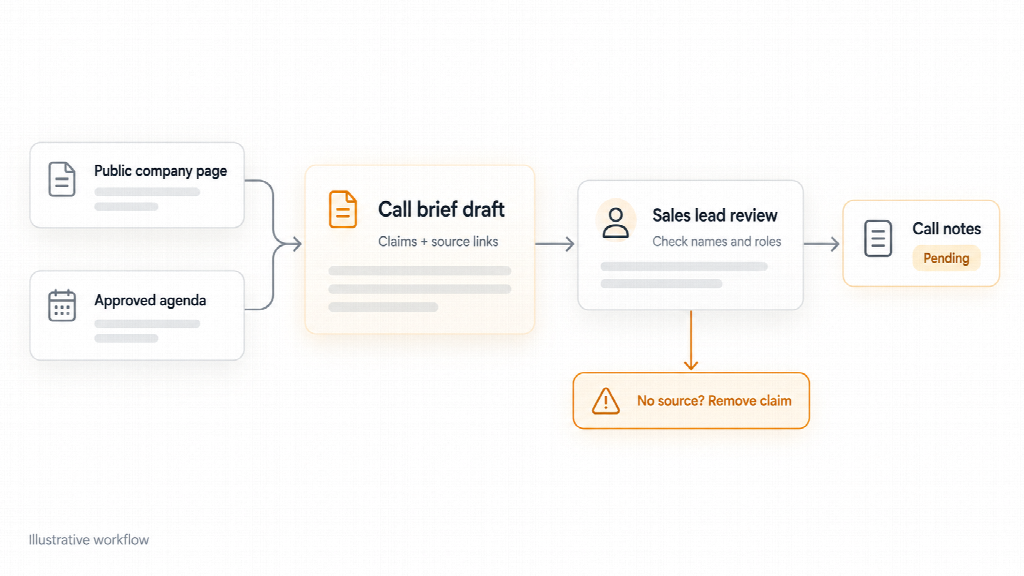
Illustrative workflow: a public company page and approved agenda feed a sourced call brief; the sales lead checks claims before using call notes.
Start with read-only material where possible. Name the date of each source and keep the original beside the draft. A job is not ready to delegate if the team cannot get trustworthy inputs or if nobody owns the review. That is a practical test for AI agents for small teams, and for business automation it means starting with work that ends in a document someone can inspect, before trying to automate an action.
Meeting preparation: make a brief, then verify it
The sales lead has a call tomorrow. An agent could take the prospect’s public company page and an agenda the team is allowed to share, then prepare a short brief with links beside each factual claim. A catalogue of ready-made AI agents by job includes a Meeting Prep Agent described as researching a company and people before a call in one brief. That is a starting point for this job, not a source of private calendar or contact data.
The lead checks names, roles and company details against the linked pages. They strike out an outdated title rather than letting it enter the call notes. The agent might also suggest questions, but the lead decides which fit this customer and the purpose of the meeting. If a key claim has no usable source, it stays out of the brief. The call should begin with facts the lead can trace.
Competitor watch: compare changes worth discussing
What actually changed? The team saves two dated versions of a public product page and a relevant review, then asks for a side-by-side comparison with URLs. The draft should separate a changed sentence or price shown on a page from a guess about why the rival changed it. Those are different kinds of statements.
The team lead opens both sources, checks the dates and decides whether the difference matters to customers. A missing old page means “change unconfirmed”, not “no change”. SpringBrand’s agent catalogue describes Competitor Analysis as lining up competitor pages, positioning and reviews side by side. It does not establish continuous monitoring here. Someone must start a recurring comparison or arrange a separate scheduler, and the lead still reviews the result. The team lead can take verified differences into the next planning meeting and leave speculation out.
Weekly reporting: draft the question, not the verdict
The operations manager sees a jump in a weekly figure. Before asking an agent to explain it, they export the report with its date range, metric definition and source. Were both weeks counted the same way? If one export uses enquiries and the other uses qualified leads, a comparison would mislead the team.
The SpringBrand site gives an example of answering questions about exports and reports. For a weekly-report job, that could help draft a list of unusual figures and questions to investigate. It does not make a scheduled, approved weekly report.
The manager returns to the original exports, recalculates any cited change and checks whether the data supports the proposed explanation. If it only shows that a number moved, the report says that. It does not claim to know the cause.
An agent may be useful for spotting a missing column or drafting a plain-English note about a definition. Sign-off stays with the manager, especially when a report will inform staffing or spending. When the data is late, the right output is a visible gap and a request for the source, not a polished paragraph that fills it in.
Lead research: show the evidence behind a shortlist
The sales lead first writes down the ideal customer profile (ICP): the type of organisation the team serves, its location and the signs that make it relevant. A vague request to “find good leads” gives the agent no defensible filter. The inputs are those criteria and public or authorised sources, with the source for each shortlisted account kept alongside it.
The draft shortlist should say why an account appears to fit, where that evidence came from and what remains unknown. The lead checks relevance, duplicates and whether a proposed contact detail is appropriate to use. An agent’s match is a research suggestion, not a qualified sales opportunity. If the evidence is thin, the record waits for human research rather than entering a contact workflow.
SpringBrand’s catalogue splits this work in two. The Lead Generation Agent finds accounts and enriches records, while the Lead Qualification Agent checks inbound leads against an ICP with the evidence attached. A small team should pick the job it actually has, and neither agent replaces the lead’s check before a record enters the pipeline.
Content materials: prepare drafts for an editor
The editor has an approved product fact sheet and a list of questions customers have asked. Those are safer inputs than an open request for “five exciting posts”.
An agent could turn them into topic options, draft copy and visual ideas. The editor compares each factual line with the approved sheet, checks that the proposed format suits the audience and removes claims the source cannot support.
The Content Creation entry in the agent catalogue covers topic research, draft posts and media creation. In this hypothetical team, the output is still material for editorial review. The editor decides what can be used, what needs a new source and whether the team has rights to any supplied media. If a draft invents a customer result, the editor rejects that claim and asks for a supported replacement before publication.
Choose one pilot with an owner and a stop rule
Pick one job whose inputs are available, whose draft is easy to check and whose mistakes can be caught before they affect a customer. Write the reviewer’s name and the stop rule on the task brief. A meeting brief should present accurate details about the company, supported by trustworthy and independently verifiable evidence.
Then choose how to produce the draft. A team could use a job-focused agent, or gather public material manually and work from exports in its existing tools. Keep the first run small enough for the owner to inspect every claim. If the owner cannot trace a statement back to its input, pause that workflow and repair the source trail before widening it.