
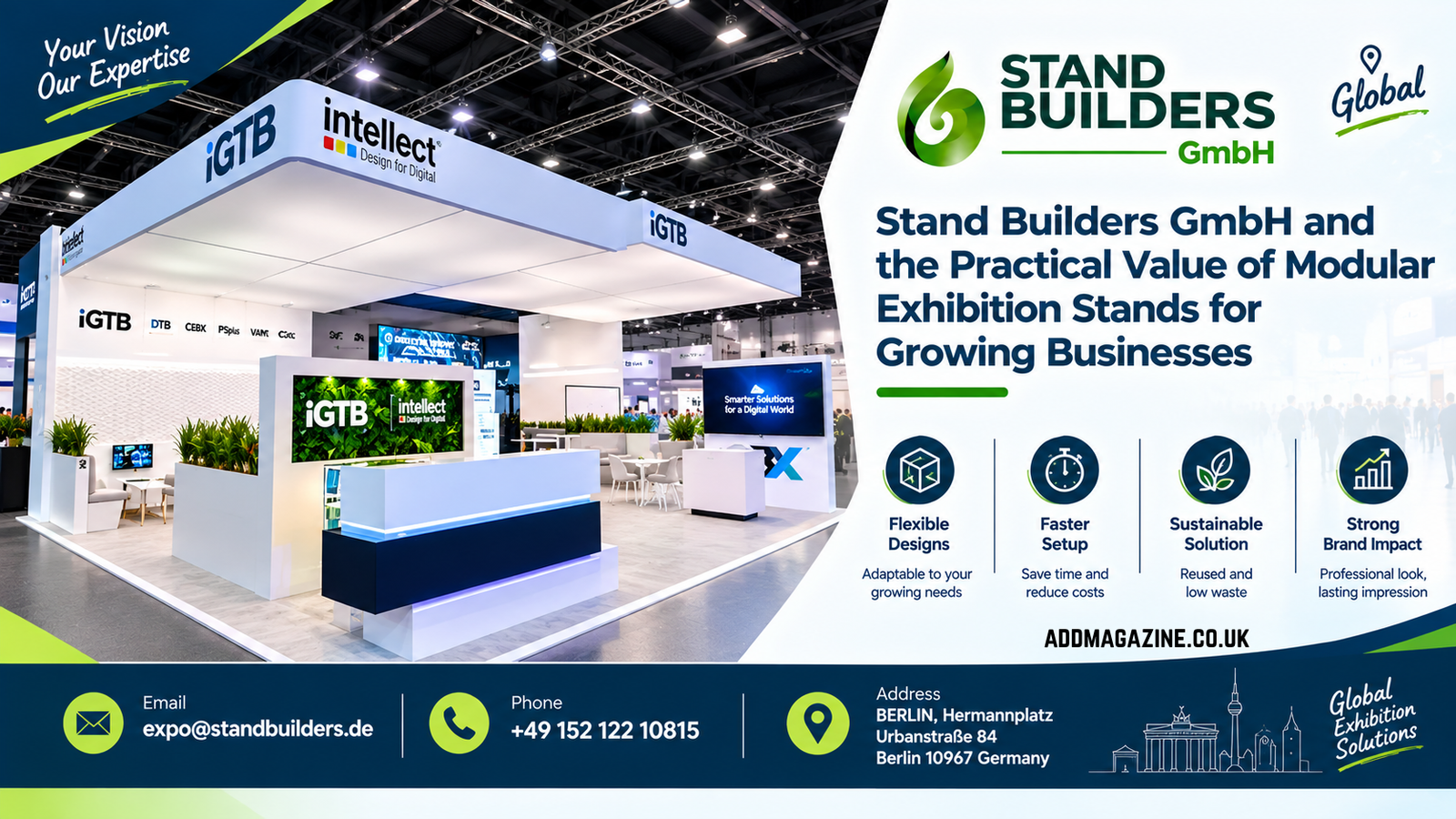
Participating in a trade fair is rarely a one-time activity for businesses looking to develop new markets. Businesses may participate in multiple trade shows each year, moving between locations and adapting their exhibition spaces to suit different venue layouts and sizes. This creates an important question: should every exhibition require an entirely new stand? Businesses searching for the best Stand builder in Germany should consider not only the appearance of a booth but also its adaptability, construction quality, transportation requirements, and potential for future use. Based in Berlin, Stand Builders GmbH develops adaptable exhibition stand systems that help businesses meet their space, design, and installation requirements.
Unlike exhibition structures created exclusively for a single layout, modular stands use interchangeable components that can be assembled into different configurations. This makes them particularly relevant for exhibitors who want a consistent brand presentation without starting the design and manufacturing process from the beginning for every event.
One Exhibition Stand, Different Venues: Understanding the Modular Approach
Consider a business planning to showcase its products at three separate trade events. Its first event offers a compact corner booth, the second provides a larger open-front space, and the third requires a different arrangement for product demonstrations. Although the company’s branding remains the same, its exhibition environment changes.
A modular exhibition stand can accommodate these differences through a system of reusable frames, panels, connectors, and display components. Instead of treating each booth as an entirely separate construction project, designers can plan how existing elements might be rearranged or supplemented.
Stand Builders GmbH develops modular exhibition stands using lightweight aluminium structures and adaptable display components. Its modular exhibition stand solutions are intended for businesses that need flexible layouts, transportable structures, and opportunities to reuse stand elements at multiple trade fairs.
The main advantage is not simply that components can be assembled again. This approach allows businesses to maintain a consistent brand presence at exhibitions while adapting their stand layout to fit each venue and event’s needs.
What Actually Makes a Modular Stand Reconfigurable?
Modular construction works through standardised components that connect to form a complete exhibition structure. Frames provide support, panels create walls or display surfaces, and accessories accommodate branding and presentation requirements.
The structure can be modified by changing the arrangement or number of compatible components. For example, a smaller booth might contain a reception counter, branded back wall, and product display. A larger version could incorporate additional display panels, a meeting area, or more extensive graphics.
However, adaptability has practical limits. Some features may not suit the chosen space or style, while specific modifications could call for different supplies or additional installation work. A modular system should therefore be planned with likely future booth sizes in mind.
This is where early discussions with an exhibition stand designer become useful. Rather than focusing exclusively on the next event, exhibitors can explain their broader exhibition schedule and identify features they expect to reuse.
How Modular Booth Design Supports Consistent Branding
A consistent visual identity helps visitors remember a company, making it easier to identify the brand at future exhibitions, even when the booth design changes.
Modular exhibition stands support this objective by allowing certain design elements to remain consistent. Brand colours, graphics, logos, and key display features can be retained while the surrounding structure is adapted.
For example, a technology company might use the same branded presentation wall at several exhibitions while adjusting the number of demonstration counters. A manufacturer may retain its visual identity but reorganise product displays depending on the equipment being introduced.
The challenge is to maintain consistency without making every exhibition presentation feel identical. Graphics can be updated, lighting can be adjusted, and product areas can be reorganised to reflect the audience and purpose of each event.
A modular structure provides the foundation, but thoughtful design determines how effectively that structure communicates the brand.
Four Key Exhibition Solutions Provided by Stand Builders GmbH
Although modular construction is useful for frequent exhibitors, different business objectives may require different stand formats. Stand Builders GmbH offers exhibition stand solutions in four distinct styles to suit different display needs.
1. Modular Exhibition Stands
Modular exhibition stands are developed from reusable, interchangeable components. Companies can easily reconfigure these booths to create exhibition spaces that match the size, layout, and specific needs of each event.
Each stand can be tailored to the project, incorporating custom branding, visitor counters, product displays, and other practical elements. They are particularly relevant when flexibility, repeated use, and manageable transportation are important considerations.
2. Custom Exhibition Stands
A bespoke exhibition booth can be built to match a company’s visual identity, venue dimensions, and product display goals, with flexibility in its structure, finishes, arrangement, and presentation elements.
Companies planning a significant product launch or aiming to create a memorable presence at a trade show often choose a bespoke exhibition stand. This approach allows the layout, appearance, and features to be tailored to the brand’s specific goals rather than following a standard modular format. Certain materials and structural elements can also be retained for future events.
3. Double-Decker Exhibition Stands
Double-decker stands provide two levels of usable space within an exhibition footprint. The upstairs space can serve as a setting for exclusive gatherings and business discussions, whilst the ground floor provides an area where guests can explore exhibits and engage with live presentations.
These structures require additional engineering considerations and approval from the exhibition organiser. Larger exhibition venues are often a better fit, as the extra space can be put to practical use.
4. Country Pavilion Exhibition Stands
Country pavilions provide a shared exhibition space where businesses can showcase their products and services under a unified national presence. They are commonly relevant to trade associations, national delegations, and organisations representing groups of businesses.
The design must balance a shared visual identity with separate presentation areas for individual participants. Clear navigation, consistent signage, and coordinated construction are important features of this format.
The Financial Question: Does Reusability Always Reduce Costs?
Modular stands are often associated with cost efficiency, but the financial benefits depend on how frequently and effectively the components are reused.
A company attending several exhibitions may avoid some repeated manufacturing expenses by retaining its existing structural elements. Lightweight components can also simplify certain transportation and handling requirements.
However, exhibitors should consider the full cost of ownership rather than looking only at the initial construction quotation.
Storage, transport between venues, replacement graphics, repairs, installation labour, and modifications can all contribute to future expenses. A structure designed without considering upcoming exhibitions may also require substantial changes before it can be reused.
The most useful approach is to compare the expected costs across several events. Businesses should ask which components can be retained, which are likely to require replacement, and whether the proposed system accommodates their typical booth sizes.
Modular construction can offer long-term value, but its advantages are strongest when future use is considered from the beginning.
From Concept to Construction: How Stand Builders GmbH Develops Modular Projects
A modular stand still requires professional planning. Reusable construction does not eliminate the need for design approval, manufacturing, technical coordination, or installation.
Stand Builders GmbH follows a project process that begins with understanding the exhibitor’s objectives, brand identity, target audience, and available exhibition space.
Its designers then prepare 3D concepts that allow clients to review the proposed appearance and arrangement of the stand. The team reviews the suggestions and makes necessary adjustments before the design is approved for manufacturing.
The company uses in-house production facilities to manufacture and prepare stand components. Its modular solutions include lightweight aluminium elements intended to provide a practical balance between strength and transportability.
Once the structure is prepared, the project continues through transportation, on-site supervision, installation, and support. The company also provides equipment removal and secure storage solutions once an event has concluded.
This connected process helps exhibitors coordinate the different activities involved in preparing their exhibition space.
Where Sustainability Fits Into Modular Exhibition Planning
The environmental value of a modular exhibition stand comes primarily from its potential for repeated use.
When suitable structural components are retained across multiple events, businesses may reduce the need to manufacture entirely new elements for each exhibition. Reusing frames and compatible accessories can also help limit discarded materials.
Stand Builders GmbH highlights reusable aluminium-based structures and recyclable materials in its modular exhibition stand offering.
Nevertheless, sustainability should be evaluated across the complete project. Transportation distances, packaging, storage, material choices, and the actual number of times a structure is reused all influence its environmental impact.
A modular stand used only once may deliver fewer environmental advantages than a system maintained and adapted across several exhibitions.
For this reason, exhibitors should discuss realistic reuse plans, component durability, and maintenance requirements during the design stage.
Before Ordering a Modular Stand, Think About the Next Three Exhibitions
One of the most useful planning exercises is to consider future events before approving the first design.
An exhibitor should review upcoming venues, expected booth dimensions, presentation requirements, and the types of products likely to be displayed. This information can help determine whether a modular system will remain practical over time.
Another key consideration is deciding which features need to be preserved over the long term. The main structural framework, brand colours, and certain display components may be retained, while graphics and presentation features can change.
Businesses should discuss the ease of dismantling, packaging requirements, storage arrangements, and the availability of replacement components.
These considerations turn modular construction from a short-term booth choice into a more deliberate exhibition planning strategy.
Conclusion
A modular exhibition stand is more than a collection of reusable panels. It is a flexible presentation system that can help businesses maintain brand consistency while adapting to different trade fair environments.
Its practical advantages include configurable layouts, reusable structural components, transportation flexibility, and opportunities to reduce repeated manufacturing requirements. However, these benefits depend on thoughtful design, realistic budgeting, and a clear understanding of future exhibition needs.
Stand Builders GmbH supports exhibitors through modular stand design, 3D visualisation, in-house production, transportation, installation, dismantling, and storage. The company also provides custom, double-decker, and country pavilion stands for projects requiring different construction approaches.
For businesses exhibiting regularly in Germany and across Europe, the important decision is not simply whether a modular stand looks attractive at the next event. It is whether the structure can continue supporting the company’s presentation needs as its exhibition programme develops.