Proceu combines two essential principles: process and utility. The methodology asserts that each task should have a defined purpose and a clear path to completion. Traditional workflows, whether in businesses or personal projects, often contain redundant steps that add little value. Proceu encourages removing these unnecessary layers to create a smoother, more focused process.
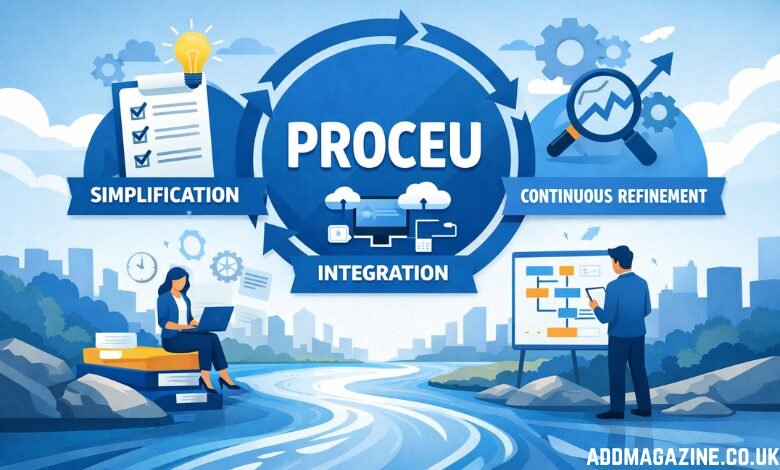
A helpful analogy is that of a river. Water flows freely when the channel is clear, yet any obstruction slows progress or creates unnecessary turbulence. Similarly, Proceu identifies friction points in workflows and clears them, allowing tasks to progress with precision and intention. It is not about rushing tasks but about ensuring the right steps are performed efficiently.
The Three Pillars of Proceu
The methodology rests on three main pillars: simplification, integration, and continuous refinement. These elements work in tandem to create streamlined and adaptable workflows.
1. Simplification
Many workflows are unnecessarily complex and could function more efficiently with fewer steps. People often assume complex problems require complex solutions, but Proceu challenges this assumption. By analyzing workflows critically, individuals and organizations can identify steps that do not contribute to the end goal.
Simplification involves asking fundamental questions: Is this task necessary? Does it add measurable value? Any task that fails to contribute meaningfully is eliminated from the workflow. The result is a lean, focused process that reduces wasted effort and allows teams to concentrate on meaningful activities.
2. Integration
Modern operations often involve a range of tools, from email clients to project management software and cloud storage systems. Moving between disconnected tools wastes time and focus, slowing down overall productivity.
Proceu promotes a connected ecosystem where information flows seamlessly across platforms. For example, when sales and marketing systems are integrated, data moves without manual transfer, reducing delays and errors. Integration not only enhances operational speed but also ensures that insights and actions are based on comprehensive information.
3. Continuous Refinement
No process remains ideal indefinitely. Markets evolve, technologies advance, and user behaviors change. Proceu emphasizes ongoing assessment and improvement. Regularly monitoring workflows helps identify bottlenecks or outdated steps, allowing adjustments before inefficiencies escalate.
This iterative approach ensures that processes remain effective over time. Rather than striving for a static “perfect system,” Proceu focuses on sustainable optimization, maintaining balance between structure and flexibility.
Practical Benefits of Proceu in Organizations
Organizations implementing Proceu often see benefits that extend beyond cost savings.
Cost Efficiency
Eliminating unnecessary steps and automating repetitive tasks naturally reduces expenses. Streamlined processes require fewer resources, and fewer errors lead to lower corrective costs.
Employee Engagement
Monotonous or redundant tasks can demotivate employees. Proceu frees teams from routine, low-value work, allowing them to focus on creative problem-solving and meaningful contributions. This helps employees feel more engaged, lowers stress, and encourages them to stay longer.
Enhanced Customer Experience
Internal efficiency directly affects external performance. For example, streamlined order processing ensures timely deliveries, and integrated customer support systems allow staff to access complete client histories without repeated questions. A smooth internal process translates into reliable, responsive, and professional service for customers.
Applying Proceu to Personal Life
Proceu is not limited to business environments. Individuals can adopt its principles to create more organized, less stressful daily routines.
Morning Routines
A simple example is reducing morning chaos. Instead of searching for keys or misplaced items, one can implement small organizational systems like hooks or designated storage spaces. These minor adjustments prevent repeated friction and save time daily.
Financial Management
Managing recurring tasks like budgeting or bill payments can also benefit. Automating transfers, creating standard expense tracking templates, and maintaining consistent organization reduces mental load, leaving more energy for decision-making and strategic planning.
Household Tasks
Even mundane chores, such as grocery shopping, can be systematized. Standard shopping lists, scheduled orders, and streamlined meal planning reduce the time spent repeating tasks. This allows focus on activities that provide more value or enjoyment.
Overcoming Challenges in Adopting Proceu
Implementing a new methodology often encounters resistance.
Habitual Resistance
People are accustomed to familiar routines, even if inefficient. Overcoming this requires clear communication about the purpose of change. Emphasizing how Proceu reduces frustration and workload can help individuals embrace new approaches willingly.
Over-Optimization
Excessive refinement can become counterproductive. Spending too much time perfecting systems may delay the actual work. Proceu advocates balance: systems should support productivity rather than dominate it.
Leadership Role
Successful adoption requires guidance. Leaders must model the methodology, provide clear rationale, and encourage team feedback. Leadership ensures that Proceu principles are implemented consistently without becoming burdensome.
Technology and Proceu
Advances in AI and machine learning make Proceu even more relevant. Automation and data analysis can be handled by machines, but human judgment remains essential for designing workflows that align with organizational goals.
AI can execute repetitive tasks efficiently, but it cannot inherently determine the value or ethical implications of processes. Human oversight ensures that automation is applied wisely, enhancing effectiveness without compromising quality or principles.
Proceu in Modern Business Contexts
Businesses that embrace Proceu gain a strategic advantage. By creating efficient internal systems, they respond faster to customer demands, adapt to market shifts, and allocate resources more effectively.
Operations and Supply Chain
Clear, integrated workflows reduce delays and errors in logistics, procurement, and production. This enables consistent product quality and on-time delivery.
Data Management
Integrating systems ensures data integrity and accessibility. Decision-makers can rely on accurate, up-to-date information, reducing miscommunication and redundant work.
Innovation and Growth
By eliminating low-value tasks, teams have more bandwidth to explore new ideas, implement improvements, and innovate. A culture of ongoing refinement encourages experimentation within a structured framework.
Key Takeaways
- Purposeful Actions: Every task should contribute meaningfully to a goal.
- Clear Workflow: Eliminate unnecessary steps to create smoother operations.
- Integrated Systems: Tools and processes should communicate efficiently.
- Continuous Improvement: Evaluate and adjust workflows regularly to maintain relevance.
- Applicability: Proceu can enhance both professional and personal routines.
Getting Started with Proceu
To implement Proceu effectively:
- Map Your Current Processes: Identify all tasks and workflows, noting redundancies.
- Prioritize Simplification: Remove steps that do not add measurable value.
- Enhance Integration: Use software or systems that facilitate seamless communication.
- Set Feedback Loops: Monitor performance and identify friction points.
- Iterate: Regularly refine workflows to adapt to changing needs and technologies.
Even small adjustments, when consistently applied, compound into significant efficiency gains.
Conclusion
Proceu is not merely a set of tools or a productivity hack. It is an approach that emphasizes clear purpose, streamlined processes, and actions that deliver real results. By focusing on simplifying workflows, integrating tools, and continuously refining processes, individuals and organizations can reclaim time, reduce stress, and enhance outcomes.
In business, this approach improves operational performance, employee satisfaction, and customer experience. In personal life, it creates a more structured, less chaotic daily routine. The principles of Proceu are straightforward, yet their impact is profound.
Ultimately, Proceu represents a shift in mindset: from simply doing more to doing better. By consciously aligning actions with purpose and streamlining processes, anyone can achieve more while working less. This methodology is not a temporary trend—it is a framework for sustained efficiency and clarity in a complex, fast-moving world.