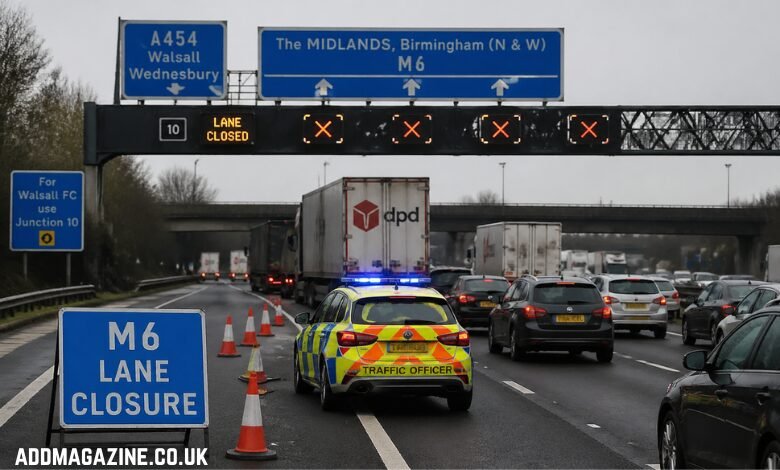
On March 23, a significant traffic incident unfolded on the M6 southbound between Walsall and Wednesbury, leading to a major disruption for commuters. The collision, which involved multiple lorries, resulted in the closure of three lanes on one of the busiest motorways in the UK. In this article, we will explore the details of the incident, the resulting traffic issues, and the measures taken to mitigate the impact on the road users. Additionally, we’ll delve into the ongoing and upcoming works on the M6 corridor, which are likely to affect traffic flow in the coming years.
The Incident: A Brief Overview
The morning of March 23 saw a major accident on the M6 southbound between Junction 10 (Walsall) and Junction 9 (Wednesbury). The crash, involving several heavy goods vehicles (HGVs), led to the closure of lanes two, three, and four. National Highways reported the incident just before 9:00 AM, and within moments, the motorway became a scene of significant congestion.
Traffic cameras situated at Junction 11, Cannock, a little further north, showed a two-mile tailback with traffic moving at a slow pace. The closure of three lanes on this busy section of the motorway exacerbated the situation, leading to delays that stretched well beyond the immediate area of the crash.
National Highways quickly took to social media to warn motorists about the ongoing situation. Their message included specific details about the closed lanes and the approximate length of the traffic queues. In a tweet, they noted that delays were increasing and urged drivers to plan ahead.
The closure was a result of the severity of the crash, which required significant clearing operations to remove the damaged vehicles and debris from the road. During this time, emergency services were on site, working to ensure that the motorway could be reopened as quickly and safely as possible.
The Aftermath: Traffic Disruptions
The M6 is one of the UK’s most critical motorways, serving as a major artery connecting the Midlands to the rest of the country. As such, any incident on this route can have widespread consequences for road users. The crash near Walsall on March 23 was no exception, as it caused significant delays for drivers traveling from the north of the country towards Birmingham.
After the lanes were closed, traffic on the M6 southbound had to be diverted or channeled through fewer lanes, causing the already heavy traffic to slow down even more. The two-mile queue, reported by National Highways, was just a glimpse of the widespread disruption. Commuters traveling to Birmingham, Walsall, and beyond faced lengthy delays, with some even having to divert onto alternative routes.
It’s not just the drivers directly involved in the incident who felt the effects of the disruption. The knock-on impact affected other routes in the area, as vehicles attempted to find alternative paths to bypass the M6 closure. Local roads quickly became congested as a result of the motorway incident, further compounding the already stressful situation.
National Highways’ Response: Ensuring Safety
In response to the incident, National Highways implemented a series of measures to ensure the safe and efficient management of traffic. These included the closure of multiple lanes to allow emergency services to clear the crash site safely and a public communication campaign to keep motorists informed about the situation.
In addition to the traffic management efforts, National Highways also issued advice to motorists to avoid the affected area and plan their journeys accordingly. By alerting drivers early to the ongoing closure and providing updates, they helped to alleviate some of the uncertainty that drivers often experience during traffic disruptions.
Ensuring safety remained a top priority throughout the process. While the crash was being cleared, the authorities made sure that the motorway remained safe for drivers to use once the lanes were reopened. This included carrying out thorough checks to ensure that the carriageway was free of debris and any other hazards before allowing traffic to flow freely again.
Ongoing Development of the M6 Corridor
While the March 23 incident caused temporary disruption, it is not an isolated event in the ongoing development of the M6 corridor. The M6 is a key route for both domestic and international transport, and its continued maintenance and improvement are essential for the smooth operation of the UK’s transportation network.
The M6 South Viaduct: A Major Infrastructure Project
One of the significant projects currently underway on the M6 is the construction of the M6 South viaduct, which will carry a new high-speed railway over the motorway. This viaduct, part of the larger infrastructure works related to the development of the HS2 railway, is a critical component of the government’s transportation strategy.
Impact on Traffic Flow During Construction
The project will have a significant impact on traffic flow in the area, with lane closures, diversions, and temporary closures of the motorway expected during different phases of construction.
Phase One of the M6 South Viaduct Launch
In fact, work on the M6 South viaduct has already begun. The first phase of the viaduct launch was completed in June 2025, with the launch of the first section over the M6 Junction 4 off-slip. This work is not expected to be completed until at least 2027, and it will involve several additional phases, including the closure of both northbound and southbound lanes of the M6 for extended periods.
Phase Two: Major Closures and Disruptions Ahead
From September 2025 onwards, Phase Two of the viaduct project will commence, including overnight lane closures between Junctions 4 and 4A. Further closures will be implemented over weekends, with full carriageway closures scheduled between Junctions 4 and 4A, and M42 Junction 7A to M6 southbound, for a full weekend closure in late September 2025.
Managing the Complexities of Construction
These closures will undoubtedly affect traffic in the region, especially as the HS2 project progresses. The ongoing work highlights the complexities of maintaining and improving the M6 while ensuring the safety of workers and the smooth flow of traffic for the millions of drivers who rely on the motorway each day.
Impact on Drivers and Businesses
The construction works and occasional lane closures are bound to continue affecting the M6’s traffic flow, especially for local businesses and commuters who rely on this route to travel between Birmingham, Walsall, and other parts of the Midlands. Businesses dependent on road freight, for example, will need to plan ahead to avoid delays caused by lane closures or road diversions.
For individual drivers, the closure of key sections of the M6 can mean extended travel times, higher fuel costs, and the inconvenience of dealing with traffic backups. Many drivers, particularly those traveling during peak hours, will need to reconsider their routes and adjust their travel schedules accordingly.
The M6 closures also highlight the challenges faced by local authorities and businesses in managing the flow of traffic during periods of construction. While necessary for the long-term improvement of infrastructure, these disruptions are a reminder of how crucial it is for road users to stay informed about ongoing projects and adjust their plans accordingly.
Safety Measures: How Authorities Are Managing Traffic During Roadworks
As the M6 corridor continues to undergo significant changes, both due to accidents and planned infrastructure projects, the role of National Highways and other local authorities becomes even more critical in overseeing traffic flow and prioritizing the protection of all motorists. These authorities have a clear mandate to minimize disruption while ensuring that workers remain safe during construction activities and that the public can still travel efficiently.
In response to the recent closures and to prepare for the ongoing works, National Highways and local traffic management teams are implementing a range of strategies. These include:
Advanced Traffic Signaling
Digital variable message signs (VMS) are placed well in advance of the affected areas to inform drivers of closures, delays, and diversions. These signs provide real-time updates and can be adjusted as conditions change. In the case of the M6 crash on March 23, this advanced warning was crucial for motorists, allowing them to alter their routes if necessary.
Diversion Routes
For major closures, such as those related to the M6 South viaduct works, National Highways will provide well-established diversion routes to guide drivers around the affected areas. These diversions are planned to ensure that traffic flows as smoothly as possible, though they can still result in delays, particularly if other parts of the network become congested.
Overnight and Weekend Closures
To minimize the impact on commuters, many of the M6’s closure times are scheduled for overnight hours or weekends. This reduces the impact on daily traffic, though it can still affect those traveling during these times. It also gives workers more time to complete necessary tasks, such as the incremental launch of the viaduct sections or the installation of new lighting.
Live Traffic Updates and Alerts
National Highways and local authorities are actively monitoring the traffic conditions around the clock. This helps them provide live updates to road users, which include traffic speed, delays, and the availability of alternative routes. Additionally, authorities work closely with local radio stations and digital platforms to broadcast urgent information when necessary.
The Role of Technology in Managing M6 Traffic
As we move into a more digitally connected era, technology continues to play an increasingly important role in traffic management on major roads like the M6. National Highways has invested in several technological advancements to help manage traffic more effectively.
- Intelligent Traffic Systems (ITS): These systems use real-time data from sensors embedded in the road surface, traffic cameras, and GPS tracking of vehicles to provide a comprehensive picture of current traffic conditions. By analyzing this data, authorities can detect traffic jams, accidents, and other potential hazards, and respond in real time. This is essential for minimizing congestion and improving safety.
- Drone Technology for Accident Management: In some cases, authorities are using drones to assess accident scenes from above, particularly when dealing with large-scale incidents involving multiple vehicles. These drones can quickly provide detailed images of the crash site, helping emergency services to manage the scene more efficiently and safely.
- Smart Road Signs: In addition to traditional VMS, there are now signs that are capable of adjusting their messages based on traffic conditions. For example, if a significant incident occurs, these signs can display warnings and detour instructions, making it easier for drivers to understand which lanes are closed and what their best options are.
- Mobile Apps for Real-Time Updates: National Highways and other agencies have developed mobile apps that provide up-to-date traffic information, route planning, and even alerts for specific roadworks or incidents along the M6. These apps can be incredibly useful for daily commuters who need to plan ahead to avoid major delays.
Impact on Local Communities and Businesses
While the long-term benefits of the M6 upgrades are clear—improved infrastructure, reduced congestion, and enhanced safety—local communities and businesses are experiencing short-term challenges.
Local Communities: Navigating Disruptions
For residents near the M6, the roadworks and lane closures can be a constant source of frustration. The frequent closures and detours often lead to increased traffic in residential areas, particularly during rush hour. This creates a noisy and polluted environment, which can be detrimental to the quality of life for those who live close to the motorway.
Local authorities are aware of these issues and have been working with National Highways to minimize disruption in nearby neighborhoods. This includes offering noise mitigation measures during construction and encouraging the use of quieter roadworks techniques. Additionally, authorities have been collaborating with local police to manage traffic on secondary routes, which are sometimes used as diversions when the M6 is closed.
Businesses: Adjusting to Roadwork Disruptions
For businesses that rely on the M6 for transport and distribution, such as logistics companies, the lane closures can significantly affect operations. For example, a distribution company might face delays in delivery schedules due to increased travel times or unexpected diversions. The impact on freight and logistics could result in increased costs for these businesses, which may be passed on to consumers.
To mitigate the effects on businesses, some companies are adjusting their operations. For example, businesses are exploring alternative transport routes or shifting their delivery schedules to avoid peak travel times when roadworks are most likely to cause delays.
Looking Ahead: What Motorists Should Expect
As we move further into 2025 and beyond, the M6 will continue to be an important part of the UK’s road network, and the ongoing construction works will undoubtedly continue to impact drivers in the region. For those traveling through the Walsall to Birmingham corridor, the need to stay up to date with traffic information will be paramount.
Motorists should ensure that they plan their journeys in advance, particularly when they know there are ongoing works in the area. Using apps and resources from National Highways, such as real-time traffic updates and travel planning tools, can help drivers avoid unnecessary delays. Additionally, it is advisable to factor in extra time for travel, especially during peak hours when traffic is most likely to be affected.
As the M6 South viaduct project progresses and additional phases of work continue to roll out, drivers can expect more disruptions in the coming months and years. The key will be to stay informed, plan ahead, and remain patient as the necessary works are carried out to improve the UK’s transport infrastructure.
Conclusion
The M6 southbound closure near Walsall on March 23, caused by a crash involving multiple lorries, was a stark reminder of the importance of road safety and the impact that such incidents can have on traffic flow. While the immediate disruption was resolved relatively quickly, the ongoing construction works on the M6 corridor—such as the M6 South viaduct—suggest that similar disruptions may continue in the future.
Motorists should remain vigilant, plan their routes in advance, and adjust their travel schedules when necessary. With infrastructure improvements and roadworks on the horizon, staying informed about the latest developments on the M6 will help ensure a safer and more efficient journey for all road users.