You can spend years reading about menopause and still be completely blindsided by what it does to your hair. Hot flushes get the headlines. Hair changes? Not so much. Yet for a huge number of women in their forties and fifties, the shifts in their hair are among the most unsettling parts of the whole experience.
Nobody really prepares you for finding a completely different texture in the mirror one morning, or noticing your ponytail is half the thickness it used to be. There’s a lot to unpack here, so let’s take a proper look at what’s actually happening and why.
Why Your Hair Feels Like It Belongs to Someone Else
The main driver behind most midlife hair changes is hormonal. As oestrogen and progesterone levels decline during perimenopause and menopause, androgens (male hormones that all women carry in small amounts) become relatively more dominant. This shift affects every stage of the hair growth cycle.
Hair that was once thick and glossy can start to feel coarser, drier or wiry. Some women find their naturally straight hair develops a wave or kink. Others lose curl definition they’ve had their whole lives. None of it is your imagination, and none of it means you’re doing something wrong.
Texture Shifts That Catch You Off Guard
One of the least-talked-about changes is porosity. Hormonal shifts can alter how your hair absorbs and retains moisture, which is why products that worked perfectly for decades suddenly stop performing. Your hair isn’t damaged. Its structure has genuinely changed.
Grey hair adds another layer to this. Grey and white strands tend to have a different texture to pigmented hair. They’re often more resistant, drier and prone to frizz. If you’re going grey at the same time as experiencing hormonal changes, the combination can make your hair feel almost unrecognisable.
Slower Growth and More Shedding
Hair grows in cycles. During the growth phase (anagen), individual follicles produce hair for anywhere between two and seven years. In midlife, this phase shortens, which means hair doesn’t grow as long before it falls out. You’ll also notice the resting phase lengthening, so more hairs are in the shed phase at any given time.
This is why brushing your hair suddenly seems to result in much more than it used to. Some shedding increase is entirely normal, but it’s worth keeping an eye on whether it stabilises or continues to worsen over time.
The Role of Iron and Ferritin in Midlife Shedding
One factor that often gets overlooked during this stage is iron. Perimenopausal women are particularly vulnerable to low ferritin levels because heavier or more irregular periods can deplete iron stores faster than the body can replenish them.
Iron is essential for carrying oxygen to your hair follicles, and when levels drop, follicles can enter the resting phase early, leading to increased shedding. What makes this tricky is that standard blood tests may show your haemoglobin as normal while your ferritin sits well below the level your hair actually needs to grow properly.
If your shedding feels disproportionate to the hormonal changes you’re experiencing, it is well worth asking your GP for a full iron panel rather than relying on a basic blood count alone. Catching a deficiency early can make a real difference to how quickly your hair recovers.
When Thinning Becomes More Than a Cosmetic Concern
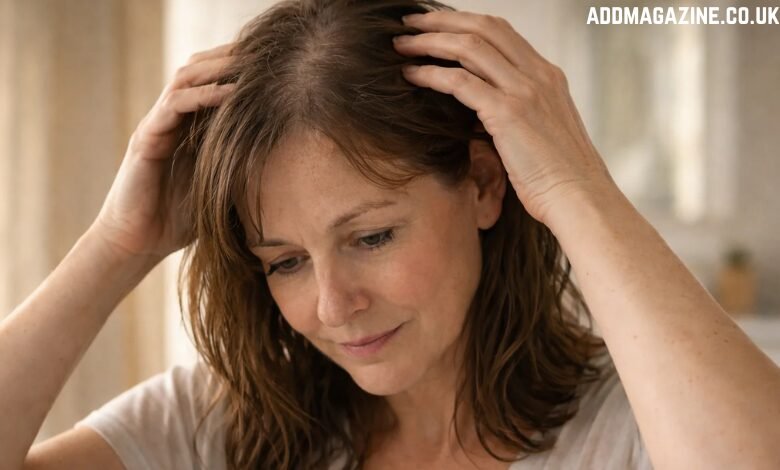
There’s a difference between hair feeling thinner and experiencing genuine female pattern hair loss. The latter typically shows up as diffuse thinning across the top of the scalp, a widening parting or increased scalp visibility. It tends to be gradual and progressive rather than a sudden change.
For women in this situation, there are real clinical options available. Minoxidil remains one of the most well-evidenced topical treatments. And for women whose hair loss has progressed significantly, a surgical route is now on the table. Treatment Rooms London is one of the best clinics women are turning to in the UK, offering surgeon-led consultations specifically for female hair loss patients where every step of the process is handled by the same doctor from start to finish.
It’s worth having a consultation sooner rather than later if you’re concerned. Hair loss that’s addressed early tends to respond better to treatment.
What You Can Do Day to Day
Not all midlife hair changes require clinical intervention. Plenty can be helped with some straightforward adjustments:
- Switch to a sulphate-free shampoo. These are gentler on hair that’s lost moisture-retention ability.
- Use a bond-building or protein treatment once a week to support structural integrity.
- Reduce heat tool use where possible, or always use a heat protectant. Post-hormonal hair is more vulnerable to damage.
- Check your diet. Iron deficiency and low ferritin are surprisingly common in perimenopausal women and can accelerate shedding.
- Talk to your GP about HRT. For some women, hormone replacement therapy has a noticeable positive effect on hair thickness and growth rate.
The Emotional Side Nobody Talks About Either
Hair is deeply tied to identity for many women. Watching it change, particularly when you can’t quite pin down why or stop it, can be genuinely distressing. It’s worth saying plainly: that response is entirely valid.
The good news is that awareness is growing, both clinically and culturally. More specialists now take female hair loss seriously, more treatments exist than ever before, and more women are talking openly about it instead of suffering quietly.
What It All Comes Down to
Midlife hair changes are common, real and remarkably varied. Some are cosmetic and manageable with product tweaks. Others signal something worth investigating properly. The key is knowing the difference between normal hormonal shifts and progressive thinning that warrants a conversation with a professional.
Your hair will very likely change in your forties and fifties. But change doesn’t have to mean loss of control.