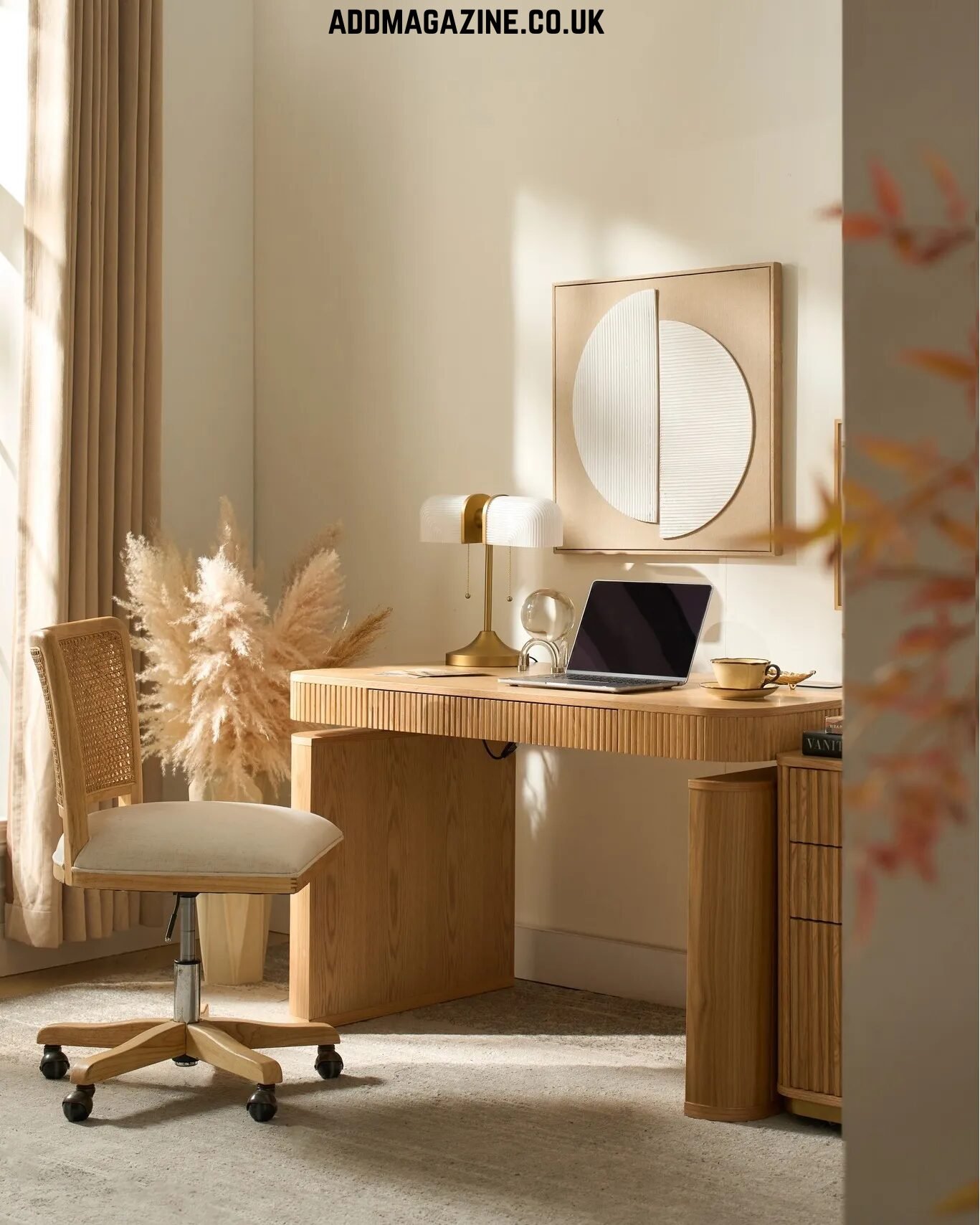
The furniture that serves the body and the room — and why finding both in one object took longer than it should
The British Interior as a Design Brief
There is a particular quality to a well-considered British domestic interior that resists easy description. It is not the result of a single design decision or a coordinated purchase. It is, rather, the result of accumulation — of objects chosen at different times, under different circumstances, that have somehow arrived at a state of visual coherence. The lamp that was inherited. The chair that was chosen twenty years ago and has been in four different homes. The floor that has been lived on long enough to carry its history in its surface.
What distinguishes this kind of interior from a designed one — from a room that was installed rather than accumulated — is warmth. Not warmth in the colour-temperature sense, though warm tones are often part of it, but warmth in the sense of a room that has been touched by life. Where aged timber has been touched by hands and light for decades. Where objects have the kind of provenance that comes not from a certificate of authenticity but from the simple fact of having been somewhere, done something, belonged to someone.
This is the design brief the British domestic interior sets for every object that enters it. Not ‘does this function well?’ — that is a minimum, not a merit — but ‘does this belong here?’ The standing desk interiors UK question, in other words, is not whether a standing desk is ergonomically justified. It is whether it can pass the belonging test.
Why Ergonomic Furniture Usually Fails It
Ergonomic design is, by its nature, a body-centred discipline. It optimises for human physiology — for spine angle and elbow height and visual field and weight distribution. It tests in controlled conditions: the laboratory, the office, the controlled use study. These are the conditions it was designed for, and it performs well in them.
British domestic interiors test under entirely different criteria. The question is not how does this support the body at 11am on a Tuesday. The question is how does this look at 7am, before the laptop is opened and the room is still itself. How does it look at 7pm, when the working day is over and the room has to be somewhere you want to be, not somewhere you have to be. How does it relate to the floor it stands on, the wall behind it, the objects around it that were chosen before it arrived and will, in all likelihood, outlast it.
Ergonomic furniture has been consistently slower than most other furniture categories to engage with these questions. It has proceeded on the assumption that function is sufficient — that if a product serves the body well enough, the room will accommodate it. In a British domestic interior, that assumption is almost always wrong. The room does not accommodate. It evaluates. And it evaluates by criteria that no ergonomics specification can satisfy.
The Standing Desk’s Specific Challenge
Of all ergonomic furniture categories, the standing desk faces the most acute version of this problem. It is height-variable by definition — which means it is never, at any given moment, the height it will be at another moment. It has a motor, which means it has a controller, which means it has a keypad with buttons that need to be accessible from the surface, which means there is a rectangle of plastic or metal on the face of the desk frame that reads, regardless of what surrounds it, as office equipment.
It has cables. Not just the power cable for the motor, but the cables for whatever is on the surface — monitor, laptop, keyboard, phone charger. A standing desk in motion is a cable-management event: a set of connections that have to flex and travel with the surface as it rises and falls. Even the best cable management solutions leave traces. In a room where the visual logic demands that objects do not announce their mechanical nature, a motorised desk is a challenge.
And then there is the surface itself. The standing desk has spent most of its commercial history offering surfaces in materials that are correct for offices and wrong for homes. Laminate that photographs convincingly and reads cheaply in person. Engineered wood with a printed grain pattern that looks nothing like the real thing in the specific quality of light in a north-facing British room at nine in the morning. These are surfaces designed for function and indifferent to context.
What Julia Resolved
Design objects carry their decisions in their materials. Walk through what the Julia’s specific material choices argue, and you walk through a set of domestic-aesthetic problems solved.
The solid wood surface rather than laminate: this is not merely a quality decision, though it is that. It is a contextual decision. Real timber has tonal variation — it reads differently in morning light than afternoon light, differently in a warm room than a cool one. It ages in the way that domestic objects age: acquiring, over time, the particular quality of something that has been lived with rather than simply used. In a room full of objects with that quality, a laminate desk surface announces itself as the exception. A solid wood surface joins the conversation.
The clean square edge tabletop: a design decision that speaks precision and considered craftsmanship. In a period room, clean square edges read as furniture-grade quality — the visual language of something made to belong in a domestic setting, not deployed in a commercial one. This is not decorative. It is the difference between an object that reads as installed and an object that reads as chosen.
The warm-toned base where the category default is silver or black: this is the decision that has the largest single impact on how the desk reads in a domestic room. A silver base announces its office origins from across the room. A warm-toned base recedes — it relates to the floor, to the skirting, to the warm tones that accumulate in any lived-in British interior. It is a decision that says: I was designed for this room, not relocated into it.
The built-in drawer and cable management are the functional completions of this design philosophy: a desk that has thought about daily life in a domestic room at the level of the small things — the phone and notebook and earphones that accumulate on any working surface, the cables that would otherwise trail and announce the desk’s mechanical nature — as well as at the level of the large aesthetic argument.
Available in Cocoa Walnut and Light Oak, the Julia standing desk from Hulala Home represents, in our view, the most complete current answer to the question the British domestic interior poses to ergonomic furniture: not can you function here, but can you belong here?
The Standard British Interiors Sets
The British domestic interior is not, finally, a style category. It is not a collection of Pinterest boards or a set of purchasing decisions. It is a quality of attention — the accumulated evidence of someone having cared, over time, about the space they live in. It is, in the truest sense, a design critic. Not a professional one, not a theoretical one, but a practical one: a critic that evaluates every object that enters it by the simple, unforgiving standard of does this belong here.
Ergonomic furniture has spent too long assuming it is exempt from this evaluation. The standing desk, in particular, has proceeded on the assumption that its functional virtue — its genuine ergonomic benefit, its real improvement to the quality of the working day — entitles it to spatial residence regardless of visual merit. It does not. No object is exempt from the belonging test.
What the best current standing desks have finally begun to understand is that passing the belonging test is not a compromise of function. It is an extension of it. A desk that belongs in your room is a desk you will use every day, for years, without ever feeling the low-level dissatisfaction of an object that should not be there. The ergonomic benefit compounds. The room stays right. The object earns its place.
That is the standard British interiors set. It is a high one. The category is, at last, beginning to meet it.