Not every engineering problem can be solved by adding more material. In aerospace structures, motorsport components, and defense systems, the design constraint is often the opposite — maximum strength within a fixed weight and volume envelope. When engineers face this constraint, the aluminum alloy specification decision frequently leads to one conclusion: 7075-T73.
Among commercially available aluminum alloys, 7075 occupies a distinct position at the top of the strength range. Its zinc-based alloying system produces tensile strengths approaching those of mild steel at roughly one-third the density — a performance ratio that makes it irreplaceable in applications where structural failure is not an acceptable outcome and weight is simultaneously non-negotiable.
What Makes 7075-T73 the Strongest Commercial Aluminum Alloy?
7075 aluminum belongs to the Al-Zn-Mg-Cu (7000 series) family — the highest-strength group of structural aluminum alloys in commercial production. The primary alloying elements are zinc (5.1–6.1%), magnesium (2.1–2.9%), and copper (1.2–2.0%). This combination produces a dense precipitation structure during artificial aging that significantly exceeds the strengthening mechanisms available in 6000-series (Al-Mg-Si) alloys.
The strength of 7075 comes from the formation of MgZn₂ precipitates during aging — a phase that creates a finely dispersed obstacle network that impedes dislocation movement through the alloy’s grain structure. The result is a material with tensile strength values that overlap with structural steel grades, at a density of just 2.81 g/cm³.
The T73 temper designation is a critical part of the specification. T73 indicates the alloy has undergone a two-stage overaging process specifically designed to maximize resistance to stress corrosion cracking (SCC) — a failure mechanism that affects 7075 in the peak-strength T6 temper under sustained tensile stress in corrosive environments. The T73 overaging process reduces tensile strength by approximately 10–15% compared to T6, but eliminates the SCC susceptibility that makes T6 unreliable in many structural and aerospace applications.
Mechanical Properties in Detail
Engineers evaluating 7075-T73 aluminum for structural applications will find a property profile that consistently supports demanding load cases across aerospace, defense, and industrial programs:
7075-T73 Mechanical and Physical Properties
| Property | 7075-T73 Value |
| Ultimate Tensile Strength | 469 MPa (68 ksi) |
| Yield Strength | 400 MPa (58 ksi) |
| Elongation | 11–13% |
| Brinell Hardness | 135 HB |
| Density | 2.81 g/cm³ |
| Elastic Modulus | 71.7 GPa |
| Shear Strength | ~283 MPa |
| Fatigue Strength | ~159 MPa (at 5×10⁸ cycles) |
| Thermal Conductivity | ~155 W/m·K |
The tensile strength of 469 MPa places 7075-T73 well above 6061-T651 (310 MPa) and significantly above 5052-H32 (228 MPa). For structural members carrying high compressive or tensile loads in weight-constrained assemblies, this strength advantage directly translates to reduced cross-section and lower component mass.
The elongation of 11–13% is a meaningful indicator of toughness — despite its high strength, 7075-T73 maintains adequate ductility for structural applications where crack initiation under dynamic or impact loading must be avoided. Fatigue strength of approximately 159 MPa at 5×10⁸ cycles supports the alloy’s use in cyclically loaded aerospace and motorsport structures.
Industries That Depend on 7075-T73
The combination of high strength, controlled toughness, and stress corrosion resistance positions 7075-T73 across sectors where structural failure carries severe consequences.
Aerospace Structures
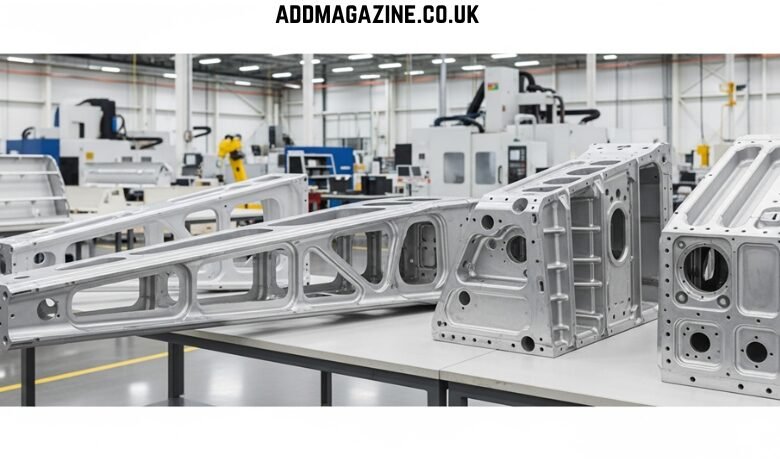
7075-T73 plate and forgings are used extensively in commercial and military aircraft primary structures — fuselage frames, wing spars, bulkheads, and rib structures where weight reduction is directly linked to fuel efficiency and payload capacity. The T73 temper’s SCC resistance is mandatory for thick-section plate and forged components in sustained-load structural roles, where T6 material would be disqualified by stress corrosion susceptibility under flight load conditions.
Defense and Military Systems
In defense applications, 7075-T73 is used for armored vehicle structural components, weapons system housings, missile airframe sections, and ground support equipment requiring high strength-to-weight performance. Military specifications — including MIL-DTL-7079 for plate and MIL-DTL-22771 for forgings — frequently designate T73 as the required temper for thick-section structural applications.
Motorsport and High-Performance Vehicles
Formula 1, endurance racing, and high-performance road car programs specify 7075-T73 for uprights, suspension links, gearbox casings, and structural chassis nodes where minimum weight and maximum rigidity are simultaneously demanded. The alloy’s specific strength (strength-to-density ratio) exceeds titanium alloys at significantly lower material cost, making it the dominant high-strength aluminum specification in competitive motorsport.
Precision Tooling and Mold Plates
The combination of hardness (135 HB), dimensional stability, and machinability makes 7075-T73 plate a standard material for plastic injection mold tooling, jigs, fixtures, and vacuum forming tools. The T73 stress relief provides the dimensional stability required for precision tool surfaces that must maintain form accuracy through repeated thermal cycling.
T6 vs T73 Temper — Why the Difference Matters for Engineers
The choice between T6 and T73 temper is one of the most consequential specification decisions in 7075 aluminum engineering. Both tempers use the same base alloy with the same solution heat treatment, but diverge significantly in their aging process and resulting properties.
7075-T6 vs 7075-T73 — Property and Application Comparison
| Property | 7075-T6 | 7075-T73 |
| Tensile Strength | ~572 MPa | ~469 MPa |
| Yield Strength | ~503 MPa | ~400 MPa |
| Elongation | 11% | 11–13% |
| SCC Resistance | Poor | Excellent |
| Fatigue Life | Slightly higher | Good |
| Typical Use | Thin sheet, non-critical structures | Thick plate, primary structures |
T6 delivers peak strength — approximately 22% higher tensile strength than T73 — but carries significant stress corrosion cracking risk in sustained-load applications, particularly in the short-transverse grain direction of thick plate. For this reason, aerospace and defense specifications for primary structural members in sustained tension routinely mandate T73 or T7351 temper, accepting the strength reduction in exchange for reliable SCC performance.
T6 remains appropriate for thin sheet applications (typically under 25mm), non-structural components, and applications where sustained tensile stress is not a service condition. For thick plate used in machined structural components, aerospace bulkheads, and any application involving sustained loading in corrosive environments, T73 is the required specification — not a conservative option.
How to Source High-Quality 7075-T73 Aluminum
Sourcing 7075-T73 for structural and aerospace programs requires attention to certification, temper verification, and supply chain traceability that exceeds standard commercial procurement requirements.
Essential sourcing criteria include compliance with ASTM B209 for sheet and plate, AMS 2770 for heat treatment process control, and AMS 4078 for 7075-T73 plate specifically. For aerospace and defense applications, suppliers must provide full mill test certificates documenting chemical composition, mechanical test results per heat lot, and heat treatment batch traceability.
Thick plate in T73 and T7351 temper requires verification that the two-stage aging process was performed to specification — suppliers should provide aging cycle documentation or material certifications confirming compliance with the applicable AMS or ASTM standard.
For structural programs requiring consistent supply of certified 7075-T73 plate and bar, working with an established Aluminum Manufacturer in China with documented aerospace material certification capabilities and international logistics experience provides access to competitively priced material that meets the exacting standards of structural and defense engineering programs.
Conclusion
7075-T73 aluminum earns its position at the top of the commercial aluminum strength range through a property combination that no competing alloy replicates: tensile strength approaching mild steel, density one-third that of steel, SCC resistance suitable for sustained-load structural applications, and machinability that supports precision component production.
For structural engineers, defense program managers, and aerospace procurement teams, the specification decision for high-stress aluminum components frequently comes down to whether the application demands peak strength (T6) or the combination of high strength and proven stress corrosion resistance that only T73 delivers. In primary structural roles — where in-service failure is not an option — T73 is the specification that engineers have relied on for decades.