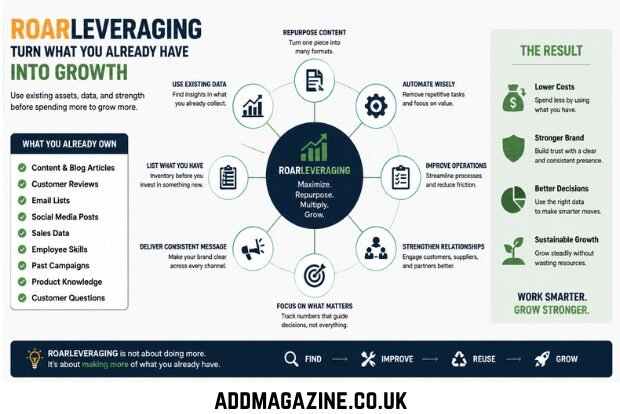
The Roarleveraging Business Infoguide by Riproar is based on the idea that companies can achieve stronger growth by making better use of their current resources before increasing spending on new initiatives.
This guide is not about loud advertising for the sake of attention. It is about building a clear business presence, using data with discipline, and making better use of people, content, tools, customer relationships, and brand reputation. For small companies, startups, service providers, online sellers, agencies, and creators, this approach can offer a useful way to plan growth without depending only on bigger budgets.
The other is leverage: the ability to get more value from existing work, information, platforms, and relationships. When these two needs are handled together, growth becomes less random and more controlled.
What Roarleveraging Means in Business
The “roar” represents how the business is seen and perceived by the public. The “leveraging” part refers to using assets already inside the business instead of always creating something from zero.
A company may already possess valuable resources such as blog content, customer testimonials, subscriber lists, social media assets, sales insights, employee expertise, previous marketing efforts, and customer feedback. Yet many of these assets remain underutilized while the business continues investing in new marketing campaigns, additional software, or expensive advertising initiatives.
Roarleveraging asks a simple question: what can be improved, reused, combined, or redirected before more money is spent? A sales report may show which product deserves more attention. A training document may become part of an onboarding system. The framework turns ordinary material into business fuel.
The Purpose of the Infoguide
The Roarleveraging Business Infoguide by Riproar is best viewed as a structured reference for applying this approach. Its purpose is to help a business examine its current position, identify underused resources, and create a plan that links branding, marketing, operations, and customer value.
Many business guides focus on one area only. Some focus on branding, others on sales, automation, content, or analytics. A company may have good content but weak distribution. It may have strong data but unclear messaging. The infoguide is useful because it encourages the business to look at the full system.
Why Businesses May Need This Approach
Most companies struggle not from a shortage of ideas but from poor execution and resource management. A brand may post regularly but without a clear message. A team may use several software tools but still depend on manual work. A company may collect customer information but never use it to improve offers or service. Roarleveraging deals with this gap between activity and outcome.
The approach is especially useful for businesses operating with limited budgets. It has to compete by being clearer, faster, more focused, and more consistent. This requires knowing which resources already have value and where they can be applied.
Building a Clear Business Voice
A clear business voice does not mean using dramatic language. Without this clarity, even good marketing becomes weak.
The first step is to define the core promise. A company should be able to explain its value in plain language and keep that explanation close to what customers actually need.
Consistency builds recognition. It also prevents mixed signals. When a brand communicates differently across platforms, customers can struggle to understand its true identity and value.
Auditing Existing Resources
Before pursuing new resources, a company should inventory existing tools, content, and capabilities. Private resources like client databases, workflow systems, sales documentation, email templates, team expertise, and vendor connections are also part of this.
Conducting the audit requires serious attention rather than being a routine checklist exercise. It should ask which assets still work, which are outdated, which can be improved, and which are being ignored. An article attracting steady organic visitors may perform better with clearer prompts that encourage readers to take the next step. A highly viewed video can be repurposed into bite-sized segments for broader distribution.
Content Repurposing as a Growth Tool
Reusing and adapting existing content illustrates roarleveraging in its most practical form. Creating original content takes time. Research, writing, filming, editing, designing, and publishing all require effort.
A long article can become social posts, a newsletter, a short video script, a client handout, or part of a sales presentation.
This approach helps a business stay active without creating pressure to produce new ideas every day. It also keeps messaging consistent. When content comes from the same strategic source, the brand voice becomes easier to recognize.
Using Customer Data Without Overcomplication
Customer data can support better decisions, but many businesses either ignore it or make it too complicated. Roarleveraging treats data as a practical tool. The key is to look for patterns that affect revenue, service quality, retention, and customer satisfaction.
Valuable data can consist of patterns like repeat buying habits, recurring customer complaints, abandoned shopping carts, email engagement rates, traffic sources, common inquiries, and reasons for product returns. These details can help a business understand what customers actually do instead of relying only on assumptions.
Frequent customer inquiries can indicate areas on the website that require clearer explanations or guidance. Consistent customer concerns often highlight underlying weaknesses in a product, service, or business process. Data becomes leverage when it leads to action.
Automation and Process Improvement
Within roarleveraging, automation handles routine tasks, freeing staff to focus on decision-making, strategy, and innovation, rather than replacing every function. The aim is to automate the right things.
These systems reduce delays and make the business more reliable.
Process improvement matters just as much. A company should document repeated work so it can be done consistently. This may include how leads are handled, how content is approved, how customer complaints are escalated, or how reports are reviewed. Well-defined workflows enable teams to work more efficiently by eliminating uncertainty and unnecessary delays.
Applying Roarleveraging to Marketing
Marketing under this framework starts with focus. A business should not try to appear everywhere simply because every platform is available. It should choose channels based on where customers pay attention, how they make decisions, and what type of content supports the buying process.
A local service business may benefit from search visibility, reviews, and referral systems. An online education brand may depend on email, video, and community engagement. Business-to-business companies can effectively reach prospects by leveraging informative content, client case studies, webinars, and focused outreach efforts. The channel matters less than the fit between the audience and the message.
Applying Roarleveraging to Operations
Growth is not only a marketing issue. If operations are weak, more attention can create more problems. For this reason, the infoguide approach should include internal systems.
Operational efficiency can increase by outlining the entire customer journey, from initial engagement through repeat sales. Each step should be examined. Where do leads get delayed? Where do customers become confused? Are there critical responsibilities that rely heavily on a single individual to be completed? Which errors happen repeatedly? These questions reveal where leverage is needed.
Measuring What Matters
A roarleveraging strategy should be measured. Without measurement, businesses may confuse activity with progress. Posting daily, launching campaigns, or adding tools does not always mean the company is moving forward.
The right measures depend on the business model. Common indicators include leads, conversion rate, customer acquisition cost, average order value, retention rate, repeat purchases, response time, website traffic quality, email engagement, and customer satisfaction. Success comes from focusing on meaningful performance indicators rather than tracking every piece of available data. The focus should be on measuring data that supports informed business decisions.
Measurement should lead to review. If leads increase but response time slows, the sales process may need support. If customer retention improves after better onboarding, that system should be strengthened.
Common Mistakes to Avoid
One mistake is treating roarleveraging as a shortcut. It is not a trick for instant growth. Businesses still need good products, honest service, and consistent execution.
A Practical Implementation Plan
In the first week, it can audit content, customer data, tools, and internal processes.
During week two, the company should focus on clarifying and strengthening its central value proposition. This includes rewriting the main offer, updating website language, aligning social profiles, and preparing a short explanation that the team can use consistently.
In the third week, the company can choose three assets to leverage. It may update a strong blog post, turn a customer story into a case study, or create an email sequence from common buyer questions. The focus should be on practical reuse.
In the fourth week, the business can set measurement rules. It should decide which numbers matter, how often they will be reviewed, and who is responsible for changes. This keeps the strategy active rather than theoretical.
Final Thoughts
Roarleveraging Business Infoguide by Riproar is useful because it places attention on business discipline. It reminds owners and teams that growth is not always about adding more. Sometimes the better move is to use existing resources with more care, connect scattered work, and make the brand message easier to understand.
The framework works best when it is treated as a habit, not a one-time project. A business should keep checking its assets, improving its message, listening to customers, and measuring outcomes. Over time, this can lead to stronger visibility, lower waste, and more stable growth.
For businesses that feel busy but not effective, this approach offers a direct way to regain control. It starts with what the company already has and asks how each part can work harder. That is the main value of roarleveraging: not making more noise, but turning useful resources into clearer results.