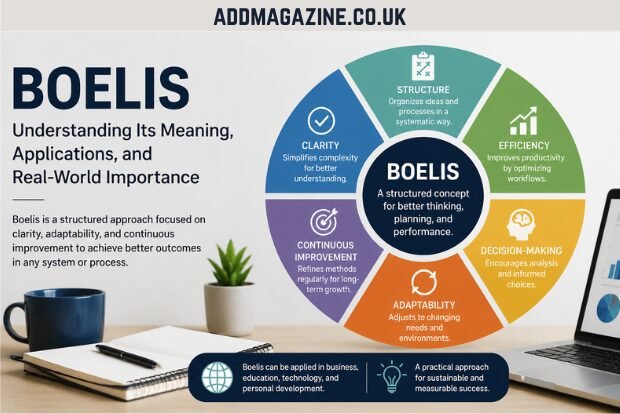
Boelis is a term that appears in different contexts, often without a fixed or universally agreed definition. In some discussions it is treated as a concept, in others as a framework, and in certain professional environments it is used to describe a structured way of handling processes or ideas. Because of this flexibility, boelis does not belong to a single field. Instead, it adapts depending on how people apply it.
At a basic level, boelis can be understood as a method of organizing thinking and actions in a more structured and outcome-focused way. It is associated with clarity, system-based reasoning, and improving how tasks or decisions are handled. While the term may seem abstract, its value comes from how it is used in practice rather than a fixed dictionary meaning.
This article explores boelis in a practical and realistic way—how it is understood, where it is applied, and why it is becoming more relevant in environments that rely on structured decision-making and efficiency.
Understanding the Meaning of Boelis
Boelis is best described as a structured approach to improving processes, thinking patterns, or systems. It is not a single tool or software, nor is it limited to one industry. Instead, it works as a guiding principle that emphasizes order, logic, and continuous refinement.
In simple terms, boelis focuses on three core ideas:
- Breaking complex problems into smaller parts
- Creating structured methods to solve those parts
- Improving outcomes through repetition and adjustment
Unlike rigid systems that follow fixed steps, boelis allows flexibility. It adjusts based on the situation while still maintaining structure. This balance between adaptability and order is one of its defining characteristics.
In many cases, people use boelis without labeling it. For example, when a team improves a workflow by identifying weak points, reorganizing tasks, and testing better solutions, they are applying a boelis-style approach.
The Conceptual Origin of Boelis
The idea behind boelis can be traced to broader principles of systems thinking and process optimization. It does not originate from a single inventor or institution. Instead, it reflects a gradual evolution of how humans approach efficiency and structured problem-solving.
Early forms of similar thinking were seen in engineering, management science, and academic research. Over time, as systems became more complex, the need for simplified yet structured approaches increased. Boelis emerged as a term used in some discussions to represent this shift toward organized adaptability.
In modern usage, boelis has expanded beyond technical environments. It is now referenced in discussions involving planning, digital systems, education, and even personal productivity.
Core Principles Behind Boelis
Although boelis can vary in application, several core principles remain consistent across its usage.
1. Structure Over Randomness
Boelis encourages a structured approach to tasks. Instead of handling problems in an unorganized way, it promotes creating a clear sequence or system.
2. Continuous Improvement
Nothing under boelis is considered final. Every process can be reviewed and improved over time.
3. Practical Decision-Making
Decisions are based on analysis and observation rather than assumptions or guesswork.
4. Adaptability
While structure is important, boelis also allows changes when conditions shift. It is not rigid.
5. Outcome Focus
The main goal is always improved results, whether in productivity, understanding, or efficiency.
These principles make boelis useful in both simple and complex environments.
Applications of Boelis in Real Environments
Boelis is not limited to theory. It appears in multiple real-world areas, often without being directly named.
Business and Management
In business environments, boelis is reflected in workflow optimization and operational planning. Companies use structured systems to reduce delays, improve communication, and increase productivity. When managers analyze performance data and adjust strategies accordingly, they are applying boelis principles.
Technology and Digital Systems
In technology, boelis can be seen in system design, software development, and data organization. Developers often break problems into modules, test solutions, and refine code. This step-by-step structured process aligns closely with boelis thinking.
Education and Learning
Students and educators use boelis-like methods when organizing study plans or simplifying complex topics. Breaking subjects into sections, reviewing them regularly, and improving understanding over time reflects the same structured approach.
Personal Productivity
On an individual level, boelis appears in daily planning, time management, and habit formation. People who create routines, track progress, and adjust their behavior based on results are naturally applying boelis principles.
Benefits of Boelis
The growing interest in boelis comes from its practical benefits rather than theoretical appeal.
Improved Clarity
Boelis helps reduce confusion by organizing information into clear structures. This makes it easier to understand complex topics.
Better Efficiency
By focusing on structured steps, tasks are completed more efficiently. Time and resources are used more effectively.
Stronger Decision-Making
Decisions become more reliable because they are based on analysis rather than assumptions.
Long-Term Stability
Instead of short-term fixes, boelis promotes solutions that remain effective over time.
Reduced Errors
Structured processes help identify mistakes early, reducing the chance of repeated errors.
These benefits explain why boelis-like approaches are widely used in professional and academic environments.
Common Misunderstandings About Boelis
Despite its usefulness, boelis is often misunderstood.
Misunderstanding 1: Boelis Is a Fixed System
Some people think boelis refers to a strict method with defined rules.
Misunderstanding 2: Boelis Guarantees Instant Results
Boelis is not a shortcut. It improves processes gradually through consistent refinement.
Misunderstanding 3: It Is Only for Experts
Boelis is not limited to professionals.
Misunderstanding 4: It Is a Technology or Tool
Boelis is not software or a digital platform. It is a way of thinking and organizing actions.
Understanding these misconceptions is important for using the concept effectively.
Boelis in Modern Systems
Modern environments are becoming increasingly complex. Businesses handle large amounts of data, education systems manage diverse learning needs, and individuals deal with constant information flow. In such conditions, boelis becomes more relevant.
It provides a way to manage complexity without losing structure. For example, in data-heavy environments, boelis helps organize information into usable formats. In planning systems, it ensures that goals are aligned with execution steps.
As systems continue to expand, structured thinking models like boelis become more valuable.
Relationship Between Boelis and Efficiency
Efficiency is one of the central outcomes of boelis. However, it is important to understand that boelis does not focus only on speed. It focuses on balanced efficiency—combining speed, accuracy, and sustainability.
A process may be fast but unreliable. Another may be accurate but slow. Boelis aims to find a middle ground where systems perform well consistently over time.
This is achieved through:
- Removing unnecessary steps
- Improving weak points in processes
- Reorganizing tasks logically
- Testing and refining outcomes
Through this approach, efficiency becomes stable rather than temporary.
Future Relevance of Boelis
As systems become more automated and data-driven, structured approaches will play a larger role. Boelis is expected to remain relevant in this shift because it supports adaptability and organization.
In future environments, where artificial intelligence, automation, and large-scale data systems dominate, the need for clear frameworks will increase. Boelis aligns with this requirement by offering a flexible but structured way of thinking.
- Digital system design
- Strategic planning
- Learning models
- Organizational workflows
Its adaptability ensures that it can evolve with changing environments.
Applying Boelis in Daily Practice
Using boelis does not require special tools. It begins with small behavioral changes:
- Organizing tasks before starting work
- Breaking large goals into smaller steps
- Reviewing progress regularly
- Adjusting methods when needed
- Focusing on clear outcomes
Over time, these habits create a structured way of thinking that improves decision-making and productivity.
The key is consistency. Boelis is not about one-time effort but continuous refinement.
Conclusion
Boelis represents a structured way of thinking that focuses on clarity, adaptability, and continuous improvement. It is not limited to a single field or definition but instead acts as a flexible framework that can be applied across different environments.
Its strength lies in simplicity—breaking down complexity into manageable systems and improving them step by step. Whether used in business, education, technology, or personal life, boelis helps create order in situations that might otherwise feel unstructured.
As modern systems continue to grow in complexity, approaches like boelis will remain important for maintaining clarity and efficiency in both professional and personal contexts.