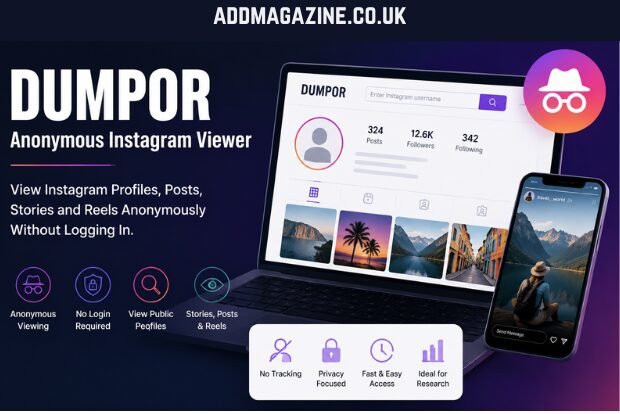
Dumpor is part of a broader category of online tools built around viewing public Instagram content without logging into an account. It is often discussed in the context of anonymous browsing, where users want to explore posts, profiles, and stories without leaving behind visible activity on the platform.
Interest in tools like Dumpor has grown alongside changes in how people use social media. Instagram is widely used for personal expression, branding, marketing, and news sharing. At the same time, not every user wants to engage directly with content through likes, follows, or account creation. Some prefer observation only, and this is where third-party viewers enter the discussion.
This article explains Dumpor in a clear and structured way. It focuses on how such tools are positioned in the digital ecosystem, what users expect from them, how they function at a basic level, and what limitations and risks are commonly associated with them.
What Dumpor Represents in the Social Media Ecosystem
Dumpor is commonly described as a web-based interface that displays publicly available Instagram content without requiring a login. It is not part of Instagram’s official system but instead works as an external layer that reflects accessible data.
The key idea behind tools like Dumpor is separation. Instead of interacting with Instagram directly, users interact with a third-party interface that organizes and displays public data in a simplified format.
In practice, this means users can search for a public username and view associated content such as profile information, posts, and sometimes stories or reels, depending on availability. However, this access is limited strictly to what Instagram already makes public.
Dumpor does not create new content or unlock restricted profiles. It functions as a viewer rather than a data source.
How Anonymous Viewing Tools Generally Work
To understand Dumpor, it helps to understand the basic structure of tools in this category.
Instagram, like most social platforms, allows public content to be accessed through web interfaces. Public profiles and posts are visible without authentication in many cases. Third-party viewers rely on this publicly exposed layer.
These tools typically work in one of the following ways:
- Data aggregation from public endpoints
They collect information that is already accessible on public profiles. - Reformatting content for external viewing
Instead of showing content inside Instagram’s interface, the tool organizes it on its own website. - Search-based navigation
Users enter a username or keyword, and the system attempts to locate matching public profiles.
This process creates the impression of anonymity because users are not interacting directly with Instagram servers through a personal account session. However, it is important to understand that anonymity here refers to user-side visibility, not necessarily full invisibility across the internet.
Key Features Commonly Associated with Dumpor
While exact functionality can vary depending on availability and platform changes, tools in this category typically offer a similar set of features.
1. Public Profile Viewing
Users can view publicly available Instagram profiles without logging in. This usually includes profile photos, usernames, bios, and follower-related indicators.
2. Post Browsing
Public posts such as images and videos may be accessible through the interface. Captions and hashtags are often displayed as part of the content preview.
3. Story Access (when available)
Some tools claim to allow viewing of public Instagram stories. However, this feature is not always stable due to Instagram’s changing policies and technical restrictions.
4. Search Functionality
A search bar is usually the main entry point. Users type a username, and the system returns matching public accounts.
5. Lightweight Interface
These tools are typically built to stay straightforward and easy for anyone to use. They avoid complex navigation or social features like commenting or liking.
Why People Use Dumpor-Type Tools
The appeal of Dumpor is not based on a single use case. Instead, it serves different types of users with different intentions.
Passive Browsing
Some users simply want to look at content without participating in the platform. They may not want an account or may prefer not to engage socially.
Content Observation Without Interaction
On Instagram, viewing stories or posts often leaves traces such as viewer lists or engagement signals. Anonymous viewers remove that layer of interaction visibility.
Market and Content Research
Digital marketers, analysts, and content creators sometimes review public profiles to understand trends, competitor strategies, or audience behavior. In some cases, third-party viewers provide a quick way to scan public content without logging into multiple accounts.
Casual Curiosity
Many users are motivated by simple curiosity. They may want to check public content from influencers, brands, or public figures without committing to following them.
Technical and Practical Limitations
Despite their appeal, tools like Dumpor have significant limitations that affect their reliability and consistency.
1. Dependence on Platform Changes
Instagram frequently updates its structure, security rules, and data access methods. When these changes occur, third-party viewers may stop working properly or lose access to certain features.
2. Incomplete or Delayed Content
Even when functional, these tools may not display content in real time. Posts can appear delayed, missing, or partially loaded.
3. Limited Access Scope
Dumpor-like tools only work with public data. Private accounts, restricted stories, and hidden posts remain inaccessible.
4. Interface Instability
Because these tools are not official, their performance can vary. Users may experience broken pages, missing content, or inconsistent search results.
5. Lack of Verification
There is no guarantee that all displayed data is fully accurate or up to date. This matters particularly for users relying on the information for analysis.
Privacy Considerations and Misunderstandings
One of the most common misconceptions about Dumpor is that it provides complete anonymity. While it may reduce direct interaction with Instagram, it does not eliminate all forms of digital tracking.
Any online activity can still leave traces through:
- Browser metadata
- IP-based logging
- Third-party scripts
- Platform-side tracking (if indirectly connected)
Another important point is that anonymity does not mean unrestricted access. Dumpor cannot legally or technically bypass private account settings. It only reflects content already made public by the account owner.
Users should also be cautious about entering personal information into any third-party site claiming to access social media data. Tools outside official platforms may not follow strict data protection standards.
Legal and Ethical Context
The use of Instagram viewing tools sits in a grey area depending on how they are implemented and used.
From a legal perspective:
- Viewing public content is generally allowed.
- Scraping or redistributing data may violate platform terms depending on method and scale.
- Accessing private data without permission is not permitted.
From an ethical perspective:
- Observing public content without interaction is typically considered acceptable.
- Using tools to bypass privacy expectations or misuse content raises concerns.
- Content creators may not always be aware their content is being viewed outside the platform.
Because of this, users are often advised to understand both the technical and ethical boundaries before relying heavily on such tools.
Risks Associated with Third-Party Instagram Viewers
Even when used casually, tools like Dumpor come with potential risks.
Data Security Risks
Some third-party websites may collect browsing behavior or inject tracking scripts. Since they are not official platforms, their data handling practices vary.
Reliability Risks
If a tool stops working or disappears, users lose access without notice. There is no guarantee of long-term availability.
Misleading Claims
Some platforms overstate their capabilities, suggesting access to private content or enhanced viewing features that are not actually possible.
Lack of Support
Unlike official apps, there is no customer support or accountability if something goes wrong.
Comparison with Direct Instagram Usage
Using Instagram directly provides a more stable and controlled experience. Users can:
- Log in securely
- Interact with content
- Access real-time updates
- Manage privacy settings
- Follow creators and brands
In contrast, Dumpor-like tools remove the social layer but also remove functionality. What remains is observation only, without engagement or control.
This makes such tools more suitable for passive viewing rather than active participation.
Practical Perspective: When These Tools Make Sense
Dumpor-type platforms are most relevant in specific situations:
- Quick viewing of public profiles without logging in
- Casual browsing without engagement
- Basic content checking without account creation
- Light research where precision is not critical
They are less suitable for:
- Professional analytics requiring accurate data
- Real-time monitoring of content
- Private account access needs
- Long-term research projects requiring reliability
Understanding this distinction helps set realistic expectations.
Final Thoughts
Dumpor represents a broader trend in how users interact with social media platforms indirectly. It reflects a demand for simpler access, reduced interaction, and more control over digital visibility.
At the same time, it also highlights the limits of third-party access in a tightly controlled ecosystem like Instagram. These tools operate within boundaries defined by public data availability and platform restrictions.
For casual use, Dumpor-style viewers may offer convenience. For anything requiring accuracy, stability, or deeper interaction, official platforms remain the more reliable option.
The key is not to view such tools as replacements for Instagram, but rather as narrow-purpose interfaces with clear constraints.