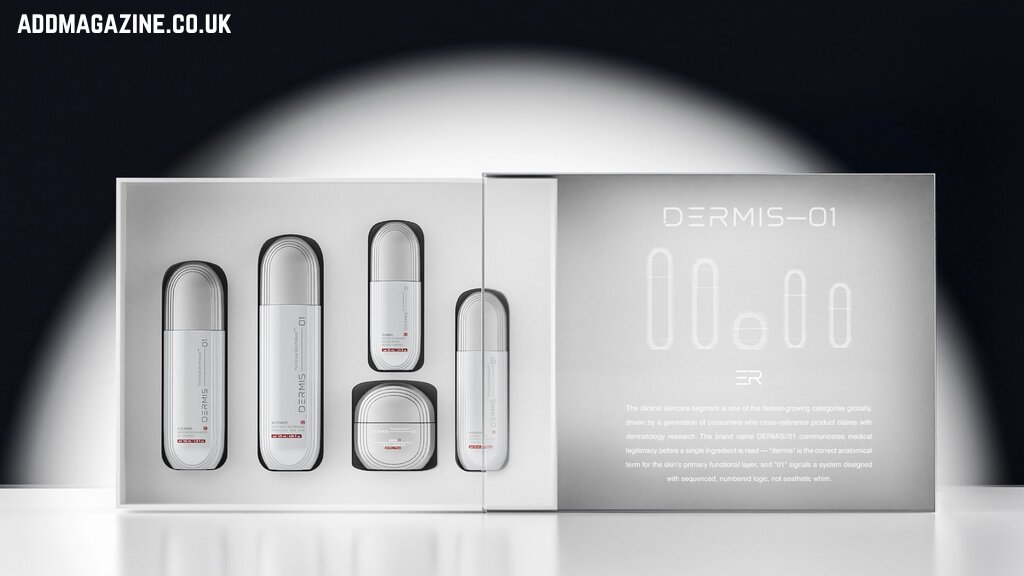
DERMIS//01 introduces a five-product cosmeceutical skincare collection built around an elegant capsule-inspired glass bottle and jar system, with the complete packaging concept creatively developed and engineered by Jarsking Packaging.
The beauty industry is no longer won at the formula level. In today’s hyper-competitive market, where five new skincare launches happen every hour and consumer attention spans are tightening, the brands that consistently outperform are not necessarily those with the best ingredients. They are the ones whose packaging does the selling before a single word is read.
This shift represents one of the most significant structural changes in how beauty products are designed, sourced, and scaled — and it has profound implications for every brand, founder, and buyer operating in the UK and global market today.
The Problem with Conventional Packaging Development
For decades, the standard approach to cosmetic packaging followed a predictable arc: develop your formula, then find a container that fits. Packaging was treated as a logistical afterthought — a vessel to protect the product during shipping and catch the eye on a shelf.
That model is functionally obsolete.
Modern consumers are sophisticated, sustainability-aware, and visually literate. They have been trained by social media to evaluate beauty products through the lens of aesthetics, tactility, and perceived brand identity — all of which are communicated by packaging, not by what is inside. A poorly chosen jar or an uninspired pump bottle can undermine even the most technically advanced formula.
The industry is beginning to reckon with this reality in earnest, and nowhere was it more visible than at this year’s major trade events.
Trade Shows as Barometers of Industry Direction
Cosmoprof North America 2026 proved to be a pivotal moment for packaging professionals. The conversation on the trade floor shifted decisively away from “standard stock solutions” and toward what practitioners are now calling brand-led packaging development — a model in which packaging strategy is integrated from the earliest stages of product development rather than bolted on at the end.
This is not simply a trend. It is a structural reorientation of the entire supply chain. Brands that attended this year’s show returned with a clearer understanding that their packaging supplier needs to function less like a commodity vendor and more like a strategic design partner.
Jarsking, a global leader in custom cosmetic packaging, demonstrated exactly this philosophy at the show. Their approach — which you can read about in full detail in their Cosmoprof North America 2026 brand-led packaging development coverage — illustrates how a supplier-side commitment to co-creation changes the outcome for brands at every price tier, from emerging independents to established luxury labels.
What Brand-Led Development Actually Means
Brand-led packaging development is not about aesthetics alone. It encompasses three interconnected layers that most conventional sourcing models fail to address simultaneously.
Structural integrity and formula compatibility. Packaging must be engineered in tandem with the formula it contains. With the proliferation of high-concentration actives — retinoids, vitamin C derivatives, peptide complexes — incompatibility between formulation chemistry and container materials is a real and costly risk. Brand-led development builds compatibility testing into the earliest prototyping phases.
Sustainability by design, not by retrofit. The UK’s evolving regulatory environment around single-use plastics and extended producer responsibility means that sustainability can no longer be added as a feature; it must be embedded in material selection and structural choices from day one. Brands sourcing from suppliers who treat eco-credentials as optional will face increasing compliance exposure.
Visual differentiation as a business asset. Beyond compliance and function, packaging carries the brand. Finish, weight, closure mechanism, label interplay — these micro-decisions collectively determine whether a product feels premium or generic in the hand of a consumer. In a market where unboxing content drives measurable sales velocity, this is not a soft consideration.
The Supplier Relationship Has to Change
The brands succeeding in this environment are those who have moved beyond transactional supplier relationships.
This requires a different kind of packaging company. One that has invested in its own innovation infrastructure, maintains in-house tooling capabilities, and employs specialists who understand the regulatory, formulation, and commercial dimensions of beauty packaging simultaneously.
Jarsking has positioned itself explicitly in this space. As outlined on their company introduction, the company operates with a vertically integrated model that spans custom glass, plastic, and component manufacturing — all underpinned by a philosophy that packaging development should serve the brand’s long-term strategic goals, not just its immediate production requirements.
What UK and European Brands Should Take From This
For beauty brands operating in the UK and EU markets, the implications are direct and actionable.
First, audit your current packaging development process. If your packaging decisions are being made after formulation sign-off, you are almost certainly leaving differentiation and margin on the table.
Second, evaluate your suppliers not just on unit price, but on development capability. Can they prototype rapidly? Do they offer material alternatives that address sustainability requirements? Can they produce custom tooling for exclusive structural forms at a viable minimum order quantity?
Third, treat packaging investment as a brand-building budget line, not a cost-of-goods optimization problem. The brands commanding premium price points in the current market — across skincare, colour cosmetics, and wellness beauty — are those whose packaging communicates value before the consumer reads a single claim.
The Market Is Rewarding the Prepared
The data from recent trade events is consistent: beauty buyers, retailers, and consumers are increasingly drawn to brands that demonstrate coherence between product quality and packaging quality. The gap between brands that treat packaging strategically and those that treat it operationally is widening — in shelf placement, in press coverage, and in consumer loyalty metrics.
Brand-led packaging is not a luxury available only to large companies with dedicated product development teams. With the right supply partner, it is accessible to independent founders, boutique laboratories, and scaling brands at every stage of growth.
The opportunity for UK and European beauty brands is clear. The suppliers capable of delivering it are ready. The question is whether your brand is prepared to close the gap.