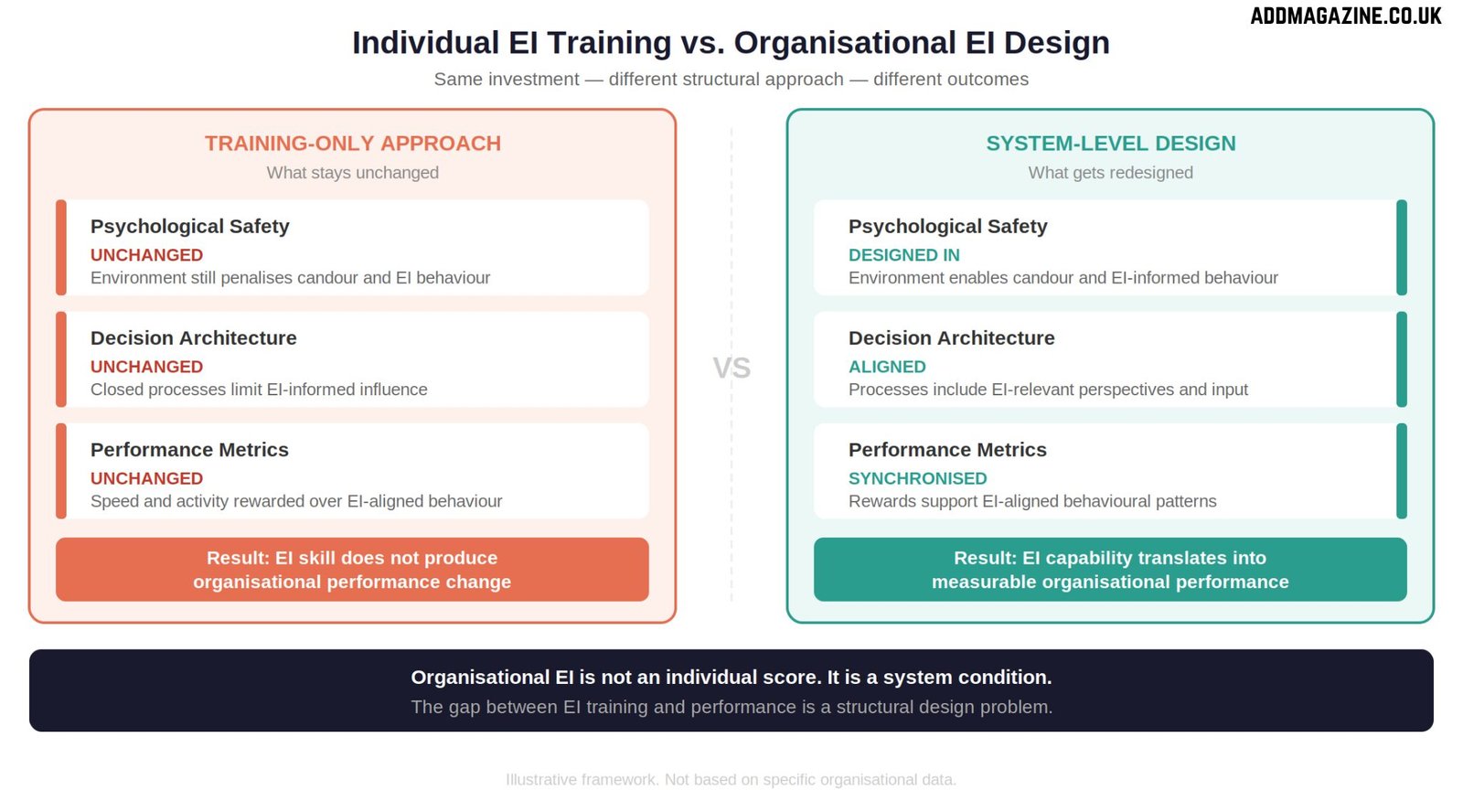
Organizations invest heavily in emotional intelligence training. Individual awareness often improves. Organizational performance rarely does. The reason is structural: individual EI skills do not automatically translate into system-level outcomes. When the organizational environment does not support EI-informed behavior, individual development produces no lasting change in how the organization performs.
Why Individual EI Training Has Limited Organizational Impact
EI training is built around the individual. A leader learns to recognize emotional states, regulate reactions, and communicate with greater awareness. These are real capabilities. The problem is that individuals operate inside organizational systems, and those systems shape behavior more powerfully than any individual trait.
A leader with high EI still operates within structures that reward speed over reflection, certainty over curiosity, and visibility over depth. When the system penalizes the behaviors that EI enables, individual development produces minimal organizational change regardless of how strong the training program is.
What Actually Determines Whether EI Translates Into Organizational Performance
Organizational EI is not the average of individual EQ scores. It is a function of how the organization is designed: what behaviors the environment rewards, how decisions get made, what is permitted in meetings, and whether leaders can actually operate with the awareness and regulation their training developed.
This distinction changes what needs to change. If individual training is the only intervention, the organization is betting that personal development will overcome structural barriers. It rarely does. When organizational performance is the goal, the structural conditions become the target.
Carlos Raposo Coaching’s EI Systems Lab™ takes this as its foundation. Rather than measuring individual EI capability, the work examines whether the organizational conditions for EI-informed leadership are present, functional, and aligned to performance goals. The diagnostic entry point is the system, not the individual leader.
Three System Conditions That Determine Whether EI Produces Results
1. Psychological safety at the team level. Individual EI cannot function when the environment penalizes the candor, uncertainty, and self-disclosure that EI enables. Safety is a system condition. It cannot be trained into individuals if the structure works against it.
2. Decision-making architecture. How decisions are made, who is included, and whether dissent is permitted shapes whether EI-informed leadership can influence outcomes. A high-EI leader in a closed decision system is constrained by that system, not empowered by their development.
3. Performance metrics alignment. What the organization measures and rewards either supports or undermines EI-informed behavior. When speed and output volume are the primary metrics, relational quality and reflective practice are deprioritized regardless of individual EI levels.
What to Focus On Instead
For organizations where the gap between emotional intelligence and organizational performance persists despite significant training investment, the root cause is almost always structural. The shift is from measuring individual EI development to assessing the organizational conditions that either enable or constrain EI-informed leadership.
That means examining psychological safety across teams, evaluating how decisions include or exclude EI-relevant input, and testing whether performance metrics create the behavioral environment EI requires to function.
A System-Level Approach to Emotional Intelligence and Organizational Performance
Carlos Raposo Coaching’s EI Systems Lab™ works at the system level rather than the individual level. The work identifies the organizational conditions that enable or constrain EI-informed leadership and builds the structural environment needed for EI to produce measurable performance outcomes.
The EI Systems Lab™ is not an EI training program. It is a system-level assessment and design process for organizations that want emotional intelligence to function as an organizational capability, not just an individual skill.
For leadership teams where EI investment has not translated into organizational performance, Carlos Raposo Coaching addresses the structural conditions that determine whether EI produces results.
Frequently Asked Questions
Why doesn’t EI training improve organizational performance?
Because individual EI skills operate inside organizational systems, and those systems shape behavior more powerfully than individual capabilities. When the structure rewards behaviors that contradict EI principles, individual development has minimal lasting impact on organizational outcomes.
What is the difference between individual EI and organizational EI?
Individual EI is a set of personal capabilities. Organizational EI is the degree to which the organization’s structure, decision-making processes, and performance environment enable those capabilities to influence outcomes. High individual EI scores in a low-EI organizational system produce limited results.
What system conditions are required for EI to work at the organizational level?
Three conditions are foundational: psychological safety at the team level, decision-making architecture that includes EI-relevant input, and performance metrics that do not penalize the reflective and relational behaviors EI develops. When these three are aligned, individual EI translates into organizational performance.
How do you measure organizational EI?
Not through individual assessments. Organizational EI is measured through the structural conditions that enable it: levels of psychological safety across teams, the degree to which EI-informed perspectives influence decisions, and whether the performance environment supports or suppresses EI-aligned behavior.