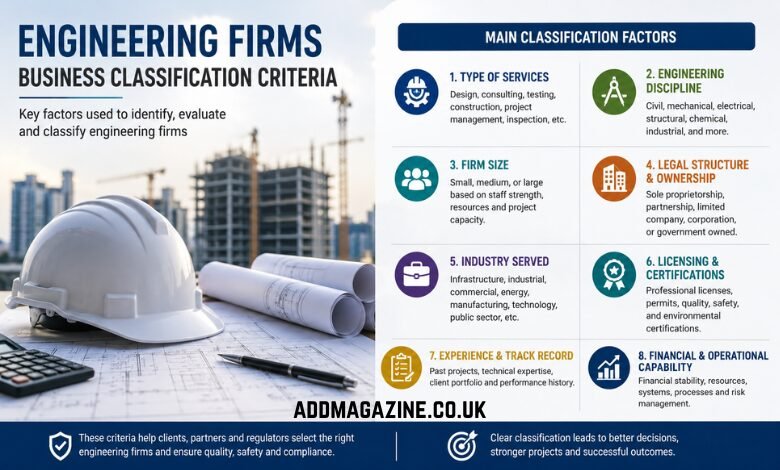
The term engineering company can describe many different types of businesses. One firm may spend most of its time preparing technical plans, while another installs machinery, inspects construction work, or advises clients about difficult engineering problems. For this reason, engineering companies need to be identified according to what they actually do rather than simply being placed under one general industry label.
Engineering firms business classification criteria are used to examine the nature of a company’s work, its professional resources, operating structure, experience, and ability to handle particular projects. These criteria give clients, government departments, and other organizations a clearer understanding of the services a firm can realistically provide.
Looking at the Firm’s Actual Work
The most useful starting point is the company’s main commercial activity. An engineering business should generally be classified according to the work that forms the central part of its operations. Advertising several services does not necessarily mean that the firm has equal experience in all of them.
For instance, a company earning most of its income from technical advice and project studies may be considered an engineering consultancy. Examining real projects and contracts usually provides a more accurate picture than relying only on a company description.
The Difference Between Advisory and Practical Services
Some engineering businesses mainly provide professional knowledge. Their engineers study problems, perform calculations, prepare reports, review plans, and recommend possible solutions. These firms are commonly hired before major decisions are made or when specialist knowledge is required.
Other companies have a more practical role. They may install equipment, manage field activities, repair systems, supervise construction, or carry out technical tests. The difference between giving professional advice and physically delivering work is an important factor when determining a company’s business position.
Engineering Specialization Matters
The technical field in which a firm works is another major consideration. Engineering covers many areas, and each requires different knowledge, staff, equipment, and working methods.
Civil, structural, mechanical, electrical, chemical, industrial, and technology-related firms can therefore be identified separately. Larger organizations may operate across several disciplines, but smaller companies often concentrate their resources on one or two technical areas.
How Service Range Affects Classification
Not every engineering company provides the same amount of project support. Some firms are hired for one clearly defined task. A business might only conduct land surveys, prepare technical drawings, inspect welding, or test construction materials.
Other organizations stay involved throughout much of the project. They can participate in early studies, design development, procurement assistance, site supervision, testing, and final project completion. Understanding the actual range of services helps clients determine whether a company is a specialist provider or a broader engineering organization.
Company Size and Project Capacity
The size of an engineering firm can provide useful information about the type of work it is prepared to manage. This does not necessarily make it less capable, especially when highly specialized knowledge is required.
Medium and large companies generally have more departments, employees, equipment, and management resources. They may be better positioned to handle projects involving several locations, long schedules, or large teams.
Legal Structure and Ownership
The way an engineering company is legally established also forms part of its business identity. A professional may work independently, several engineers may create a partnership, or the business may operate as a limited company or corporation.
Ownership arrangements can affect financial responsibility, decision-making, reporting, and business management. A formally registered company must still prove that it has the people and experience required for engineering work.
The Industries a Firm Serves
The type of market served by an engineering company can reveal much about its experience. Some businesses work mainly on government infrastructure, while others serve factories, property developers, energy companies, manufacturers, or private organizations.
Previous industry experience becomes particularly important when projects involve unusual technical requirements. Clients often study past assignments to determine whether a firm understands the conditions of their particular sector.
Professional Skills Within the Company
Engineering businesses depend heavily on the people they employ. For this reason, employee expertise is often examined during company evaluation.
The number of engineers is only one part of the assessment. Education, professional registration, practical experience, specialist knowledge, and the availability of key staff can also be considered. A smaller company with experienced professionals may sometimes be more suitable for a specialized assignment than a much larger general firm.
Licensing and Permission to Provide Services
Certain engineering activities are controlled by professional and government regulations.
Licensing requirements can affect whether a firm is permitted to approve designs, issue technical documents, or accept responsibility for regulated work.
Reviewing Previous Engineering Projects
Completed work is one of the clearest ways to understand the capability of an engineering business. A project record can show the type of assignments handled by the firm, the industries served, and the level of technical difficulty it has faced.
Good evaluation should examine more than a list of project names. The company’s exact responsibilities, contract size, completion record, and ability to deal with technical problems can provide a more useful view of its experience.
Quality Control Within Engineering Work
Engineering companies need methods for checking their work before it reaches clients, construction teams, or manufacturing operations. Mistakes in calculations, drawings, specifications, and inspections can create serious project problems.
For this reason, evaluators may look at how a firm reviews technical work, manages revisions, stores records, and corrects errors. A company with organized checking procedures is generally better prepared to maintain consistency across different assignments.
Safety as a Business Evaluation Factor
Companies working at construction sites, factories, energy facilities, and other operational locations must manage workplace risks. Safety performance can therefore become an important part of engineering firm assessment.
Clients may review employee training, hazard management procedures, incident records, and the company’s approach to field activities. The level of safety review usually depends on the nature of the services being provided.
Financial Ability to Complete Projects
An engineering company needs enough financial stability to continue operating throughout the duration of a contract. Staff salaries, equipment expenses, travel, materials, insurance, and other costs may need to be managed before all client payments are received.
A technically experienced firm can still create difficulties if it lacks the resources needed to maintain operations until the work is finished.
The Importance of Proper Engineering Records
Engineering work produces calculations, drawings, reports, approvals, inspection results, and many other documents. These records need to remain organized and accessible throughout the project.
Poor document management can result in outdated drawings being used or important technical decisions becoming difficult to trace. A firm’s approach to maintaining accurate records can therefore provide useful information about the quality of its internal operations.
Why One Classification May Not Be Enough
Modern engineering companies often perform work that crosses traditional business categories. A firm may provide design services while also developing software, inspecting installations, and advising clients. Another company may combine engineering consultancy with project management.
Because of this overlap, a company can sometimes belong to several categories. The best approach is to identify its primary activity first and then record any important secondary services separately.
What Clients Should Examine Before Hiring a Firm
Clients should avoid selecting an engineering company based only on its size or marketing claims. A better assessment considers whether the firm’s experience matches the project, whether suitable professionals are available, and whether the business has the systems needed to complete the work.
Legal status, technical resources, previous assignments, financial position, safety practices, and internal work procedures can all contribute to the final decision. The importance of each factor will change according to the size and nature of the project.
Conclusion
Engineering firms business classification criteria help distinguish companies according to their real activities and capabilities. Factors such as technical specialization, service range, company size, ownership, professional staff, market experience, licensing, project history, and financial resources can all be used during the classification process.
No single criterion can provide a complete understanding of an engineering company. When classification is based on actual work and documented capability, clients can more easily identify firms that are suited to their technical and project requirements.