Paid TikTok distribution can create reach quickly. It cannot, on its own, establish whether a message uses the audience’s language, resolves a genuine objection or fits the cultural context in which it will be seen.
That is the role of conversation before advertising: a pre-ad validation layer. Teams listen to relevant communities, participate where they can add value, publish a focused content hypothesis, respond to substantive feedback and document what they learn before committing meaningful budget. This is not a claim that comments create For You distribution. TikTok does not publicly document such a direct causal relationship. It is a practical way to reduce uncertainty around creative, audience and offer fit.
What conversation-first marketing means
Conversation-first marketing turns audience feedback into a defined paid-media test.
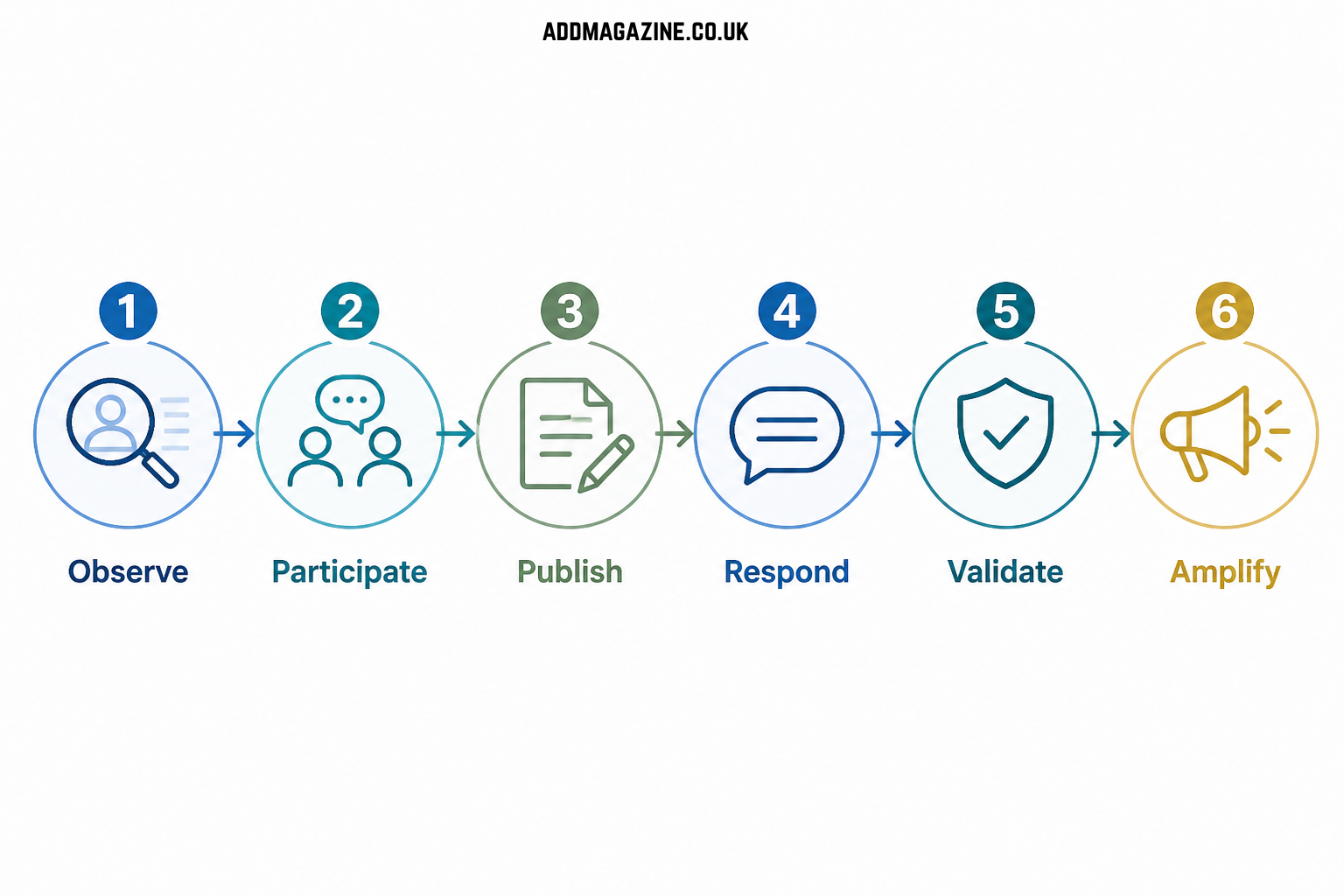
Conversation-first marketing is not asking for comments to make a post look busy. It is a sequence of observation, participation and learning:
- Observe: Identify recurring questions, creators, formats, language, use cases and friction points in a relevant community.
- Participate: Contribute useful comments or work with creators where the brand has legitimate expertise and relevance.
- Publish: Make a post that tests one clear proposition and invites a specific response.
- Respond: Answer worthwhile questions, pin essential clarifications and use video replies when an answer warrants its own asset.
- Interpret: Classify feedback, distinguish patterns from noise and turn useful themes into testable changes.
- Amplify: Put paid budget behind a defined next test, not behind comment volume alone.
For eligible advertisers, TikTok’s Comment Insights tool is documented as offering comment trends, question detection, word clouds, audience information, comment tables and sentiment analysis. Access, interface and data coverage can vary by account and market. Its sentiment labels are generated by an internal model and can be corrected, so teams should treat them as a starting point for human review rather than an objective verdict.
Why conversation should precede spend
It surfaces audience language
A team may call a benefit “streamlined reporting.” The people it hopes to reach may describe the desired outcome as “finally knowing where the budget went.” That phrasing is not automatically a winning headline, but it is a credible creative hypothesis to test in a hook, script, landing-page heading or sales asset.
Maintain a comment-intelligence sheet with the original wording, the theme, likely audience segment, confidence level and proposed action. Keeping the original wording matters: it limits the tendency to turn a small observation into a broad market claim.
It exposes objections while changes are still cheap
A paid ad can efficiently scale an unclear claim. Public responses may reveal price uncertainty, compatibility questions, regional availability, privacy concerns or doubts about a demonstration. Those themes can become a creative brief:
- A repeated beginner question may justify a beginner-specific opening.
- A recurring proof request may require a clearer demonstration or qualification.
- A repeated post-purchase question may point to an FAQ, onboarding or customer-support gap.
This does not prove that fixing the issue will improve conversion. It gives the team a defined problem to test before expanding reach.
It tests relevance, not activity
A high comment count may reflect disagreement, generic praise, a trend, spam or a question unrelated to the offer. It is not a reliable proxy for trust, purchase intent, incremental reach or revenue.
The more useful question is whether the intended audience understood the proposition and supplied consistent, decision-relevant feedback. Comments are one qualitative input; retention, site behaviour and commercial outcomes still decide whether a paid test should continue.
Treat comments as qualitative research
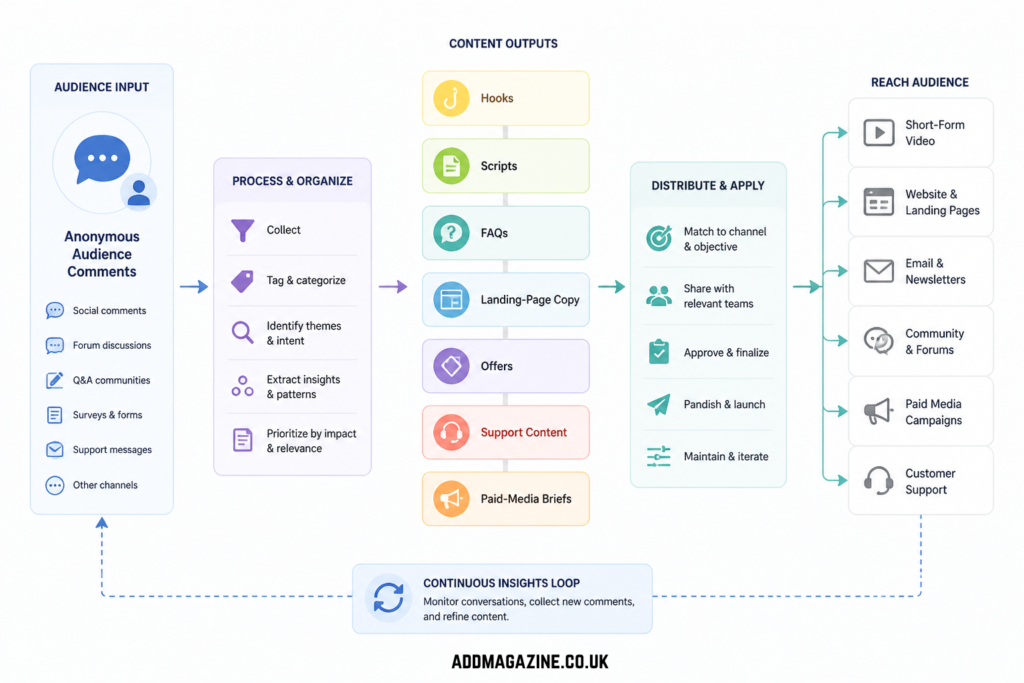
Useful comments can inform creative, customer support and campaign planning without being treated as proof of demand.
Classify comments by meaning rather than reporting one total.
| Comment type | What it may indicate | Practical action |
|—|—|—|
| Specific question | Missing information or active evaluation | Reply; add a pinned clarification; update FAQ |
| Objection | Friction, doubt or an unclear claim | Test proof, qualification or a different angle |
| Use case | Who can see themselves using the product | Develop segment-specific creative |
| Feature request | Product or positioning gap | Route to product; do not promise delivery |
| Purchase-intent cue | A potential path to conversion | Make the next step clear and measurable |
| Emotional reaction | Tone or cultural fit | Preserve, refine or reconsider the voice |
| Generic or irrelevant activity | Limited diagnostic value | Do not treat as validation |
A single comment is anecdotal. A pattern repeated across posts, creators or language groups is a hypothesis. Record its frequency, source context and contradictions, then test a specific response. For example, turn a repeated objection into one revised video and one landing-page variation rather than rewriting the whole campaign around a handful of remarks.
A 7- to 14-day operating framework
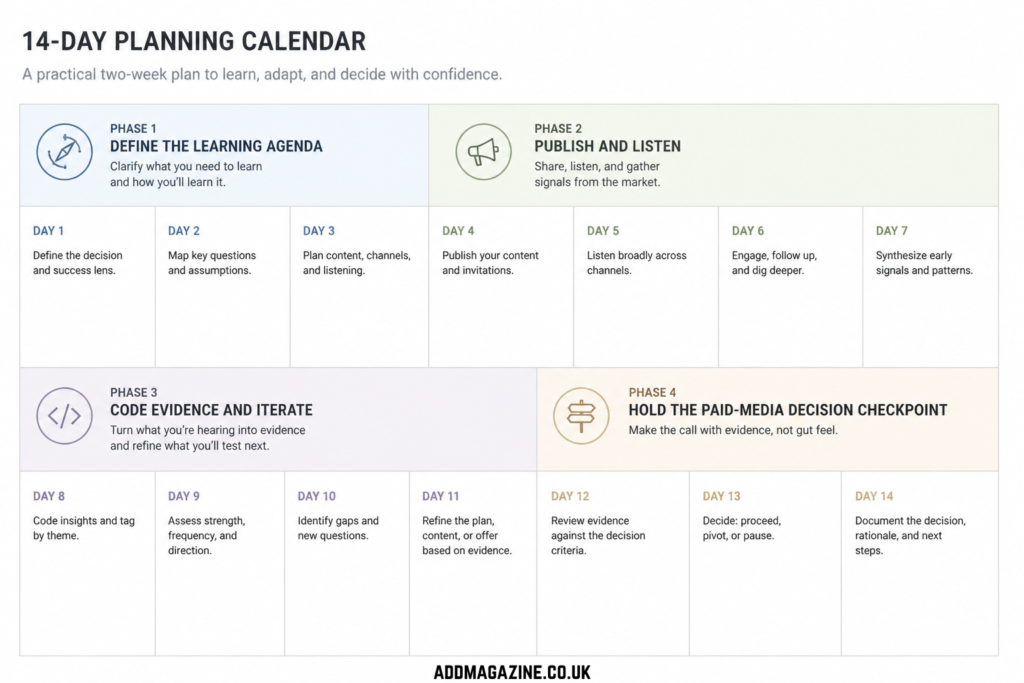
The operating window is a planning framework, not a universal performance benchmark.
This is a planning window, not a universal benchmark. Niche B2B audiences, low posting cadence, seasonality and multilingual markets may need more observation or more posts.
Days 1–2: define the learning agenda
Write two or three hypotheses, each tied to a decision. For example:
- Operations leads care more about approval delays than reporting features.
- First-time users need a before-and-after demonstration before evaluating price.
- In a particular market, availability is a larger barrier than product relevance.
Assign response owners before publishing. Specify who can answer product questions, who handles complaints, what requires customer-support, legal or safety escalation, and what can be hidden or reported under current platform controls and policy.
Days 3–6: publish, listen and participate
Publish several variations that test one central idea at a time. Use prompts that generate useful information: “Which step takes longest?” is more diagnostic than “Thoughts?”
Reply where a response adds information. Pin a comment when it clarifies a common issue. Use a video response when the explanation can stand as useful content. Do not force a playful voice into technical, serious or sensitive discussions.
Days 7–10: code the evidence and iterate
Run a daily review. For each post, document:
- the hypothesis and exact hook;
- relevant-comment share and the main themes;
- recurring questions, objections and use cases;
- original audience language worth preserving;
- sentiment context, including sarcasm or disagreement;
- retention, saves, shares, profile actions, clicks and available conversion signals;
- sample limitations, such as low volume, one dominant creator audience or one language market.
For small or noisy samples, mark findings as exploratory rather than validated. For multilingual work, code themes in the original language, use local reviewers where possible and compare meaning rather than relying on direct translation. When samples contradict one another, segment them by post, creator, market, language or audience type before choosing a new test. Do not average away an important difference.
Days 11–14: hold a paid-media decision checkpoint
Bring a one-page evidence brief to the decision meeting. It should show the original hypothesis, posts tested, comment themes, counter-evidence, proposed creative change, target audience, landing-page implication and the metric that will determine the next decision.
Then choose one action:
- Amplify: The proposition is understood, discussion is relevant, and content and downstream signals justify a controlled paid test.
- Revise creative: Interest is present, but the hook, proof or explanation is weak.
- Revise the offer or page: The content is understood but a recurring commercial friction point remains.
- Return to listening: Evidence is too thin, mixed, culturally mismatched or dominated by irrelevant activity.
Metrics that matter before scaling
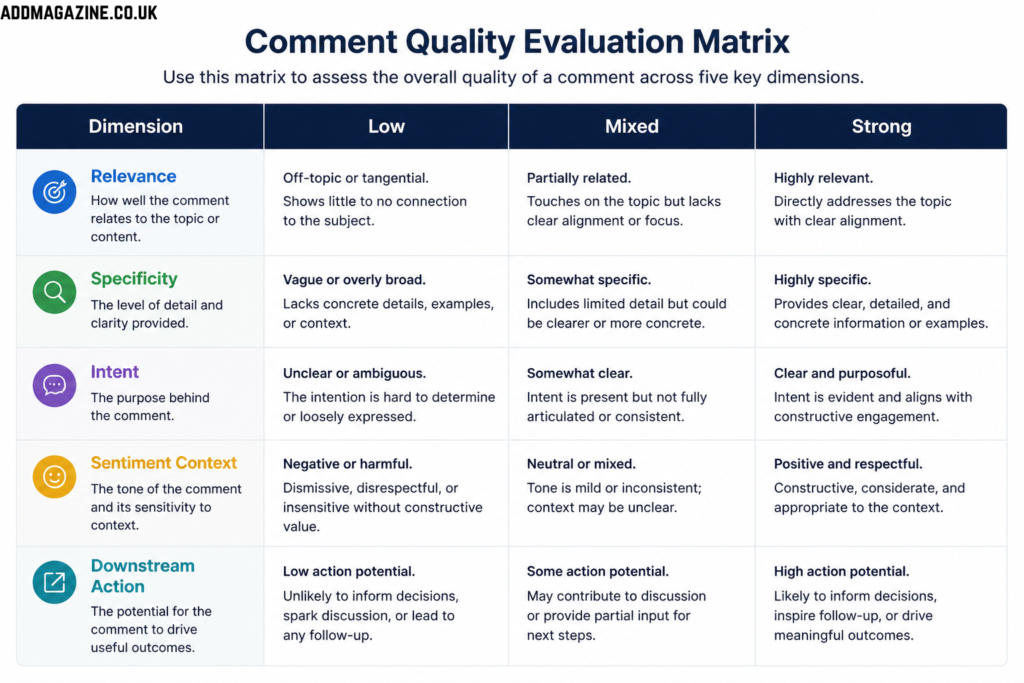
Comment quality is more informative when assessed alongside context and downstream signals.
Use a scorecard that combines conversation quality with attention and business outcomes. Weight it according to the campaign objective.
Conversation quality: relevant-comment share; consistency and specificity of questions or objections; use-case detail; manually reviewed sentiment; response rate and time to meaningful reply.
Content and audience signals: watch-time or retention patterns; saves and shares where relevant; profile actions; qualified clicks; fit by market, language and community.
Commercial signals: conversion rate and conversion quality; lead quality; support burden, returns or cancellations where relevant; and results from a controlled paid test rather than organic engagement alone.
Comment volume should remain a context metric, not a go signal. A post is ready for further investment only when qualitative feedback supports a coherent insight and the wider signal set does not contradict it.
Turn organic winners into paid tests
TikTok documents Spark Ads as a format that can promote an existing organic post from a brand account or an authorised creator account. Engagement gained during promotion can be attributed to the original post. Specifications, authorisation requirements, objectives and availability can change, so confirm current account-level settings before launch.
Spark Ads can preserve useful continuity when the original post, creator relationship and public discussion provide context for a paid test. They do not guarantee paid performance. A dark-ad test may be more appropriate when a team needs tighter variable control, wants to test an unproven claim or must separate markets.
Creator-led participation should be treated as its own category: it can be authentic when a creator has genuine community relevance and communicates honestly, but commercial relationships and incentives require appropriate disclosure. Choose creators for audience fit and explanatory ability, not only follower count.
Artificial engagement is not audience evidence
Keep five categories distinct: authentic organic comments; creator-led participation; disclosed incentivised activity; paid amplification of real content; and fabricated or purchased comments. They differ in source, disclosure, insight value and risk.
A TikTok comments service may create a visible metric, but it cannot reliably identify genuine objections, validate purchase intent or substitute for real audience participation. TikTok’s current Integrity and Authenticity guidance addresses artificial engagement and metric manipulation; teams should review the applicable rules, advertising standards and local disclosure requirements before campaign activity.
Artificial activity also corrupts the research process. It can make irrelevant prompts look like demand, consume moderation time and lead a team to scale a message on false evidence. It should not be presented internally as social proof, market research or a distribution strategy.
Brand safety for global teams
Prepare moderation and escalation rules before launch. Route privacy, safety, legal and account-specific issues to trained owners. Correct misinformation with concise, verifiable context rather than arguing for attention. Use filtering and blocked-word settings carefully without suppressing legitimate criticism.
Create language-specific response guidance instead of translating one brand voice word for word. Review creator disclosures, claims and cultural references before amplification. Enthusiasm in one market can read as irony or scepticism in another; local context is more useful than a universal engagement benchmark.
The go/no-go checklist
Before increasing spend, ask:
- Is discussion substantially relevant to the intended audience and proposition?
- Can the team name the leading questions, objections and use cases, including meaningful counter-evidence?
- Has a specific revision addressed a recurring theme?
- Do retention, actions and commercial indicators support—not contradict—the comment analysis?
- Are sample size, language, creator-audience effects and data gaps documented?
- Are moderation, disclosure and escalation processes ready for broader reach?
- Is the paid test designed to answer a defined question rather than chase engagement?
Conversation does not replace advertising. It is a feedback and validation layer that helps teams make a more informed decision about what, where and how to amplify.