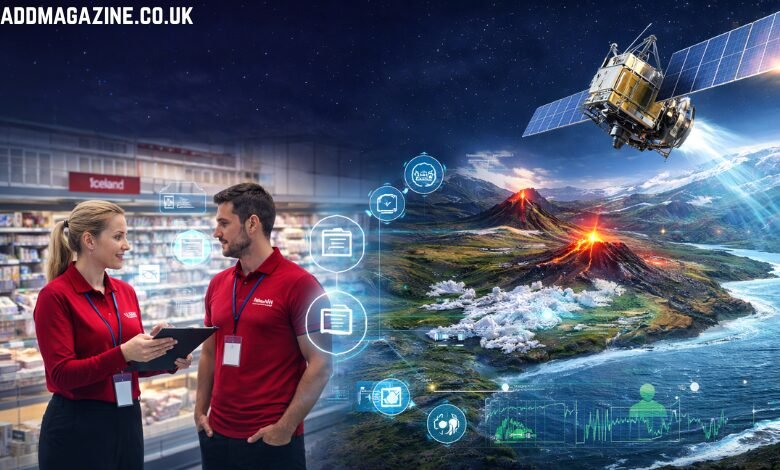
The term “Iceland Sentinel” might immediately evoke thoughts of cutting-edge technology or an advanced satellite system exploring the furthest corners of the planet. However, it refers to two distinct entities that share a common name but operate in entirely different domains: one in the retail and human resources sector, and the other in environmental monitoring and scientific research.
In this article, we will explore both versions of Iceland Sentinel, examining their unique applications and potential impact on the industries they serve. From the employee portal at Iceland Foods to the environmental monitoring capabilities offered by the Sentinel satellites, this digital system is helping shape the future of business operations and scientific discovery in surprising and innovative ways.
Iceland Sentinel in the Retail Sector: Revolutionizing Employee Management
Iceland Foods, one of the UK’s largest supermarket chains, has adopted a digital system called Iceland Sentinel to streamline its internal human resources operations and improve employee experience. The platform is a comprehensive employee portal designed to give Iceland Foods’ staff convenient access to key work-related information. This system provides essential functionalities that help employees stay connected to the company, enhancing both communication and overall operational efficiency.
A Mobile-Friendly, Accessible Platform for Retail Workers
Unlike the rigid and often outdated paper-based HR systems common in many organizations, Iceland Foods’ employee portal, Iceland Sentinel, is designed to be mobile-friendly, ensuring that it is accessible to staff working at various locations, whether in retail stores or warehouses. The accessibility of the portal enables employees to manage important aspects of their work-life balance on the go, without requiring a physical presence at the HR department or manager’s office. Employees can easily check their shift schedules, view their payslips, and review personal HR records with the touch of a button.
A Comprehensive Tool for HR Management
Iceland Sentinel is much more than just a digital HR platform—it serves as a comprehensive internal communication tool. For employees, this portal offers a seamless, efficient way to stay up to date with company news, policies, and important updates from senior management. Whether it’s a new company-wide policy or an announcement regarding workplace safety or benefits, Iceland Sentinel acts as the central hub for all communications.
Furthermore, the system serves a vital role in the onboarding process for new employees. It ensures that all the necessary information is made available from day one, allowing new hires to hit the ground running. No longer do they need to rely on face-to-face meetings to understand essential benefits, policies, and employee rights. Iceland Sentinel makes this information easily accessible, ensuring smooth transitions and helping new employees integrate into their roles quickly and effectively.
Future Potential: AI and Automation on the Horizon
Looking ahead, Iceland Foods is likely to continue refining and expanding the capabilities of the Iceland Sentinel platform. Future iterations may see the integration of artificial intelligence (AI) for more personalized employee experiences, including AI-driven shift scheduling, predictive HR analytics, and real-time performance reviews. Automation tools could further reduce administrative overhead, making the system even more efficient for both employees and managers.
The growing sophistication of the platform could also result in advanced workforce management features such as automated leave requests, skill development tracking, and integration with third-party tools for benefits management or payroll systems. The potential is vast for Iceland Sentinel to evolve into a holistic, AI-powered HR ecosystem that improves workforce satisfaction and business efficiency alike.
Iceland Sentinel in the Scientific Community: Tracking Environmental Changes from Space
While the Iceland Sentinel portal serves as a digital workplace solution, the term “Iceland Sentinel” also has significant relevance in the scientific and environmental monitoring sectors. In this context, Iceland Sentinel refers to the use of Sentinel-1 and Sentinel-2 satellites, part of the European Space Agency’s (ESA) Copernicus program. These satellites play a crucial role in monitoring the dynamic and geologically active landscape of Iceland.
The Role of Sentinel Satellites in Earth Observation
Iceland, a country known for its vast volcanic terrains, glaciers, and frequent seismic activity, benefits greatly from the Earth observation capabilities of Sentinel satellites. The data collected by the Sentinel-1 and Sentinel-2 satellites helps scientists and researchers monitor and study Iceland’s rapidly changing environment. Whether it’s tracking glacial retreat, monitoring volcanic eruptions, or observing land deformation caused by tectonic activity, these satellites provide vital information about the state of Iceland’s natural landscape.
- Sentinel-1: The Sentinel-1 satellite employs Synthetic Aperture Radar (SAR) to capture high-resolution imagery regardless of weather conditions or lighting. This makes it ideal for monitoring in regions like Iceland, where cloud cover and polar darkness can often obscure traditional optical satellites. Sentinel-1’s radar system ensures that observations can be made even during the harshest weather, providing crucial data for ongoing environmental studies.
- Sentinel-2: In contrast, the Sentinel-2 satellite is equipped with multi-spectral optical imaging sensors that capture visible and near-infrared light. This allows researchers to monitor vegetation health, track changes in land cover, and observe the growth of glacial lakes or other significant ecological changes. The optical sensors of Sentinel-2 are particularly useful for identifying land-use patterns and tracking the effects of climate change on Iceland’s fragile ecosystems.
Complementary Satellite Missions
By combining the data from both satellites, Iceland can gain a comprehensive understanding of its geophysical and environmental dynamics. Sentinel-1’s radar imagery helps monitor land surface changes such as glacial movement or volcanic activity, while Sentinel-2’s optical imaging allows for the assessment of vegetation cover and ecosystem health. Together, these satellite systems provide scientists with a well-rounded view of Iceland’s environment, helping them study the effects of natural disasters, changing climates, and human activities.
The Importance of Iceland Sentinel for Environmental Monitoring
Iceland stands out as one of Europe’s most geologically active areas, known for its frequent volcanic eruptions and seismic events It experiences frequent volcanic eruptions, earthquakes, and glacial changes, all of which can have significant ecological, economic, and social consequences. Without the tools to monitor and understand these changes, it would be difficult to mitigate the impacts of these events and make informed decisions about land use, disaster preparedness, and ecosystem conservation.
Sentinel satellites provide an invaluable resource for scientists seeking to understand Iceland’s unique environmental landscape. The high-resolution data collected by these satellites aids in the study of a wide range of natural phenomena, including:
- Glacial Movement and Retreat: With the help of radar-based imaging from Sentinel-1, scientists can monitor changes in glaciers over time. This data helps assess the rate of glacial retreat, contributing to our understanding of climate change and its impact on Iceland’s glaciers.
- Volcanic Activity: Iceland is home to many active volcanoes. Sentinel-1’s ability to detect surface deformation allows researchers to track volcanic activity and potentially predict eruptions before they occur. This helps reduce the risks to local communities and provides early warning systems in case of future volcanic hazards.
- Land Deformation: Both natural and human-induced changes in land structure, including earthquakes and mining activities, can be monitored with Sentinel-1 radar data. By identifying areas where land deformation is occurring, scientists can pinpoint areas at risk of subsidence, landslides, or other hazards.
The Integration of AI and Machine Learning in Iceland Sentinel
The integration of Artificial Intelligence (AI) and machine learning technologies into both the employee portal at Iceland Foods and the environmental monitoring systems of Iceland Sentinel is expected to revolutionize how these platforms operate in the future.
AI in Iceland Foods’ Employee Portal
Iceland Foods’ Sentinel portal, currently an advanced HR and communication tool, has the potential to become an even more powerful and intelligent platform with the introduction of AI and machine learning. One of the most promising areas of improvement is in AI-powered scheduling. By analyzing past shift patterns, employee preferences, and real-time operational demands, AI could automatically generate optimal shift schedules, reducing human error and improving overall productivity. Employees could also use the system to receive personalized notifications about shifts or upcoming HR events based on their past behavior or preferences.
Moreover, automated HR workflows can enhance the portal’s current functionality. For example, AI can help automate routine HR tasks, such as managing requests for leave, onboarding new employees, or even providing personalized training suggestions based on an individual’s career development path. AI-driven tools can help reduce the manual effort involved in HR tasks, allowing human resources personnel to focus on more complex and strategic issues.
Predictive analytics is another potential application of AI in Iceland Sentinel. The platform could use historical data to predict future trends, such as when certain roles might require more staffing or when employees are likely to require additional training. By providing this data, the system can help managers make more informed decisions, ensuring that the right people are in the right place at the right time.
These advancements could not only improve operational efficiency for Iceland Foods but also significantly enhance the overall employee experience by providing personalized and proactive support.
Machine Learning in Environmental Monitoring
On the scientific front, machine learning is already playing a crucial role in improving the analysis of satellite data collected by Sentinel-1 and Sentinel-2. One of the key advantages of machine learning is its ability to process vast amounts of data at a scale and speed far beyond human capabilities. By applying machine learning algorithms to the environmental data gathered by the Sentinel satellites, researchers can automatically detect and predict changes in Iceland’s landscape with greater precision.
For example, machine learning can be used to automate the detection of volcanic eruptions or glacial movements by analyzing changes in satellite imagery over time. Machine learning models can be trained to recognize subtle patterns in the data, such as small shifts in land deformation or temperature anomalies that may indicate volcanic activity or glacial retreat. This would not only speed up the monitoring process but could also allow scientists to make real-time predictions, improving the accuracy of early warning systems.
Another area where machine learning could be beneficial is in predictive modeling for climate change. Using historical and current environmental data from the Sentinel satellites, machine learning algorithms can simulate how Iceland’s ecosystems might evolve in response to climate change. These models can help predict the potential impacts of rising temperatures on glaciers, vegetation, and wildlife, allowing governments and researchers to make more informed decisions about conservation efforts and disaster preparedness.
Machine learning could also help in the analysis of vegetation health by interpreting multi-spectral images from Sentinel-2. The system could automatically identify stressed or dying vegetation, which could signal broader ecological changes or environmental degradation. Early detection would help authorities address potential environmental issues before they escalate.
Satellite Advancements: Future of Iceland Sentinel in Science
The Copernicus program, under which the Sentinel-1 and Sentinel-2 satellites operate, is continuously evolving. Future advancements in satellite technology and data resolution will significantly improve the scope and detail of the data collected. Iceland’s use of these satellites will continue to grow as the program introduces even higher resolution sensors, which will provide more granular and accurate data.
The upcoming Sentinel-3 and Sentinel-4 satellites, designed for monitoring sea surface temperatures, ocean color, and atmospheric composition, will complement the existing Sentinel-1 and Sentinel-2 missions. These advancements will allow for better monitoring of Iceland’s coastal areas, further enhancing the understanding of how ocean and atmospheric changes influence Iceland’s environment.
Additionally, as satellite technology improves, real-time data transmission could become more frequent, allowing for up-to-date information on environmental changes. This would help authorities react to volcanic eruptions, earthquakes, or extreme weather events faster, potentially saving lives and reducing the environmental impact of these occurrences.
Iceland Sentinel’s Role in Iceland’s Economy and Infrastructure
While much of the conversation around Iceland Sentinel revolves around its role in employee management and environmental monitoring, there are also economic and infrastructural benefits to consider.
Economic Impact
Iceland’s economy relies heavily on its natural resources, particularly tourism, fishing, and renewable energy, all of which are deeply tied to the country’s environmental health. As Iceland Sentinel continues to collect more accurate and comprehensive environmental data, this can aid in sustainable resource management, tourism development, and hazard mitigation.
By offering real-time data about land use, ice cap movement, and volcanic activity, the Iceland Sentinel satellites can help the government and private sector make decisions that contribute to sustainable growth. For example, more accurate monitoring of glaciers and volcanic activity can inform the development of infrastructure projects, ensuring that they are safe and less likely to be impacted by environmental hazards. Similarly, the monitoring of ecosystems can help Iceland maintain a balance between its natural resources and the growing demands of tourism.
Infrastructure Planning
On the infrastructure side, both the Sentinel portal at Iceland Foods and the scientific satellite data can support smart infrastructure planning. The Sentinel-1 and Sentinel-2 satellites can monitor land stability, helping authorities plan for roads, buildings, and other infrastructures in areas that might be vulnerable to earthquakes, volcanic activity, or landslides.
Additionally, the use of real-time data from the Sentinel satellites can help local municipalities prepare for and manage natural disasters, reducing the impact on infrastructure and ensuring that the country’s critical systems remain operational in the face of environmental challenges.
A Bright Future for Iceland Sentinel
In both its business and scientific iterations, Iceland Sentinel is poised for a future of even greater sophistication and impact. For Iceland Foods, the portal is expected to evolve into a highly automated, data-driven system that enhances the employee experience and optimizes business operations. On the scientific front, the ongoing development of satellite technology and AI-powered analysis tools will only increase the value of the Sentinel satellites in monitoring and understanding Iceland’s dynamic environment.
With its dual purpose in both business and science, Iceland Sentinel stands as a powerful example of how digital systems can reshape industries, improve decision-making, and enhance our understanding of the natural world. As technology continues to advance, the capabilities of Iceland Sentinel will only grow, benefiting both the workforce at Iceland Foods and the scientific community monitoring one of the most unique and geologically active regions on Earth.
Conclusion
In conclusion, Iceland Sentinel stands as a remarkable example of how digital systems can address diverse needs across industries. From transforming employee management at Iceland Foods to advancing environmental monitoring through cutting-edge satellite technology, it highlights the growing role of technology in optimizing business operations and scientific research. Both iterations of Iceland Sentinel, though serving different purposes, are deeply connected by their use of innovative solutions to drive efficiency, accuracy, and sustainability.
Looking ahead, the potential for Iceland Sentinel to evolve further is immense. In the retail sector, the integration of AI and automation promises to enhance employee experience and streamline operations. On the scientific front, advancements in satellite technology and data analysis will continue to improve our understanding of Iceland’s dynamic environment. As both systems evolve, Iceland Sentinel will undoubtedly play an increasingly crucial role in shaping the future of business and environmental research.