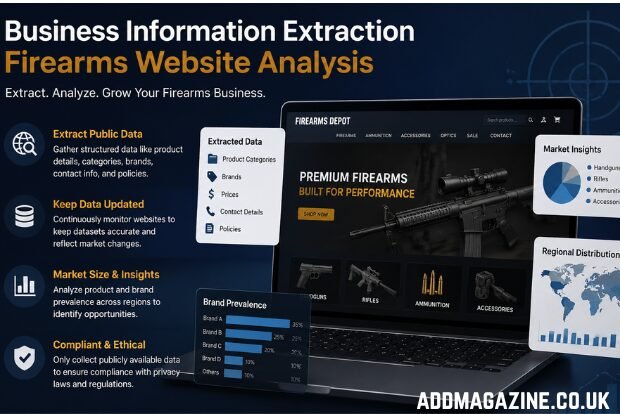
Business information extraction is the process of systematically gathering useful data from public sources, such as websites, and organizing it into a structured format. For companies in any industry, including firearms, this process enables analysts to gain a clearer picture of market trends, competitor behavior, and business operations. The goal is to transform raw website content into actionable insights that can guide research, strategy, and decision-making.
In practice, business information extraction involves identifying relevant data points on a website and capturing them consistently. Publicly visible content like company details, product offerings, store locations, and policy information can all be extracted without breaching privacy or accessing internal systems. The process is about accuracy, clarity, and reproducibility.
Why Firearms Websites Are Important for Analysis
Firearms businesses maintain a range of digital assets, and their websites often contain detailed information about products, services, legal compliance, and customer engagement. Websites can reveal much more than simple inventory lists.
For market research in the firearms sector, analyzing websites allows researchers to see patterns across different businesses. Some companies prioritize retail sales, others focus on training services, while some emphasize community engagement or safety initiatives. This diversity makes structured data extraction particularly valuable.
Key Data Points for Extraction
When conducting firearms website analysis, certain data points offer the most utility. These include:
| Data Point | Purpose |
|---|---|
| Business name | Clearly identifies the company |
| Location | Reveals market reach and regional focus |
| Product categories | Indicates the range of products offered |
| Brand names | Shows supplier relationships and positioning |
| Service offerings | Highlights added value beyond product sales |
| Contact details | Enables follow-up and validation |
| Store hours | Supports understanding of customer accessibility |
| Policy pages | Provides insight into compliance, risk management, and customer service |
| Pricing information | Allows for competitive price analysis |
| Blog or news content | Shows business messaging and areas of focus |
Collecting these data points consistently allows analysts to compare multiple businesses across the same fields, enabling meaningful insights.
Advantages Over Manual Research
Traditional research methods in the firearms sector involve manually visiting websites, noting information, and formatting it for analysis. This approach is time-consuming and prone to error, especially when covering a large number of businesses. Automated extraction tools address these issues by systematically gathering data and organizing it in a repeatable format.
Automation allows research teams to cover more websites in less time, capture smaller or less visible businesses, and maintain consistency in how information is structured. For example, one website may list a full address while another shows only a city and state. Extraction systems normalize this data so comparisons are accurate.
Moreover, automated extraction reduces bias. Analysts often focus on prominent brands, overlooking smaller competitors. Tools that scan multiple websites provide a broader market view, uncovering local sellers, niche operators, and emerging players.
Structuring Extracted Data
Once information is collected, organizing it into a structured dataset enhances its utility. Structured datasets allow sorting, filtering, and segmenting by fields such as region, product category, or service type. This organization also facilitates long-term tracking, as changes in offerings, policies, or location can be monitored over time.
Structured data supports various analytical methods, including:
- Market mapping: Identifying clusters of competitors and regional density.
- Product comparison: Understanding which businesses offer similar firearms, accessories, or training services.
- Supplier analysis: Seeing which brands are carried most frequently and by which types of businesses.
- Content strategy analysis: Evaluating how businesses communicate with customers through blogs, guides, and news.
Segmenting the Firearms Market
Website data enables segmentation of the firearms industry. For instance, a business emphasizing rifles and handguns serves a different market than one focused on training courses or accessories. Extracted brand names can reveal whether businesses target premium or budget buyers. Location data shows whether a business operates locally or offers broader shipping options.
Segmenting the market is essential for:
- Competitor analysis: Understanding direct and indirect competition.
- Demand evaluation: Identifying gaps in product categories or services.
- Strategic planning: Informing decisions on expansion, partnerships, or marketing campaigns.
Messaging and Policy Insights
The wording and content on firearms websites reveal a company’s strategic focus and priorities. A company emphasizing safety and education likely targets a training-oriented audience, whereas one highlighting inventory breadth focuses on retail sales. Policy pages, including shipping, age restrictions, and refunds, indicate compliance and operational maturity. By extracting these pages, analysts can assess how businesses manage risk and customer trust.
Blogs, news updates, and guides are equally informative. They reflect the topics businesses prioritize, whether educational content, product reviews, or market commentary. This information helps identify the competitive focus and audience engagement strategies.
Workflow for Effective Extraction
A repeatable workflow ensures accuracy and reliability in business information extraction. A common approach involves:
- Identify target websites: Define which businesses and geographic regions are relevant.
- Extract public data: Gather organized information such as product types, business contacts, and policy details.
- Clean and standardize records: Remove duplicates and normalize addresses, product names, and brand listings.
- Group by category or region: Facilitate comparisons and segmentation.
- Review patterns: Analyze for market trends, competitor positioning, and operational strategies.
- Update regularly: Ensure datasets remain current to capture website updates and shifting market trends.
Following this process ensures consistent and repeatable data collection, which is crucial for longitudinal studies and trend analysis.
Practical Applications
Business information extracted from firearms websites can support several research objectives:
- Competitive mapping: Identify which businesses compete in similar product or service categories.
- Targeted outreach: Sales and partnership teams can use structured contact and location data to build lists.
- Market sizing: Analyze how specific products, brands, or services are distributed across different regions.
- Trend monitoring: Track shifts in product focus, brand presence, or service emphasis over time.
- Content strategy evaluation: Understand how businesses communicate with their audience and emphasize safety, training, or product quality.
Limitations and Considerations
While website-based extraction provides valuable insights, there are limitations. Public websites do not reveal internal metrics such as sales volume, inventory levels, or customer retention. Some sites may be outdated, incomplete, or use complex web elements that require advanced processing to extract. Validation and cross-checking with multiple sources improve accuracy.
Moreover, the extraction process should respect legal and ethical boundaries. Collect solely openly available data; avoid hidden or private information to maintain compliance with privacy and legal standards.
Benefits to Market Research
Effective business information extraction adds value in several ways:
- Scale: Large numbers of websites can be analyzed efficiently.
- Consistency: Data fields are structured uniformly across businesses.
- Speed: Less manual effort accelerates research timelines.
- Clarity: Standardized information facilitates comparison and insight generation.
In industries like firearms, where business models and focuses vary widely, these benefits are critical. Researchers can identify patterns that are otherwise difficult to detect through manual browsing.
Building Long-Term Insights
Changes in product offerings, new service lines, or regional expansion become visible when data is collected consistently over time. This capability supports trend analysis, strategic planning, and early detection of market shifts.
Because websites are relatively stable public sources, they provide a reliable foundation for repeated data collection. Even as design or presentation changes, core fields like contact details, product categories, and policies remain accessible, allowing research teams to maintain longitudinal datasets.
Conclusion
Business information extraction from firearms websites converts raw online content into structured, actionable intelligence. By systematically capturing data such as business names, locations, product categories, brands, services, policies, and messaging, analysts can construct detailed market profiles. This process enhances research efficiency, provides consistency across comparisons, supports long-term tracking, and enables clearer insights into competitor positioning.
While extraction has limits, when executed properly it forms the backbone of evidence-based market research. By combining structured data with careful review and clear research objectives, analysts can better understand the firearms market, support strategic decisions, and uncover opportunities for growth and collaboration.