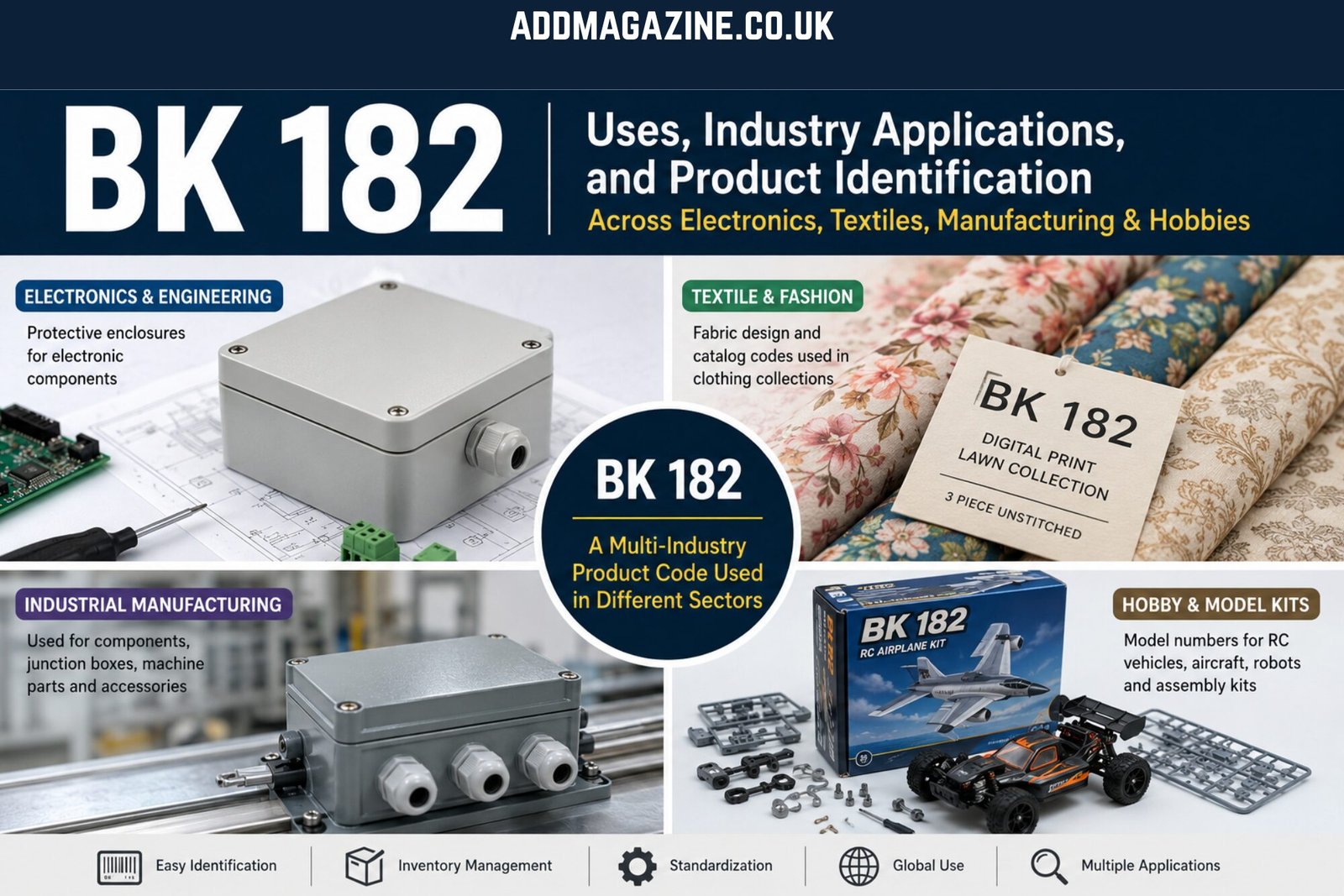
BK 182 is a model identifier that appears in multiple industries rather than a single branded product or universally recognized item. While some product codes become strongly associated with one specific item, BK 182 is more flexible and can represent entirely different products depending on the industry where it is used.
The code has been found in electronics, industrial manufacturing, textiles, hobby equipment, and catalog-based product systems. This creates confusion for buyers, researchers, and online users who expect a single definition but instead discover multiple unrelated uses.
In manufacturing and engineering, BK 182 may refer to an enclosure, protective casing, or housing unit designed for electronic components. In textile markets, the same code can identify a fabric pattern, clothing design, or seasonal collection item. In hobby industries, BK 182 may appear as a model number for a kit, collectible product, or assembly component.
Understanding BK 182 requires context. It is part of a larger identification system used by industries that handle large numbers of items, designs, and product variations.
Understanding Product Codes Like BK 182
Modern manufacturing relies heavily on alphanumeric coding systems. A code such as BK 182 helps businesses quickly classify products without long descriptions.
The “BK” portion may represent a category, manufacturer series, or internal department reference. The number “182” usually identifies a variation, version, size, or design within that series.
Companies use these systems for several reasons:
- Inventory organization
- Production tracking
- Batch identification
- Product differentiation
- Warehouse management
- Supplier coordination
- International distribution
Without model codes, large-scale production systems would become difficult to manage efficiently.
BK 182 in Electronics and Engineering
One of the most recognized uses of BK 182 appears in electronics and industrial engineering. In this context, the code may refer to an enclosure or protective housing designed for electrical components.
Sensitive circuit boards, wiring systems, and signal-processing units cannot remain exposed during operation. For this reason, manufacturers produce specialized housings that protect internal components while allowing installation flexibility.
A BK 182 enclosure-type product may include:
- ABS plastic construction
- Compact rectangular structure
- Mounting points for screws
- Ventilation slots
- Cable routing openings
- Protective covers
- Internal support sections for circuit boards
Industrial environments often expose equipment to dust, vibration, moisture, and temperature changes. Protective housings reduce these risks and extend the operational lifespan of electronic systems.
Instead of describing every physical detail manually, suppliers can reference a standardized model number.
Importance of Standardized Enclosures
Protective enclosures may appear simple, but they play a major role in electronics manufacturingStandardized enclosure systems reduce production costs and improve compatibility across multiple device categories.
If a production facility already uses a certain enclosure series, maintaining consistency across projects becomes easier.
Standardization also supports mass production.
Another major advantage is global supply chain compatibility. Electronics manufacturers often operate internationally. A model code such as BK 182 allows suppliers, distributors, and buyers in different countries to reference the same component without translation issues.
This system also improves maintenance operations. Technicians can order replacement parts using model numbers rather than relying on visual descriptions that may create confusion.
BK 182 in Industrial Equipment
Beyond electronics, BK 182-style codes also appear in broader industrial manufacturing systems. Some companies assign these identifiers to machine parts, protective casings, junction boxes, or assembly components.
Industrial equipment manufacturers produce large product catalogs that contain minor variations in shape, material, or dimensions. A single machine component may exist in dozens of versions designed for different operating conditions.
Coding systems simplify this complexity.
- Mounting brackets
- Control panel housings
- Protective covers
- Mechanical support components
- Sensor protection units
- Equipment accessories
In many industrial settings, procurement teams search by model number rather than descriptive names. This makes codes essential for technical purchasing and inventory management.
BK 182 in the Textile Industry
BK 182 is also used in textile and clothing markets.
Fashion manufacturers handle thousands of patterns, prints, and fabric combinations every year.
Textile companies may use BK 182 for:
- Printed fabric designs
- Lawn collections
- Khaddar fabric series
- Unstitched suit catalogs
- Ready-made garments
- Seasonal clothing releases
In South Asian textile markets especially, catalog codes are widely used for wholesale and retail operations. Buyers often place orders directly using these identifiers rather than product descriptions.
A retailer may request “BK 182” from a supplier because the code instantly identifies the exact fabric design, print pattern, or color variation needed.
It also helps companies organize inventory across physical stores and online platforms.
Why Textile Brands Use Product Codes
New collections are introduced frequently, and each collection may contain hundreds of variations.
Codes help brands manage:
- Color combinations
- Fabric materials
- Pattern variations
- Size categories
- Seasonal releases
- Regional product distribution
Without coded systems, wholesale ordering would become difficult and error-prone.
Product identifiers also simplify digital catalog management. E-commerce websites often rely on model numbers for search filtering and stock management.
For example, customers searching for a specific design can use the product code directly instead of browsing large catalogs manually.
In textile manufacturing, speed and organization are important.
BK 182 in Hobby and Model Industries
Another area where BK 182 appears is the hobby and model-building industry.
Hobby manufacturers produce many product variations within the same category.
BK 182 in hobby markets may refer to:
- RC vehicle kits
- Scale aircraft models
- Mechanical assembly kits
- Collectible display items
- DIY robotics components
- Educational engineering models
These products are commonly sold to collectors, enthusiasts, and hobby builders.
Precision is important in this industry because replacement parts and accessories must match specific models.
Model numbers help customers identify correct components, manuals, and upgrades.
The Role of Product Identification Systems
The widespread use of codes like BK 182 reflects the importance of organized classification systems in modern commerce.
Large manufacturers cannot rely entirely on descriptive naming systems. Product lines grow too large and complex over time.
A typical product identification system helps companies:
- Track production batches
- Organize warehouse inventory
- Manage international distribution
- Reduce ordering mistakes
- Improve catalog navigation
- Support technical documentation
- Simplify customer support
These systems are especially important in global trade, where language differences may create communication barriers.
For online platforms, product codes improve search accuracy.
Why BK 182 Creates Confusion
One major issue with BK 182 is ambiguity. Since the code is not controlled by a universal registry, multiple industries can use it independently.
This creates several problems:
- Electronics searches may return textile results
- Hobby products may appear in industrial listings
- Search engines may mix unrelated content
- Buyers may misunderstand product categories
For example:
- In electronics, it may refer to an enclosure
- In textiles, it may identify a fabric design
This is why manufacturers usually include additional descriptions, specifications, or category labels alongside model identifiers.
Ways to Determine the Exact BK 182 Product Category
When encountering BK 182 in a catalog or online listing, identifying the correct context is important.
Several methods can help determine the product category.
Check the Industry Category
The surrounding content usually provides clues. Electronics listings often mention materials such as ABS plastic, voltage ratings, or wiring compatibility.
Examine Product Images
Product images can quickly help identify whether BK 182 is related to industrial equipment, textile products, or hobby-related items.
Review Technical Specifications
Specifications such as size, material type, setup guidance, and usage information usually help determine the product’s actual purpose.
Analyze Related Product Codes
Manufacturers usually organize products within series groups. Nearby catalog numbers may indicate the broader product category.
Check Supplier Information
Company specialization helps identify the product.
BK 182 and Online Search Behavior
From a digital content perspective, BK 182 represents an ambiguous keyword. Search engines attempt to interpret user intent, but mixed-industry identifiers make this process difficult.
This creates both challenges and opportunities for websites targeting the keyword.
The challenges include:
- Mixed search intent
- Competing industry meanings
- User confusion
- Lower contextual clarity
However, there are also advantages.
Because BK 182 does not belong exclusively to one industry, websites can create informational content covering multiple interpretations. This allows broader keyword coverage and improved niche visibility.
Effective content strategies usually include:
- Clear industry-specific sections
- Contextual explanations
- Technical clarification
- Structured organization
- Distinct category breakdowns
The Global Use of Model Numbers
BK 182 reflects a broader industrial trend rather than an isolated example. Product codes exist in nearly every manufacturing sector worldwide.
Industries using similar systems include:
- Automotive manufacturing
- Electronics
- Textile production
- Medical equipment
- Aerospace engineering
- Consumer appliances
- Construction materials
- Industrial machinery
Large-scale manufacturing depends on organization. Even small companies often manage hundreds of product variations, while international corporations may handle millions.
Without coded systems, inventory tracking and product management would become inefficient and error-prone.
Conclusion
BK 182 is not a single universal product. It is a multi-industry identification code used in different sectors for entirely different purposes. Depending on the context, it may refer to an electronics enclosure, industrial component, textile design, hobby kit, or another catalog-based product.
The code demonstrates how modern industries rely on standardized identification systems to organize manufacturing, distribution, and inventory operations. These systems improve efficiency, simplify ordering, and support international trade.
At the same time, codes like BK 182 also create confusion because they are not globally standardized.
The surrounding industry, supplier information, technical details, and product category all determine its actual meaning.
As manufacturing and global commerce continue expanding, product identification systems like BK 182 will remain an important part of industrial organization, catalog management, and digital search behavior.