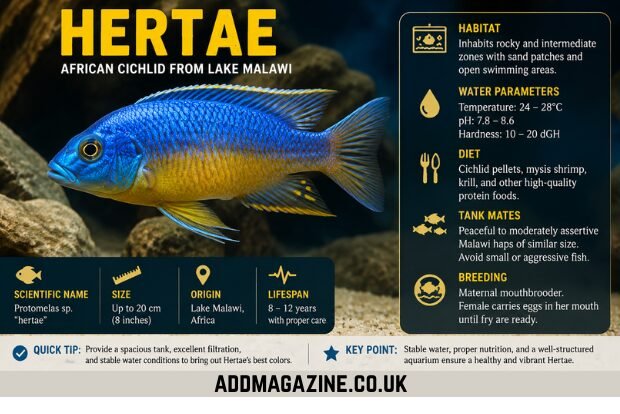
Hertae, known in the aquarium trade as Protomelas sp. “hertae”, is a freshwater fish found in the clear waters of Lake Malawi. It belongs to the Haplochromine group of African cichlids, which are widely recognized for their active behavior, natural color variation, and adaptability to specific lake environments.
Unlike many smaller cichlids that stay close to rocks, Hertae is an open-water swimmer that moves across sandy and rocky transition zones. This makes it different in behavior and care requirements compared to many other Malawi species. It is mainly kept by aquarists who have experience with African cichlids and want a species that offers both movement and color development.
Natural Environment and Origin
Hertae originates from intermediate habitats within Lake Malawi. These areas are neither fully rocky nor completely open sand flats. Instead, they are mixed environments where fish can swim freely while still having access to structure for territory and protection.
In the wild, the water is clear, warm, and rich in minerals. The stability of this environment plays a major role in the health of the species. Hertae is adapted to consistent conditions, meaning sudden changes in water chemistry can affect its behavior and growth.
These fish are often observed near island regions and rocky edges, where they can establish loose territories and interact with other cichlids in the area.
Appearance and Color Development
Hertae is known for strong differences between males and females, a common trait among Malawi cichlids.
Male Appearance
Adult males develop noticeable coloration when fully mature. Their appearance may include:
- Deep blue body tones
- Yellow or gold shading on lower areas
- Colored fins that become more defined with age
- Increased brightness during dominance behavior
Color development depends on environment, diet, and social stability. A dominant male in a calm aquarium often shows the strongest coloration.
Female Appearance
Females are more neutral in color. They usually appear:
- Silver or light grey
- Less patterned than males
- Smaller and less intense in color
Juveniles also resemble females until they begin to mature.
Size and Growth Pattern
Hertae is considered a medium-to-large African cichlid. In aquarium conditions, it can grow up to around 18–20 cm when properly cared for.
Growth is gradual and influenced by:
- Tank size
- Water quality
- Feeding routine
- Stress levels
- Genetic factors
A stable environment encourages steady growth and healthy body development rather than rapid or uneven size increase.
Aquarium Setup and Requirements
Proper aquarium design is essential for Hertae. The goal is to match its natural environment rather than create a decorative tank.
Tank Size
A spacious aquarium is required due to its active swimming behavior. Small tanks are not suitable and often lead to stress and poor health.
Layout Design
The aquarium should include:
- Open swimming areas
- Sand or fine gravel substrate
- Rock structures placed in scattered groups
- Clear pathways for movement
Rock placement should create visual boundaries without blocking swimming space.
Water Conditions
Hertae needs stable water conditions similar to its natural habitat in Lake Malawi:
- Hard, mineral-rich water
- Alkaline pH levels
- Stable temperature range
- Strong filtration system
- Regular partial water changes
Stability is more important than exact numbers. Sudden changes are more harmful than slightly imperfect conditions.
Tank Mates and Compatibility
Hertae is best kept with other African cichlids that share similar size and temperament. It does not mix well with small or delicate fish.
Suitable tank mates:
- Other Malawi Haplochromine cichlids
- Select Peacock cichlids
- Medium-sized African cichlids
Unsuitable tank mates:
- Small community fish
- Soft-water species
- Slow-moving ornamental fish
Careful selection helps reduce stress and aggression in the tank.
Social structure
A common setup includes one male with several females. This helps reduce conflict and supports natural behavior patterns.
Feeding and Diet
Hertae is an omnivorous fish that requires a balanced diet for proper growth and coloration.
Main diet:
- High-quality cichlid pellets
- Staple sinking or floating foods depending on feeding style
Additional foods:
- Mysis shrimp
- Krill
- Frozen fish foods
- Occasional vegetable-based supplements
Feeding should be controlled. Overfeeding can quickly affect water quality and fish health.
A balanced diet helps maintain:
- Healthy growth
- Strong body condition
- Natural coloration
- Active behavior
Behavior and Activity
Hertae is an active swimmer that spends much of its time in mid-water regions of the aquarium. It is territorial but not constantly aggressive when given proper space and structure.
Behavior patterns include:
- Continuous movement across the tank
- Establishing loose territories
- Displaying dominance through color changes
- Reduced aggression in stable environments
When stressed or overcrowded, behavior may become more defensive.
Breeding Behavior
Hertae is a maternal mouthbrooder. This means the female carries eggs and fry in her mouth during early development.
Breeding process:
- Male displays and attracts a female
- Spawning takes place
- Eggs are fertilized
- Female collects eggs in her mouth
- Fry develop inside her mouth until release
During this time, the female may reduce feeding and become more cautious.
Breeding care:
- Provide a calm environment
- Reduce tank disturbances
- Avoid aggressive tank mates during incubation
- Maintain stable water conditions
Responsible breeding is important to preserve healthy stock and avoid unwanted mixing of species.
Common Care Mistakes
Many problems with Hertae arise from improper care practices. The most common mistakes include:
- Keeping fish in small tanks
- Poor filtration or water quality
- Overfeeding
- Incorrect water chemistry
- Mixing incompatible species
These issues often lead to stress, poor coloration, and reduced lifespan.
Long-Term Care Considerations
Hertae requires consistent maintenance rather than complex equipment. Long-term success depends on stability.
Key priorities include:
- Clean, well-filtered water
- Regular water changes
- Proper tank size
- Balanced diet
- Suitable tank mates
When these conditions are maintained, Hertae becomes a healthy, active, and visually appealing aquarium fish.
Conclusion
Hertae is a distinctive African cichlid that reflects the natural diversity of Lake Malawi. Its combination of movement, color development, and structured behavior makes it a rewarding species for experienced aquarists.
While it is not a beginner fish, it can thrive in captivity when its environmental needs are properly understood. Stable water conditions, appropriate tank design, and careful social planning are the foundation of successful care.
With the right setup, Hertae develops into an active and balanced aquarium fish that represents the natural beauty of its original habitat.