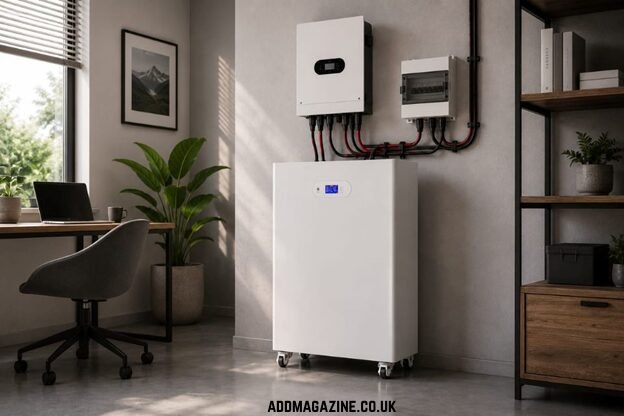
Introduction
Choosing the right battery storage size is one of the most important decisions when designing an energy storage system for a large residential property. While it may seem logical to install the biggest battery available, a larger capacity does not automatically deliver better performance or greater value. The ideal solution depends on how much electricity the property uses, which appliances need backup power, how long backup is required, and whether the battery will work alongside a solar energy system.
Understanding how to size battery storage for large residential properties helps homeowners, installers, and project developers create reliable systems that balance performance, efficiency, and long-term costs. This guide explains the key factors that influence battery sizing, including electrical loads, power demand, solar generation, inverter limitations, and future expansion, providing practical knowledge for informed planning.
Quick Answer
Battery storage for a large residential property should be sized by evaluating daily energy consumption, peak power demand, required backup duration, solar energy production, inverter capacity, and future electricity needs. Rather than selecting a battery based solely on its advertised capacity, an accurate load assessment ensures the storage system matches the property’s actual energy requirements while supporting reliable, efficient operation.
Why Correct Battery Sizing Matters
Correct battery sizing affects much more than backup duration. An undersized battery may run out of stored energy before power is restored, leaving critical appliances without electricity during an outage. On the other hand, an oversized system can increase installation costs without delivering meaningful additional benefits if much of its capacity remains unused.
Proper sizing also improves overall system efficiency. A battery that closely matches daily consumption and backup requirements typically cycles more effectively, making better use of stored energy while supporting long-term performance. This balanced approach helps homeowners avoid unnecessary investment while ensuring essential electrical loads receive dependable backup when needed.
Battery sizing also influences future flexibility. Properties that may later add electric vehicles, heat pumps, workshops, or expanded solar arrays should consider how those changes could affect future energy demand. Planning with growth in mind often creates a more adaptable energy storage solution.
Understand the Difference Between kW and kWh
One of the most common sources of confusion in battery storage planning is the difference between kilowatts (kW) and kilowatt-hours (kWh). Although the terms are closely related, they measure different aspects of electricity, and both are essential when sizing a battery system.
A kilowatt (kW) measures power, or the rate at which electricity is being used at a specific moment. Appliances with high power ratings, such as air conditioners or water pumps, require the battery and inverter to deliver sufficient instantaneous output while they are operating.
A kilowatt-hour (kWh), by contrast, measures energy. It represents the total amount of electricity consumed or stored over time. Battery capacity is normally expressed in kWh because it indicates how much energy the battery can supply before it requires recharging.
| kW | kWh |
| Measures power | Measures stored energy |
| Indicates instantaneous demand | Indicates battery capacity |
| Determines output requirements | Determines backup duration |
Understanding both measurements helps prevent costly design mistakes. A battery may have enough stored energy to power a home for many hours, but if it cannot deliver sufficient power at one time, high-demand appliances may still fail to operate.
Start with Electrical Loads, Not Battery Capacity
The first step in battery sizing should always be understanding how electricity is used throughout the property rather than choosing a battery capacity first. Every large residence has a unique combination of appliances, occupancy patterns, and seasonal demand that influences storage requirements.
A professionally designed home battery system begins with a circuit-level load assessment rather than a capacity figure selected from a product catalogue.
Rather than estimating consumption, installers often review utility bills, smart meter data, appliance specifications, and electrical panel layouts to identify both continuous and peak electrical loads. This process provides a clearer picture of actual energy demand while revealing which circuits are essential during outages and which can remain disconnected if backup power is limited.
Large residential properties frequently include additional electrical loads such as irrigation pumps, workshops, swimming pools, electric gates, or detached buildings. Identifying these loads early helps create a battery sizing plan based on measured requirements instead of assumptions, forming the foundation for a reliable and efficient energy storage system.
Calculate Daily Energy Consumption
Once the electrical loads have been identified, the next step is calculating daily energy consumption. This measurement forms the basis of battery sizing because it shows how much electricity the property uses over a typical 24-hour period. Utility bills provide a useful starting point, but smart meters and energy monitoring systems offer more detailed insights into how electricity demand changes throughout the day. Seasonal differences should also be considered, as heating and cooling requirements can significantly affect overall consumption.
Large residential properties often have higher electricity demand than standard homes due to additional equipment and larger living spaces. Features such as multiple HVAC units, swimming pool pumps, electric water heaters, workshops, irrigation systems, and EV chargers all contribute to daily energy use. Understanding these loads helps create a battery system that reflects actual operating conditions rather than rough estimates.
| Appliance | Estimated Daily Consumption (kWh) |
| HVAC System | 28 |
| Refrigerator & Freezer | 4 |
| Lighting | 6 |
| Kitchen Appliances | 8 |
| Water Pump | 5 |
| EV Charging | 18 |
| Estimated Total | 69 kWh |
This example illustrates why measured consumption is more reliable than assumptions. A property with similar energy use may require a different battery size depending on backup priorities, solar generation, and expected outage duration.
Essential-Load Backup vs Whole-Home Backup
After calculating daily energy use, the next decision is determining which appliances should remain operational during a power outage. This choice has a major influence on the required battery capacity.
Essential-load backup focuses only on critical circuits such as refrigerators, lighting, internet equipment, medical devices, and communication systems. Limiting backup to these loads reduces energy demand and allows a smaller battery to provide electricity for a longer period.
Whole-home backup aims to keep nearly every household circuit operating, including HVAC systems, electric cooking appliances, laundry equipment, workshops, swimming pool equipment, and EV charging.
| Essential-Load Backup | Whole-Home Backup |
| Critical circuits only | Most household circuits |
| Smaller battery capacity | Larger battery capacity |
| Lower installation cost | Higher installation cost |
| Longer backup duration | Greater household comfort |
The most suitable option depends on energy priorities, outage frequency, and available budget rather than assuming every appliance must remain powered.
Continuous Power vs Appliance Startup Power
Battery capacity is only one part of system design. The battery and inverter must also deliver enough power to start electrical equipment successfully.
Many appliances require a brief surge of electricity when starting. Air conditioners, refrigerators, compressors, and water pumps may temporarily draw several times their normal running power. If the inverter cannot supply this surge, the appliance may fail to start even if sufficient battery energy remains.
Considering both continuous operating power and startup demand ensures the battery system performs reliably under real operating conditions instead of only meeting theoretical energy calculations.
How Solar Array Output Influences Battery Size
Solar generation directly affects battery sizing because photovoltaic panels recharge stored energy during daylight hours. A well-matched solar array can reduce the amount of battery capacity needed for overnight use while improving overall energy independence.
However, solar production changes with weather, seasons, roof orientation, and shading. Designing a battery around realistic annual solar output rather than ideal conditions results in more dependable performance throughout the year.
Don’t Overlook Inverter Power Limitations
The inverter determines how much electricity can be delivered from the battery to household appliances at any given moment. Even a high-capacity battery cannot operate multiple heavy loads if the inverter’s output rating is insufficient.
A balanced system considers battery capacity, inverter capability, electrical loads, and solar generation together to avoid unnecessary performance limitations.
When Is 30kWh or 50kWh Storage Appropriate?
Battery size should always match the property’s actual energy requirements rather than following a standard recommendation. A 30kWh battery system is often suitable for a large family home with moderate daily electricity use, efficient appliances, and overnight backup requirements.
A 50kwh solar battery may be more appropriate for large all-electric residences, farms, off-grid homes, or mixed-use properties with higher daily consumption, multiple HVAC systems, irrigation pumps, workshops, or several electric vehicles. Choosing the appropriate capacity based on measured energy demand helps improve efficiency, reliability, and long-term system performance.
Plan for Future Capacity Expansion
Battery storage should not only meet today’s energy requirements but also accommodate future changes in electricity demand. Many large residential properties gradually add new electrical loads, such as additional air conditioning units, heat pumps, electric vehicles, workshops, home offices, or outdoor living spaces. These upgrades can significantly increase daily energy consumption over time.
Choosing a modular battery system can make future expansion more straightforward. Many modern energy storage solutions support parallel battery configurations, allowing additional battery modules to be integrated as energy requirements grow. This approach enables homeowners to increase storage capacity without replacing the original system, provided the batteries, inverter, and communication protocols are compatible.
Planning for future expansion also helps protect long-term investment. Even if current energy use is relatively modest, considering expected lifestyle changes during the initial design stage can reduce upgrade costs and simplify future system modifications.
Why Professional Load Assessments Matter
Battery sizing calculators and online estimates can provide a useful starting point, but they cannot fully account for the unique electrical characteristics of every property. Large residences often have complex load profiles that include seasonal demand, multiple distribution panels, high-power appliances, and varying occupancy patterns. A professional assessment helps identify these factors before equipment is selected.
Qualified installers typically evaluate utility consumption, circuit layouts, appliance specifications, inverter compatibility, and backup priorities before recommending a battery capacity. This detailed process reduces the risk of oversizing, which can increase unnecessary costs, or undersizing, which may result in insufficient backup during outages.
Manufacturers that support installers with scalable energy storage solutions, such as Avepower, also recognize the importance of proper system planning. Rather than focusing solely on battery capacity, a comprehensive load assessment helps ensure the battery, inverter, solar array, and electrical loads operate together as a balanced system that delivers reliable long-term performance.
Final Thoughts
Sizing battery storage for a large residential property involves much more than selecting the highest-capacity battery available. A well-designed system begins with understanding daily energy consumption, distinguishing between power (kW) and energy (kWh), identifying essential backup requirements, considering solar generation, accounting for inverter limitations, and planning for future expansion. Every property has different electrical demands, so battery capacity should always be matched to actual usage rather than assumptions.
As residential energy storage continues to evolve, informed planning remains the key to achieving reliable backup and efficient operation. Resources provided by manufacturers such as Avepower, together with guidance from qualified installers and energy professionals, can help property owners better understand their options before making long-term investment decisions.
Frequently Asked Questions
1. How much battery storage does a large residential property need?
There is no single answer. The correct battery size depends on daily electricity consumption, peak power demand, backup duration, solar generation, and the number of appliances that need to operate during an outage.
2. Is a 30kWh battery enough for a large house?
A 30kWh battery may be suitable for many large homes with moderate daily energy use and essential-load backup. Properties with higher electricity demand may require greater storage capacity.
3. When should I consider a 50kWh battery system?
A 50kWh system is often appropriate for large all-electric homes, farms, mixed-use properties, or locations with multiple HVAC systems, electric vehicles, workshops, or extended backup requirements.
4. Should battery storage capacity match my solar panel system?
Not necessarily. Battery capacity should complement expected solar generation, daily electricity use, and backup objectives rather than simply matching the solar array size.
5. Can battery storage systems be expanded later?
Many modern modular battery systems support parallel expansion, allowing additional battery modules to be added as electricity demand increases. Compatibility with the inverter and battery management system should always be confirmed before expansion.