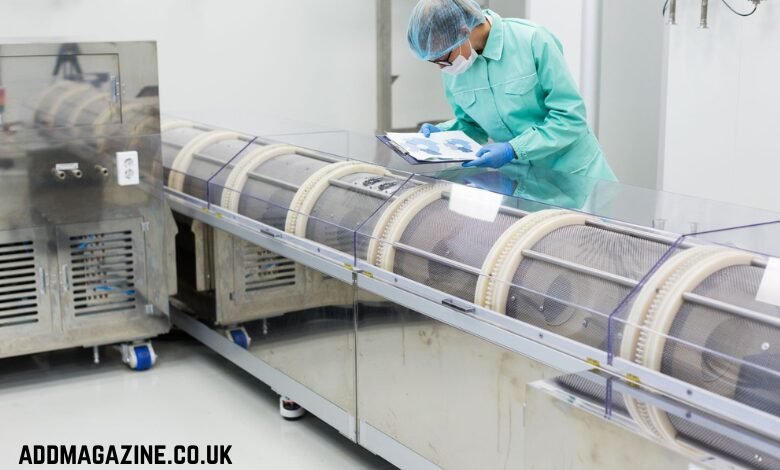
The thermoforming industry is changing faster than ever. New tools, shifting customer needs, and growing focus on sustainability are pushing service providers to adapt quickly. It’s no longer just about shaping plastic; it’s about speed, precision, and smart problem-solving. Companies that stay flexible and open to change are the ones that keep up. In this blog, we’ll look at the key trends shaping thermoforming service providers today. From faster production methods to eco-friendly materials, you’ll see what’s driving the industry forward and how these changes are helping businesses deliver better results across different markets.
Next-Gen Material Strategies Fueling Industry Growth
Material selection has quietly become a competitive signal. It’s no longer just about meeting a spec; the polymers you choose reveal how seriously a provider is thinking about performance, compliance, and long-term client outcomes.
Circular Economy and Sustainable Materials
Leading service providers are making real moves toward recycled, recyclable, and compostable inputs, driven partly by tightening regulations and partly by buyers who simply won’t accept anything less. Many forward-thinking thermoforming companies are adopting closed-loop recycling, where skeletal sheet waste gets granulated and fed back into the same production line. If your potential partner isn’t doing this already, that’s a red flag worth noting.
The providers pulling ahead aren’t stopping there; they’re building full circular systems around it.
Lightweighting Without Compromise
Thermoforming’s structural advantage is real. Thin-gauge forming can reduce resin usage by up to 25% without sacrificing integrity. Mordor Intelligence has flagged this specifically for e-grocery packaging. For brands managing cost pressures and sustainability targets at the same time, that kind of efficiency is genuinely hard to ignore.
Smarter material choices demand smarter production environments. Which brings us to automation.
Smart Automation: Where Leading Providers Are Putting Their Money
The “smart factory” concept has moved well past buzzword territory. The providers investing seriously in infrastructure are already running IoT-driven production lines that respond in real time, not after the fact.
End-to-End Automated Production
From sheet feeding through to finished packaging, automation is replacing manual bottlenecks with precision and speed. Predictive maintenance tools monitor equipment health continuously, flagging issues before they cascade into costly downtime. At scale, that’s not a small operational win; it’s a structural advantage over competitors still relying on reactive maintenance cycles.
Vision-Based Quality Inspection
High-speed optical systems now audit parts for concentricity, flange thickness, and sidewall accuracy automatically pulling failures before they ever reach a customer. In food safety and medical packaging contexts, this level of control isn’t optional. Clients in those sectors simply expect it. The data these systems generate is equally valuable, feeding directly into the next wave of digital transformation.
Digital Transformation Is Separating the Leaders from the Laggards
A growing cohort of advanced service providers has moved beyond operational automation into full digital integration. Manufacturing Execution Systems (MES) and digital twins are now being used to simulate forming processes virtually, catching problems before a single sheet of material is touched. Development timelines shrink. Costly trial-and-error gets squeezed out.
AI and Data Analytics in Daily Operations
AI-driven parameter optimization is cutting waste and improving cycle-to-cycle consistency across high-volume lines. The machines aren’t just faster, they’re getting genuinely adaptive, learning across repetitions and self-adjusting to maintain quality without human intervention. For clients who care about long-term predictability, this matters enormously.
Cloud Monitoring and Remote Support
Engineering teams can now troubleshoot equipment issues across multiple geographies without sending technicians on a plane. For companies managing global supply chains, that kind of always-on, responsive support is a real differentiator, not just a convenience. Remote capability paired with deep digital infrastructure is what long-term competitive positioning looks like right now.
What Strategic R&D Investment Actually Looks Like
The top-tier suppliers aren’t waiting for polymer producers to hand them better materials. They’re co-developing. Collaborations with academic institutions and material scientists are producing advances in processing and formulation that smaller, less-resourced operations genuinely cannot replicate. If you’re evaluating providers, ask what they’ve developed internally in the last three years.
Decorative and Functional Innovation
In-mold labeling for thermoforming (IML-T), distortion printing, and digital direct-to-shape printing are giving brand teams powerful new tools for shelf differentiation. Meanwhile, enhanced barrier films are cracking open new application windows in medical and food packaging at the same time. These aren’t incremental upgrades; they’re category-expanding capabilities.
Tooling and Processing Breakthroughs Worth Watching
Aluminum tooling with hard coatings, NFC/RFID sensor integration, and regenerative servo braking systems are fundamentally changing how leading providers plan for maintenance and production efficiency. Trim-in-place technology removes secondary trimming steps entirely, improving material yield per cycle and reducing handling time. Automated scrap collection routes reclaimed material straight back into production, nothing wasted, nothing sitting idle.
Sustainability Leadership as a Long-Term Competitive Advantage
The most forward-thinking providers in this space have embedded sustainability into product development from day one, not as an afterthought. Lifecycle analysis (LCA) and eco-design principles applied at the concept stage mean clients consistently receive products that balance performance with environmental accountability. That combination of customer-centric service backed by genuine eco-leadership is what separates the providers worth partnering with from the ones simply keeping up appearances.
1. Why are sustainability practices important for thermoforming companies?
Sustainability helps reduce waste, lower costs over time, and meet growing customer and regulatory demands. Thermoforming companies that use recycled and recyclable materials also build stronger trust with buyers who care about environmental impact.
2. What is closed-loop recycling in thermoforming?
Closed-loop recycling is a process where leftover material, like skeletal sheet waste, is collected, broken down, and reused in the same production cycle.
3. How can I choose the right thermoforming partner?
Look for a provider that uses sustainable materials, follows modern production practices, and offers flexible solutions. Experience across industries and a clear focus on reducing waste are also strong signs of a reliable partner.