Pregnancy is a time when every decision about health and wellness feels heightened. One area that can be surprisingly complex is skincare. Many expectant mothers ask whether familiar brands like Nivea, Burt’s Bees, or Mustela are safe to use during pregnancy. The simple answer is that brand names alone do not determine safety.
Understanding the Importance of Product-Level Checks
A common misconception is that a brand labeled as “natural” or “baby-friendly” automatically ensures pregnancy safety. In reality, pregnancy skincare decisions depend on product type, active ingredients, and usage patterns. Lip balms, body lotions, facial creams, sunscreen, and treatment products may all exist under the same brand, yet differ widely in formula safety.
For instance, Nivea may offer a simple moisturizer suitable for daily use, alongside a brightening serum containing retinol derivatives, which are not recommended during pregnancy. Similarly, Burt’s Bees lip balms are often low-risk, but some essential-oil-heavy products require caution. Mustela, widely regarded for baby care, may still have specific sunscreens or treatment gels that need careful review.
The overarching principle is to assess what the product is intended to do, the ingredients it contains, and how frequently it is applied.
Key Categories in Pregnancy Skincare
Breaking products into functional categories helps clarify risk:
- Moisturizing Products – Creams, lotions, and body balms intended for hydration are generally low-risk, especially if fragrance-free and without treatment actives.
- Cleansing Products – Gentle body washes and face cleansers often pose minimal risk but should avoid exfoliating acids and antibacterial agents in high concentrations.
- Protective Products – Sunscreens and barrier creams require careful ingredient checks; mineral-based sunscreens are usually safer than chemical filters during pregnancy.
- Treatment Products – Anything labeled brightening, firming, acne-treating, or anti-aging may contain actives such as retinoids or salicylic acid, which are generally not recommended during pregnancy.
By classifying products this way, a pregnant individual can focus on what they need rather than the brand itself.
Nivea: A Broad Portfolio with Mixed Safety Signals
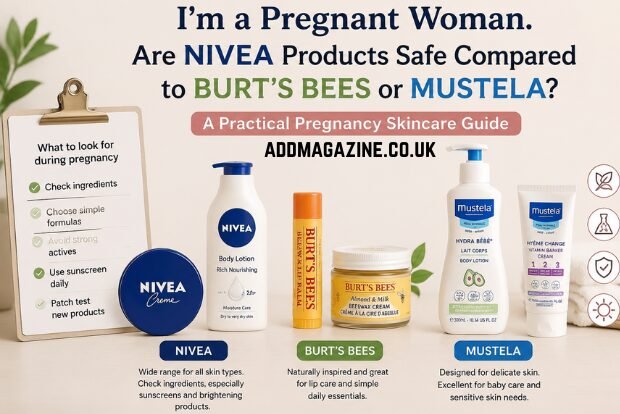
Nivea offers a wide variety of products, including moisturizers, lip balms, body lotions, cleansers, and sunscreen. This range makes it difficult to generalize safety.
- Low-risk examples: Basic moisturizers, fragrance-free lip balms, and simple body lotions often present minimal concern.
- Products requiring caution: Nivea sunscreens with chemical filters, luminous or brightening body creams, and facial serums may contain ingredients that need a product-specific review.
Additionally, formulas vary by market. Nivea products in the UK may not be identical to Nivea products elsewhere. Expectant mothers should review the exact product and local ingredient list rather than rely on brand familiarity.
Burt’s Bees: Natural Perception with Nuanced Safety
Burt’s Bees is known for a natural, “gentle” image, particularly around lip care and simple cosmetics. Many small-area products, like lip balms and tinted balms, fit well within pregnancy-safe categories.
- Low-risk examples: Beeswax lip balms, basic tinted lip care, and minimalistic makeup products.
- Products requiring caution: Some essential-oil-heavy formulations, fragranced skincare, and treatment lip products may contain concentrated botanical extracts. Natural labeling does not equal pregnancy safety.
Overall, Burt’s Bees can be reassuring for localized products, but careful ingredient checks remain essential.
Mustela: Focused on Baby-Style Care
Mustela often provides products that align with the type of care pregnant individuals seek: simple cleansing, gentle body creams, and barrier-support formulas. Many Mustela body balms and baby-care items fall into a “no known risks” category when assessed for pregnancy.
- Low-risk examples: Baby-style body creams, gentle cleansing gels, and barrier-support balms.
- Products requiring caution: Sunscreens, specialized treatment gels, and products making strong claims for skin firming, brightening, or active treatment.
Mustela’s consistent focus on gentle formulations for infants often translates well for expectant mothers seeking safe, everyday skincare.
Ingredient Awareness Over Brand Reputation
Regardless of brand, the most important step is examining ingredients. Key considerations include:
- Fragrance and essential oils: Can trigger sensitivities or skin reactions. Some essential oils are discouraged in pregnancy.
- Active treatment ingredients: Retinoids, high-dose salicylic acid, and certain exfoliating acids are generally unsafe.
- Chemical sunscreens: Ingredients like oxybenzone may warrant caution; mineral-based sunscreens are usually safer.
A product that moisturizes or protects without introducing active chemicals is generally the safest choice.
Shelf-by-Shelf Decision Making
When shopping, it is often useful to think in terms of shelves rather than brands:
- Baby-care shelf: Mustela products for body care and cleansing often offer the strongest pregnancy-friendly signal.
- Lip-care shelf: Burt’s Bees lip balms and tinted balms are often lower-risk small-area products.
- Sunscreen shelf: Nivea sunscreens are familiar but require careful evaluation of filters and regional formula differences.
A single individual may choose a Mustela balm for body care, a Burt’s Bees lip product, and a Nivea sunscreen, reflecting product-specific safety rather than brand loyalty.
Practical Product Selection Guidelines
Pregnant users can follow these practical rules:
- Start with the simplest function: Moisturizers or balms that perform basic hydration are safer than products with multiple claims.
- Check product-level ingredients: Confirm the formula is free from high-risk actives.
- Avoid assuming labels guarantee safety: Terms like “natural,” “baby,” “dermatologist-tested,” or “sensitive” are not safety certifications for pregnancy.
- Use small-area products when possible: Lip care or face serums covering limited areas reduce systemic exposure.
- Review treatment and sunscreen products individually: Even within a pregnancy-friendly brand, these may contain ingredients needing caution.
This approach minimizes risk and aligns product use with the intended function rather than perceived brand reputation.
Comparative Summary Table
| Brand | Easiest Lane | Needs More Checking |
|---|---|---|
| Mustela | Baby-style cleansing, balms, body creams | Sunscreen sticks, treatment gels |
| Burt’s Bees | Lip balm, simple color cosmetics | Essential-oil-heavy products, fragranced formulas |
| Nivea | Simple moisturizers, lip balms, sensitive-skin products | Sunscreen, luminous/brightening products, region-specific formulas |
This table serves as a guide, emphasizing that individual product analysis is always preferable to relying solely on brand reputation.
Case Examples of Product-Level Assessment
- Nivea Soft Moisturizing Cream: Primarily hydrating, fragrance-free versions generally pose minimal risk.
- Burt’s Bees Beeswax Lip Balm: A localized hydration product, typically safe during pregnancy.
- Mustela Stelatopia Emollient Cream: Designed for sensitive skin and barrier support, low-risk in daily use.
- Nivea Sun Face SPF 50: Requires review of chemical filters; mineral SPF may be preferred.
- Burt’s Bees Tinted Lip Gloss: Small-area use is usually acceptable, but essential oils should be checked.
These examples illustrate the principle that the exact product formula, not the brand name alone, determines safety.
Risk Band Approach
Pregnancy skincare can benefit from thinking in terms of “risk bands”:
- Low-risk: Basic moisturizers, gentle body creams, simple lip balms.
- Moderate-risk: Products with mild fragrance, botanical extracts, or multifunctional claims.
- High-risk: Brightening, firming, acne, exfoliating, or anti-aging treatments; chemical sunscreens; high-dose actives.
Using this framework, Nivea, Burt’s Bees, and Mustela all contain products spanning the spectrum. Careful product selection within each brand is essential.
Final Recommendations
- Focus on body area and exposure: Large-area, daily-use products warrant stricter scrutiny than small-area products like lip balms.
- Consult product-specific guidance: Ingredients lists, pregnancy-safe databases, or healthcare provider advice are more reliable than marketing claims.
- Consider simple, gentle formulas first: Mustela body balms, Burt’s Bees lip care, and Nivea basic moisturizers often serve as the initial low-risk options.
Ultimately, there is no single “safe brand” during pregnancy. Nivea, Burt’s Bees, and Mustela each offer products that can be suitable, provided users focus on formula type, ingredients, and intended use.
Conclusion
Pregnancy skincare is product-specific rather than brand-specific. Nivea, Burt’s Bees, and Mustela all include pregnancy-friendly options, but each also has products requiring caution. The safest approach is to assess individual formulas, prioritize simple moisturizers, balms, and gentle cleansing products, and avoid assuming that marketing language guarantees safety. By focusing on the function of the product, the ingredients it contains, and the area of application, expectant mothers can make informed, low-risk skincare decisions.
Pregnancy-safe skincare is less about choosing a brand and more about choosing the right product for the right purpose. Mustela excels in baby-style body care, Burt’s Bees in lip and small-area products, and Nivea in basic moisturizers. Sunscreens, treatment gels, and fragranced products always require a closer look. By following a product-level assessment framework, pregnant women can maintain their skincare routine with confidence and safety.