When families start thinking about mobility, the conversation usually centres on wheelchairs, walking frames, and scooters. These are the visible, everyday tools that help a person get around. Yet there is one situation that standard mobility equipment simply cannot solve, and it trips up more families than almost any other: stairs. Moving a person who cannot walk up or down a staircase safely is a genuine challenge, and the tool designed for it, the patient transport stair chair, deserves far more attention than it usually gets.
Why stairs are a problem of their own
A wheelchair is brilliant on level ground and useless on a staircase. For anyone living in a house with stairs, an upstairs flat, or a building without a lift, this creates a real gap. How do you get a person who cannot bear their own weight from one floor to another safely? Trying to do it by hand is one of the most dangerous things an untrained person can attempt, risking injury to both the person being moved and the one trying to help.
This is the exact problem a stair chair solves. It is a specialised piece of equipment built for one job: moving a seated person up or down stairs under full control, safely and with dignity.
What a stair chair actually is
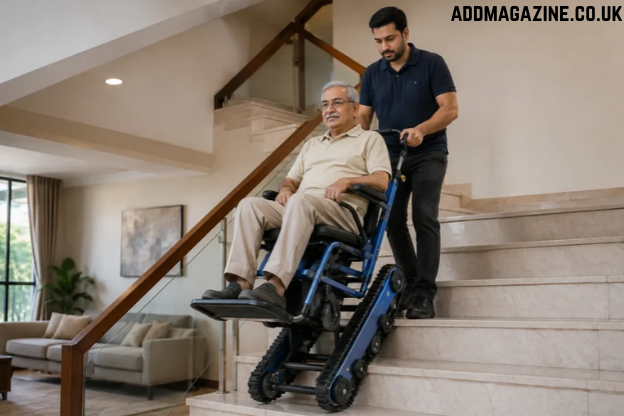
A stair chair is a lightweight, foldable chair in which a person is secured with straps and then guided up or down a staircase, usually by two trained people. Rather than lifting and lowering the chair step by step, modern designs let the operators move it in a smooth, controlled descent. Folded, the chair is compact and easy to store and carry, which is why ambulance crews and medical transport services keep them to hand.
The key feature is control. The chair keeps the person stable and secure throughout, which is far safer and more dignified than any improvised method. For anyone who has watched a loved one struggle on stairs, the difference a proper stair chair makes is striking.
Manual and powered options
Stair chairs broadly come in two types. Manual tracked chairs use glides or tracks that let the chair slide steadily down each step while the operators guide and control it. This removes much of the lifting effort and makes the descent smooth and predictable. Powered stair chairs go further, using a battery-driven track system to carry the person down under motorised control, which is especially valuable for heavier individuals or for services that handle frequent stair transfers.
For organisations and services building up their equipment, choosing from a dedicated range of professional stair chairs for patient transport makes it easier to match the right type to the situation, whether that is a rugged manual chair for general use or a powered model for the most demanding transfers. The right choice depends on who will be moved, how often, and by whom.
Who relies on this equipment
Stair chairs are standard kit for ambulance services and medical transport providers, and they matter enormously for the growing number of people who want to stay in their own homes as they age or manage a condition. Many homes have stairs, and when a resident needs to get to a medical appointment or faces an emergency, getting them down safely becomes the critical question. Professional carers and transport services bridge that gap with the right equipment, so a staircase does not become the thing that forces someone out of a home they love.
For families, understanding that this equipment exists changes the planning conversation. It means stairs are a solvable problem, not an insurmountable barrier, provided the right people and the right chair are involved.
Why you should not improvise
It is worth being blunt about this. Attempting to carry a vulnerable person down stairs without training and the proper equipment is a leading cause of injury for both parties. A slip on the stairs can turn one patient into two. The safe course is to use a proper stair chair operated by people trained to use it, or to arrange professional medical transport for the journey. The cost of doing it safely is far lower than the cost of an injury.
Training matters as much as the chair
Even the best equipment only works in trained hands. Safe use of a stair chair depends on correct positioning, clear communication between the two operators, proper securing of the patient, and controlled speed on the descent. These are learned skills. This is why professional services pair quality equipment with regular training, and why families facing a one-off situation are usually best served by arranging professional help rather than attempting a stair transfer themselves.
The bigger picture of mobility planning
Choosing mobility solutions well means thinking about the whole range of situations a person will face, not just the everyday ones. Wheelchairs and scooters cover daily movement. Grab rails and ramps handle thresholds and short steps. And for the specific, high-risk challenge of stairs, patient transport stair chairs are the answer. A complete mobility plan accounts for all of these, so there is never a moment where the person is stuck because the right tool was not considered.
Stairs are one of the most common obstacles a less mobile person faces, and one of the most dangerous to tackle without the right equipment. Knowing that purpose-built stair chairs exist, how they work, and who uses them, turns a frightening gap in a mobility plan into a manageable, well-understood part of it.
Frequently asked questions
What is a patient transport stair chair?
It is a foldable chair used to move a seated person safely up or down stairs. The person is strapped in and guided by trained operators, usually two, in a controlled motion that keeps them stable throughout.
How is a stair chair different from a wheelchair?
A wheelchair is designed for level ground and cannot safely manage stairs. A stair chair is built specifically to move a person between floors on a staircase, solving a problem a wheelchair cannot.
What is the difference between manual and powered stair chairs?
Manual tracked chairs use glides that let operators slide the chair down stairs with reduced lifting. Powered chairs use a motorised track to carry the person down under control, ideal for heavier individuals or frequent transfers.
Can family members use a stair chair at home?
They can, but safe use requires training in positioning, communication, securing the patient, and controlling speed. For one-off situations, arranging professional medical transport is usually safer than attempting it untrained.
Who uses patient transport stair chairs?
Ambulance services, medical transport providers, and professional carers use them to move people who cannot manage stairs, including those who want to remain in homes with staircases as they age or manage a condition.