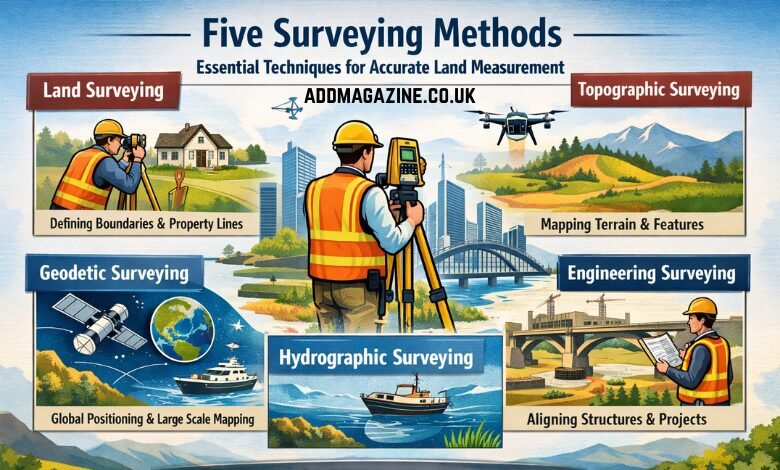
Surveying is the backbone of the construction and land development industries. From the division of land into parcels to the design of major infrastructure projects, accurate surveying ensures the precise measurement and documentation of various aspects of land and property. Five surveying refers to a set of five core surveying methods that are utilized to gather essential data related to land, structures, and the natural environment. These techniques are critical for engineers, architects, and city planners, helping them make informed decisions during the planning and construction phases of a project.
In this article, we will explore five key surveying methods, how they contribute to development projects, and the technology and skills involved in conducting accurate surveys. Whether it’s designing roads, managing natural resources, or ensuring legal property boundaries, five surveying plays an essential role in modern land development and infrastructure planning.
1. Land Surveying: Defining Boundaries and Property Rights
Land surveying is one of the most important methods within five surveying. It involves measuring land boundaries and ensuring the correct division of properties. The primary purpose of land surveying is to define legal property lines, which are crucial for property ownership, land sales, and land development. These surveys ensure that the boundaries of a piece of land are accurately represented, preventing property disputes that could arise due to inaccuracies.
Land surveying has a broad range of applications, including:
- Construction Site Planning: Ensuring the correct location for building structures, roads, and utilities.
- Subdivision of Land: Dividing large land parcels into smaller sections for residential or commercial use.
- Property Documentation: Creating official records of land boundaries for legal purposes.
Surveyors use tools like total stations and GPS devices to measure distances, angles, and elevation changes on a site. The data collected is crucial for creating legal documents and ensuring that construction projects are built according to plan.
Topographic Surveying: Documenting both Natural Terrain and Human-Made Structures
Topographic surveying focuses on identifying the natural and man-made features of a given area. This type of surveying is essential for understanding the terrain, including elevation changes, water bodies, vegetation, and structures like roads or buildings. The main goal is to create detailed maps and models that show the landscape’s features.
Topographic surveys are vital for:
- Highway Design: Ensuring the road follows the natural contours of the land for efficient drainage and construction.
- Urban Planning: Helping city planners design new developments that integrate with the existing landscape.
- Environmental Studies: Assessing the impact of construction projects on the environment.
Topographic surveys often involve the use of advanced tools like drones and laser scanning (LiDAR) to create highly accurate 3D models of the land surface.
3. Geodetic Surveying: Measuring on a Global Scale
Geodetic surveying is an advanced form of surveying that accounts for the Earth’s curvature. Unlike other surveying methods that focus on small areas, geodetic surveying deals with large-scale projects, such as mapping entire countries or continents. This method involves the use of satellites, GPS, and aerial mapping technologies to gather data on the Earth’s surface and its dimensions.
Applications of geodetic surveying include:
- Global Mapping Projects: Creating maps of vast regions with high precision.
- Navigation Systems: Providing data for GPS systems used in everything from cars to smartphones.
- Large-Scale Engineering Projects: Designing infrastructure projects that span across cities or even countries.
Geodetic surveying is essential for the accurate measurement of distances, angles, and coordinates on a global scale. Moreover, this method is used to ensure the alignment of large construction projects like highways, dams, and pipelines that require precise coordination over long distances.
4. Hydrographic Surveying: Measuring Underwater Features
Hydrographic surveying involves measuring underwater features such as rivers, lakes, oceans, and other bodies of water. This type of survey is critical for maritime navigation, port construction, and underwater resource exploration. By mapping the ocean floor or riverbeds, hydrographic surveys provide data on water depths, tides, currents, and submerged structures.
Hydrographic surveying has various applications, including:
- Port Development: Ensuring that harbors and docks are built in safe locations with adequate water depth for large ships.
- Underwater Cable Installation: Mapping the seafloor to identify suitable routes for cables and pipelines.
- Flood Risk Assessment: Understanding the flow of rivers and other water bodies to assess potential flood risks and design effective drainage systems.
Hydrographic surveys often use sonar equipment, drones, and other specialized tools to measure water depths and gather data on submerged features. This information is vital for ensuring safe navigation and effective marine construction projects.
5. Engineering Surveying: Aligning Plans with Terrain
Engineering surveying focuses on ensuring that construction plans align with the physical terrain. Moreover, it involves taking measurements and establishing reference points for the precise positioning of buildings, roads, bridges, and other infrastructure. Engineering surveys help ensure that the project is built according to the design specifications and that it fits properly into the natural landscape.
Common applications of engineering surveying include:
- Construction Progress Monitoring: Tracking the progress of construction to ensure it aligns with the plans.
- Setting Out Building Foundations: Accurately marking the locations where foundations, roads, and other structures will be built.
- Quality Inspection and Verification: Ensuring that the construction work meets design standards and is completed according to the plans.
Engineering surveys are essential for construction companies and project managers to monitor and verify that each phase of a project is progressing as intended. They involve precise measurements and verification of alignment to avoid costly mistakes and delays.
The Role of Technology in Five Surveying
The field of surveying has evolved significantly over the past few decades, with advancements in technology improving the accuracy, efficiency, and speed of surveys. Modern surveying equipment includes:
- GPS and GNSS Receivers: These devices are used for precise location measurements, particularly in land and geodetic surveys.
- Total Stations: Instruments that measure distances, angles, and elevations, often used in land and engineering surveys.
- Drones and Aerial Mapping Devices: Drones equipped with cameras and LiDAR sensors can quickly survey large areas and capture high-resolution imagery.
- Geographic Information Systems (GIS): GIS software allows surveyors to analyze spatial data and create detailed maps and models.
- Laser Scanning (LiDAR): LiDAR technology captures detailed 3D information about surfaces, including terrain and structures, which is invaluable in topographic surveys.
These tools enable surveyors to collect data faster and more accurately than ever before. Furthermore by using drones, GPS systems, and LiDAR technology, surveying professionals can survey large areas in less time and with a higher degree of precision. This allows for more informed decision-making and reduces the chances of errors in construction planning.
The Importance of Five Surveying in Modern Infrastructure
The importance of five surveying cannot be overstated. Furthermore it is the foundation upon which most construction, land management, and infrastructure projects are built. Without accurate surveys, projects would be more prone to errors, delays, and legal disputes. Five surveying ensures that all stakeholders, including developers, engineers, architects, and city planners, have access to accurate data for making informed decisions.
Some of the key benefits of five surveying include:
- Accuracy: Surveying eliminates costly mistakes by providing precise measurements of land and structures.
- Safety: Proper surveying helps prevent structural failures by ensuring that buildings, roads, and bridges are built on solid ground and correctly aligned.
- Efficiency: Surveying saves time during the planning and construction phases by providing accurate data upfront.
- Legal Security: Accurate land surveys ensure that property rights are clearly defined, preventing legal disputes over land boundaries.
Surveying in Different Industries
Five surveying methods are indispensable in a variety of industries, each of which benefits from the accurate data provided by these techniques. The ability to measure and map land, as well as the natural and built environment, is essential for several sectors. These industries rely on surveys to ensure that projects are completed safely, efficiently, and according to regulations.
1. Smart City Planning
As cities continue to grow and evolve, planning for urban spaces requires precise data about land use, infrastructure, and the surrounding environment. Surveying techniques like topographic and land surveying are essential in smart city planning. They support architects, engineers, and city planners in creating buildings, roads, and utilities that seamlessly integrate with the surrounding natural environment and meet urban requirements.
Surveyors play a key role in designing sustainable urban developments that minimize environmental impact while maximizing the efficiency of the urban infrastructure. Furthermore with the integration of technologies like Geographic Information Systems (GIS), surveyors can provide valuable data that supports the creation of modern, technologically advanced, and sustainable cities.
2. Transportation Infrastructure
One of the most significant applications of surveying is in the construction of roads, highways, railways, and bridges. Engineering surveys are crucial to ensuring that these structures are built in the correct location and in accordance with safety standards.
- Road Design: Moreover, surveying allows engineers to understand the lay of the land and make informed decisions about where to place roads, minimize erosion, and create safe travel routes.
- Railway Design: With topographic and engineering surveys, planners can assess the best paths for railways, minimizing the risks posed by natural terrain.
- Bridges and Tunnels: Complex projects like bridges and tunnels require precise alignment and measurements. These structures need to fit within the surrounding environment, avoiding hazards like waterways or unstable ground.
Transportation infrastructure often involves multiple stakeholders, from local governments to private contractors. Accurate surveys ensure that each step of the project is aligned with the broader plan and complies with regulations.
3. Energy Projects
Energy infrastructure projects, such as the construction of dams, wind farms, and oil pipelines, require extensive surveying to assess the land and environmental conditions before construction begins. Hydrographic surveying, in particular, plays a vital role in these projects by measuring water levels, flow rates, and the depth of bodies of water for dam construction or underwater pipelines.
- Wind Farms: Surveying is essential in selecting the best locations for wind turbines. Topographic and environmental surveys help assess wind speeds and ensure that turbines are placed in areas with sufficient wind flow.
- Oil and Gas Pipelines: Surveys are conducted to assess the land and minimize environmental damage. Engineers use data from land and topographic surveys to choose optimal routes for pipelines, minimizing risks to ecosystems.
Furthermore in these energy-related projects, accurate surveying is crucial for identifying safe locations, ensuring proper installation, and minimizing the impact on natural environments.
4. Residential and Commercial Development
For residential and commercial property development, five surveying methods ensure that the construction of buildings, roads, and utilities goes according to plan. Furthermore from land surveying to engineering surveying, these techniques ensure that projects align with local regulations and that structures are built on solid, stable ground.
- Property Boundaries: Land surveying defines the boundaries of the property to avoid disputes between developers and property owners.
- Building Construction: Furthermore engineering surveys are used to establish precise locations for building foundations, ensuring that the building structure is placed correctly and meets all design specifications.
- Urban Planning: Furthermore topographic surveys help developers assess terrain and incorporate the natural landscape into their designs, ensuring that residential and commercial buildings fit seamlessly into the surrounding area.
Accurate surveys help developers avoid costly delays and mistakes, allowing them to build high-quality properties that are both safe and efficient.
5. Mining and Resource Exploration
Surveying is also crucial in the mining and resource exploration industries. Furthermore for mining operations, accurate data about the land’s terrain and the location of resources is necessary to determine where to dig, what equipment to use, and how to manage environmental risks.
- Exploration: Geodetic surveys and land surveys help mining companies locate mineral deposits and evaluate the land’s suitability for resource extraction.
- Mining Operations: After identifying a site, detailed surveys are conducted to design the mine layout, incorporating access routes, excavation zones, and waste disposal systems.
- Environmental Protection: Moreover, surveys are essential in assessing the environmental impact of mining operations, helping companies minimize their ecological footprint and meet regulatory requirements.
Accurate surveys are necessary for ensuring that mining operations are carried out efficiently, safely, and in compliance with environmental regulations.
The Role of Surveyors: Skills and Expertise
Surveyors are professionals who possess a combination of technical, mathematical, and analytical skills. They must be proficient in using the latest surveying equipment and technologies, including GPS devices, total stations, drones, and laser scanning systems.
Key skills and expertise for surveyors include:
- Mathematical and Geographical Knowledge: Surveyors must understand the principles of geometry, trigonometry, and land measurement techniques.
- Proficiency with Digital Instruments: Surveyors use advanced technology such as GPS, LiDAR, and GIS to gather accurate data and analyze land features.
- Map Interpretation: Understanding and interpreting complex maps and survey data is a critical part of a surveyor’s role. Surveyors use these maps to provide clear, actionable insights for construction projects.
- Attention to Detail: Surveyors must be meticulous, ensuring that measurements are taken correctly and accurately recorded.
- Problem-Solving: In challenging or complex terrains, surveyors must think critically to determine the best approach to data collection and land analysis.
Surveying professionals often work in diverse environments, from urban areas to remote locations. Moreover, their ability to work outdoors and adapt to different weather conditions is vital in gathering accurate and reliable survey data.
Conclusion
Five surveying is integral to shaping the modern world. From land divisions to expansive infrastructure projects, gathering precise information about land, structures, and environments is vital to ensuring the success of any construction or development initiative. Moreover, through various surveying methods like land, topographic, geodetic, hydrographic, and engineering surveying, experts guarantee that each project is constructed on a strong foundation, complies with legal standards, and aligns with design specifications.
As technology continues to advance, the tools and methods used in five surveying become increasingly efficient, making it easier to measure land, assess environments, and design infrastructure. Moreover, surveying is not just a technical task; it is a fundamental practice that impacts the way we live, work, and interact with the world around us.
Furthermore with the combination of skilled professionals, advanced technology, and a thorough understanding of surveying principles, five surveying will continue to play a critical role in land development, construction, and infrastructure projects for years to come. Whether in urban planning, road design, energy projects, or resource exploration, the importance of accurate surveying cannot be overstated.