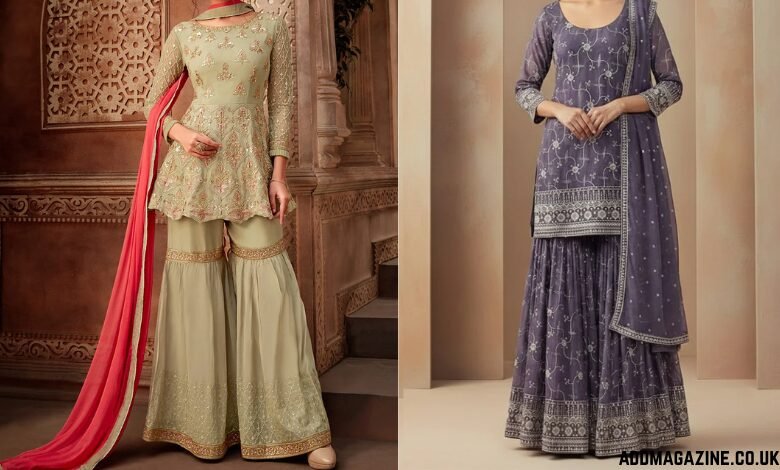
There’s a moment most of us have experienced standing in front of a rack of beautiful ethnic wear, holding up two outfits that look almost identical, and genuinely not knowing which is which. If you’ve ever confused a gharara for a sharara (or the other way around), you’re not alone. These two silhouettes have been tangled up in fashion conversations for years, and honestly, even seasoned shoppers mix them up.
But here’s the thing, once you understand what makes each one unique, you’ll never confuse them again. And more importantly, you’ll know exactly which Sharara Sets works for your body, your occasion, and your personal style.
Let’s break it down properly.
First, a Little History
Both the gharara and the sharara trace their roots to the royal courts of Lucknow and the broader Mughal era of South Asia. They were originally garments of aristocratic women layered, elaborate, and designed to move beautifully with every step. Over centuries, both silhouettes travelled through generations, adapted to changing tastes, and eventually found their way into mainstream Indian and Pakistani fashion.
Today, you’ll spot both styles at weddings, Eid celebrations, mehndi nights, and festive gatherings — worn by women who want something that feels rooted in tradition but looks entirely current.
So, What Exactly Is a Gharara?
A gharara is a two-piece or three-piece outfit where the trousers are the star of the show. The defining feature is the dramatic flare, but here’s the key detail, the flare starts from the knee. Above the knee, the fabric fits close to the leg. Below the knee, it opens into wide, heavily gathered pleats that sweep the floor.
This creates a very distinct, almost theatrical silhouette. When a woman walks in a gharara, the fabric moves like water around her feet. It’s graceful, dramatic, and unmistakably traditional.
Gharara sets are almost always heavily embellished. Think rich zari work, intricate thread embroidery, mirror detailing, and fabrics like silk, velvet, or organza. They are, at their heart, ceremonial garments — built for occasions that deserve dressing up.
And What Makes a Sharara Different?
A sharara might look similar at first glance, but the construction is quite different. In a sharara, the flare begins from the waist not the knee. This means the entire trouser is wide and flowy from top to bottom, giving it a more relaxed, palazzo-like silhouette compared to the structured drama of a gharara.
The result is an outfit that feels lighter, easier to move in, and depending on how it’s styled more versatile. Modern Sharara sets come in everything from heavily embroidered bridal versions to simple, printed cotton styles that work just as well at a casual festive gathering as they do at a formal event.
This is probably why sharara sets have seen such a strong comeback in recent years. They offer that ethnic, festive feel without the weight and formality of a gharara. You can dress them up or bring them down depending on the fabric, the dupatta, and the jewellery you pair them with.
The Key Differences at a Glance
Gharara — flare starts at the knee. Structured, dramatic, ceremonial.
Sharara — flare starts at the waist. Flowy, relaxed, versatile.
The gharara has that old-world grandeur to it. The sharara is its more modern, free-spirited cousin.
Which One Should You Pick?
This really comes down to three things, your body shape, the occasion, and how comfortable you want to feel wearing it.
For your body shape:
If you’re petite, a sharara can work beautifully because the continuous flare from the waist creates the illusion of length and elongates the frame. A gharara, with its fitted upper leg and dramatic lower flare, can sometimes visually cut the leg — though the right kurti length can balance this out perfectly.
If you’re tall or have a fuller figure, both styles work well. The gharara’s structure can be incredibly flattering, while a well-cut sharara drapes elegantly without clinging anywhere you don’t want it to.
For the occasion:
Gharara for a nikah ceremony, a formal wedding reception, or a high-ceremony cultural event — absolutely.
Sharara sets for a mehndi function, an Eid gathering, a festive family dinner, or even a semi-formal wedding and yes, every time. They hit the sweet spot between dressed-up and comfortable, which is honestly what most of us are looking for at events that go on for five hours.
For comfort:
Let’s be honest here. A gharara, especially a heavily embellished one, is not the outfit you want to be navigating a crowded wedding venue in. It’s stunning, but it demands a certain awareness of how you move. A sharara, on the other hand, is far more forgiving.
How to Style Each One
For a gharara, keep the focus on the outfit itself. A simple, fitted kurti or short angrakha top lets the trouser speak. Opt for traditional jewellery — jhumkas, a maang tikka, layered necklaces — and let the embellishment on the fabric do the rest. A silk or net dupatta draped across the shoulder completes the look without overwhelming it.
For a sharara, you have more room to play. Jewellery can range from heavy traditional pieces to delicate gold — the silhouette handles both with ease.
The Final Word
Both the gharara and sharara are extraordinary silhouettes with deep cultural roots and genuine staying power in modern fashion. Neither is better than the other — they’re simply built for different moments and different moods.
If you want grandeur and ceremony, lean into the gharara. If you want elegance that moves with you through a long, joyful day, the sharara is your answer. Either way, you really can’t go wrong.